
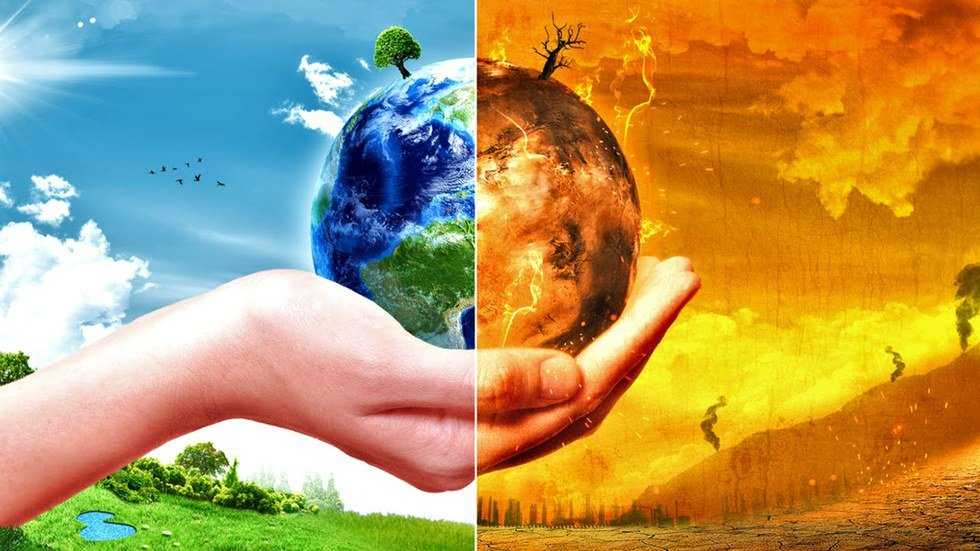
Just two weeks ago, it was reverberated across the media that, according to recent data released by NASA, climate change may indeed be worse than we think. NASA has reported that the Earth has been warming at a rate faster than any time in the past 1,000 years. According to The Guardian, "NASA has stated that records of temperatures that go back far further, taken via analysis of ice cores and sediments, suggest that the warming of recent decades is out of step with any period over the past millennium."

The Guardian then goes on to say that it is unprecedented in 1,000 years and that there is no period that has seen this trend in the 20th century in terms of the inclination of temperatures. All of this could have serious ramifications if something is not drastically done immediately. Quite frankly, I like Miami Beach and I would still like for it to be here in my sixties, however, according to the current rate of the oceans expansion and if the projections are true, the western half of Miami beach will be underwater by that point in time.
NASA also stated that in the history of 136 years of modern record-keeping, July 2016 was the warmest July according to a monthly analysis of global temperatures by scientists at NASA's Goddard Institute for Space Studies (GISS). Making July 2016 the hottest month in recorded history. Every successive year is the hottest year in recorded history. 2014 was the hottest year, then it was 2015 and that leaves me to conclude that 2016 might also be the warmest year on record. Based on the research, it is definitive that every year is the hottest year it has ever been. Just five more years of carbon dioxide emissions at the current levels and we will destroy any chance we have at restraining temperatures to the appropriate minimum — thus creating irreversible damage.
In addition, The Center of Biological Diversity has even confirmed that we are in the midst of the Earth's sixth mass extinction. They go on to explain, "We’re currently experiencing the worst spate of species die-offs since the loss of the dinosaurs 65 million years ago. Although extinction is a natural phenomenon, it occurs at a natural “background” rate of about one to five species per year. Scientists estimate we are now losing species at 1,000 to 10,000 times the background rate, with literally dozens going extinct every day. It could be a scary future indeed, with as many as 30 to 50 percent of all species possibly heading toward extinction by mid-century," And 99 percent of the currently threatened species are at risk from human activities.
What we are currently doing to curb carbon dioxide emissions is not sufficient enough. The Paris Climate Treaty is not enough and is not even due to be enforced until 2020. At that point, it will be too late and we will have reached the point of no return.
I believe all of this stems from a bigger underlying issue: Untethered capitalism.
Capitalism Vs. Democracy
Our need, our insatiable desire for wealth accumulation and our greed may be the very thing that destroys us. Yet, conservatives refuse to even acknowledge the scientific evidence before them, partially because the donors who keep them in office are the very CEOs who own these companies responsible for these harmful greenhouse gasses. Capitalism is a wonderful thing, it gives citizens the opportunities to start businesses, it fosters innovation and it allows us the freedom to pursue happiness and prosperity. However, anything which is extreme will eventually devour itself. As Sam Smith said in his song Good Thing, "Too much of a good thing, won't be good anymore." As a society, we need to reassess our politics. As our politics have a direct influence on our policies. We need to question our own democracy. Is it truly a democracy?
In a real democracy, policies that empower the state also aim to empower the individual, hence the well-being of that individual. In a true democracy, the interest of the general population would take precedent over corporate interest. We live in a society where corporate and nationalistic well-being overrides the well-being of all. The needs of the state vs. the needs of the individual. The values of capitalism and democracy are ideological contradictions - they are in direct conflict with one another. One values liberty, freedom and justice for all and the other values capital accumulation and commodity production. Can we really have a balance without one being compromised? I love capitalism, and we all enjoy the fruits of a fairly free market economy everyday, but when we ignore the facts and continue cause long-term harm to our planet - that is an injustice that I would rather not flirt with.
The scientific evidence is real, but the political will is not present because we have allowed greed to distort our perceptions. The greed and corruption of politics has enabled these corporations to continue their toxic actions with no accountability. Just 90 companies caused two-thirds of the world's man-made global warming emissions.
Can we really call nations that encourage the exploitation of our Earth and the general well-being of the life that inhabits it truthfully democratic?
Why are humans so destructive?
Renewable energy sources, such as solar power, become more inexpensive year after year, yet this is hardly about renewable energy sources or sustainability. It is more so question of ethics and morality and further begs the question: is a short term decrease in profit margin not worth our planet's climatic stability? Nations and companies alike need to be held accountable for the long-term damage they are causing our planet. They need to be held accountable for the institutional murder they are committing. A man who shoots another man is held on trial for murder, but a corporation, they run free - as if destroying our planet is not manslaughter on a macro level.
We must ponder why we, collectively as humans, are so self-destructive, and why we allow the narcotic of money to distort our view of the greater picture. Most of all, why do we allow this institutional violence to take place? We all have dreams and aspirations of one day being rich and wealthy, but at what cost? I want to be rich. I want to one day joyride down 5th Avenue in my parched silver Fisker, but again, at what cost? At the cost of the acidification of our oceans, the extinction and endangerment of species, the catastrophic floods year-round, the arid droughts, the disappearance of island nations, the famines, the more expensive food and the crop failures or worst of all, the loss of Nutella. Is all that worth a few extra millions in the hands of a few? No. Yet, I even ask myself sometimes, where would I draw the line? As a hypothetical shareholder of BP for example, who sits on the board of directors, where do I draw the line on decisions that will negatively impact the planet? As an entrepreneurial person who appreciates the art of business, it is a tough call, but it is a question we must all ask ourselves.
Are our own desires of material possessions at odds with the greater good of all even the planet we live on? We must take into account that every decision we make has an effect on someone or something else, whether positive or negative, especially when we are in a position of power. When we allow ourselves to be vulnerable and, for a moment, become introspective enough to truly ponder how our choices could potentially impact someone else is a start for living a life from a higher level of consciousness - a more awakened state of mind, who are a breed of people who are unfortunately rare to come by. CEOs and governmental officials are clearly not living from this state of consciousness, but it starts with us. It starts with us becoming principled individuals who place our ethics ahead of our values. How can we as a population, in our supposed democracy, condemn the actions of corporations and government when we, ourselves, commit acts that contradict our ideals. I can value wealth, but what choices am I making to grow my wealth. Values, the things we believe in, as opposed to our ethics, the rules that govern the actions that we take to get what we value and believe in. It begins with us knowing that difference to make a difference.
We destroy our planet, we inevitably destroy ourselves
This is not a debate between the ideology of conservatism or progressivism - but the progressive movement is surging and it is through this movement that we must be emboldened, tenaciously fight and force the indifferent, and the ignorant to heed to the messages of reason. It is through this movement that we will hopefully return to the basis of all creation. Love. Love, as Deepak Chopra says, “is the evolutionary impulse that expands life.” Love of our planet, and a deep regard for all life on it is the start of change . Of course, we will be too late, but we do not have a choice. An awakening needs to take place. An illumination of our deaden collective consciousness. We cannot continue to enable a handful of oligarchs to be the the demise of our planet. We reside on a planet that thrives off interdependence and interconnectedness. When we neglect our planet, we forgo that interconnectedness. As humans, it is easy for us to believe we are independent from the Earth and the natural world, but we live in an interdependent reality and it is that reality which has allowed us to prosper. It can also be challenging for us to be cognizant of the effects of global warming because it is not something we can readily see on a daily basis. Yet, we need not forget that if we continue to dismantle our planet, we will also continue to destroy ourselves. After we are gone and have finished our destruction — the flowers will one day bloom once again, and the sun will continue to rise — without humans. Let us be mindful and keep that in mind.