


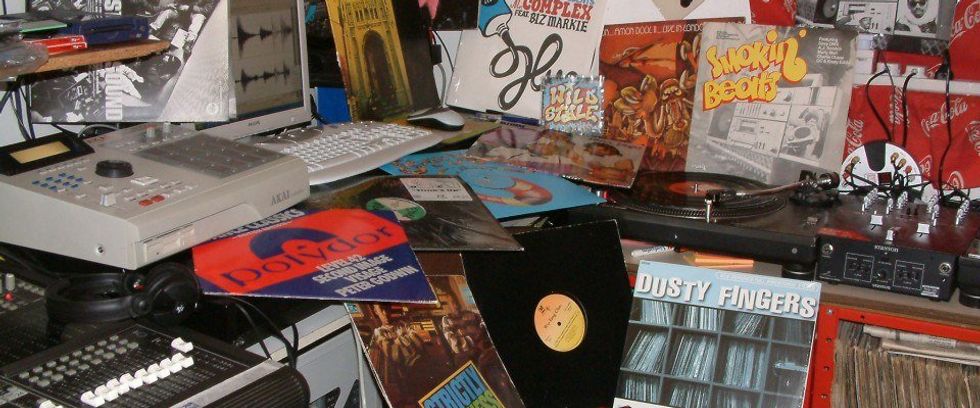
It was Sept. 16, 1979, when hip-hop trio, The Sugarhill Gang, released their magnum opus, "Rapper's Delight." The song was the first rap song to receive mass airplay and circulation on the radio. Naturally, this became the model that hip-hop has developed from since then. One practice that was definitely passed down from the Sugarhill Gang was sampling. Sampling is the popular method in hip-hop production in which the producer takes a portion of a previous recording and composes it into their own music.
The Sugarhill Gang had sampled the instrumental from Chic's "Good Times" and composed it into the instrumental of "Rapper's Delight." Since then, a multitude of hip-hop songs use sampling to create their records. The scope of intricateness in sampling is vast, ranging from Vanilla Ice's "Ice Ice Baby" where the artist simply rapped over a slightly altered version of the instrumental from Queen's "Under Pressure," to Kanye West's "Stronger" in which he mixed Daft Punk's "Harder, Better, Faster, Stronger" 50 times before releasing the record.
Enter the Copyright Act of 1976. The genre shifting motion decreed,"A work is protected in all media and for all possible derivative uses as soon as it is fixed in a tangible medium of expression" This means that a recording is protected by a law, thus making sampling illegal without permission. Now, the solution is simple right? As long as the sampling artist receives permission, all should be well. Unfortunately, having a sample cleared for use is much easier said than done. An array of steps, requirements, and guidelines stand in the way of a cleared sample, and none are in favor of the sampling artist. The difficulty in clearing a sample to comply with copyright law turns away potential sampling artists and limits the creativity that could have came from the music they would have created from the samples they would have used.
The first task step in sample clearance is establishing a connection to the owner of the original sample. These opening negotiations are often overlooked by inexperienced producers because they are unfamiliar with the system and do not know to find the source, which leads to legal costs. However this usually does not become an issue unless an artist grows in popularity. For instance, Tim Love, an English producer of trip-hop and electronic dance music, stated, "My first album is completely uncleared...We never got called. I mean, we only sold a few thousand copies and, you know, never got on the charts or anything like that."
On the other hand, Jeff Chang, an American hip hop journalist, recounted the story of friend who had been sued by an obscure band for sampling their music without permission. They had heard his song on a car commercial and assumed that there was a good amount of money coming out of it. They demanded 200 percent of composition, which would have put the friend under water. The agreement met between the two parties was to stop licensing the record to be used in commercials and to declare bankruptcy on it. In regard to the band, Chang said, "They don't want to see the line of money dry up. They don't want to kill the golden goose. So, they came to some sort of an agreement, and now they've got an agreement that allows everybody to be properly compensated."This happens because copyright infringement cases only tend to happen when there is possible revenue increase for the plaintiff. Copyright laws on sampling are not used to protect identity as much as they are used to make money.
Sample licenses vary in terms and structures. There are five basic deals when granting permission to use a sample: gratis, buyouts, royalties, co-ownership, and an assignment of the copyright. Musical composition licenses usually involve royalties. Shoshana Zisk, an American music lawyer, said, "When I was working in copyright at Motown, you'd get one song and there's be fourteen people that you had to get permission from...There's a pie graph of a song and everyone has a slice."
With so many people with their stake on a sample, the sampling artist is left losing a lot of money to licensing. Additionally, there is a multitude of factors that can potentially change licensing fees. The portion of the song sampled, the importance of the portion sampled, the recognizability of the portion used, the musician's commercial success and fame, are examples of factors that can affect the licensing fee. In fact, it even matters if the sampling musician's representatives contacted the stakeholders of the sample before the track is released. Usually there are two licenses required with a single sample.
One is for sound recording and the other is for musical composition. Dana Lapolt, an attorney in legal and practical aspects of the music business, had her own opinion on the two samples, "The really fucking expensive type, and the really, really, fucking expensive type." While the sound recording license tends to be expensive, the master side is more expensive by a considerable amount. El-P, a producer and rapper, explained, "The master side is the one you always get hit hard for, because that's the side that's controlled by the record label." The ridiculous amount that must be paid just to use a sample has discouraged artists from sampling at all. Trugoy, a member of hip-hop trio De La Soul, said, "It's tough to do. We don't make as much money as people think." in response to the cost of sampling.
Consequently, Pat Shanahan, a sample clearance expert, agreed, "I've noticed there is very little sampling going on anymore because it has now become so exorbitantly expensive to do so." The creativity of sampling artists all over America are stifled by the ridiculous cost of sample licensing. Only those who were very well off could afford to sample. Artists have attempted to make their sampled music without it being authorized, but when caught were forced to deal with harsh consequence.
Hip-hop would literally be a completely different genre if The Sugarhill Gang never sampled Chic's "Good Times." Any type of hip-hop that is heard today is a direct product of that song's influence. All forms of art are built from some sort of inspiration or influence. As time goes on, this chain of influence will lead to newer ideas. The Copyright Act of 1976 has actively eliminated an infinite amount of possible genres and products of influence that could have came about from sample-based hip-hop.
The existence of the Copyright Act of 1976 does not allow sample-based hip-hop to flourish to its greatest potential, nor does it always support the original artists themselves. Even if the original artist accepts the use of the unauthorized use of a sample, other stakeholders are able to sue sampling artists, and that very fact is testament to how the act is not a way to protect artists interests, but a scheme to empty the pockets of sampling artists into the pockets of corporate companies with stakes on the original records. Even if that is not the direct intention of the act, its nature cannot coincide with sample-based hip-hop.
Until sample-based hip-hop is accepted as original music, copyright law will continue to limit sample-based hip-hop, thus destroying a constituent of all hip-hop, music, and art itself.
















