
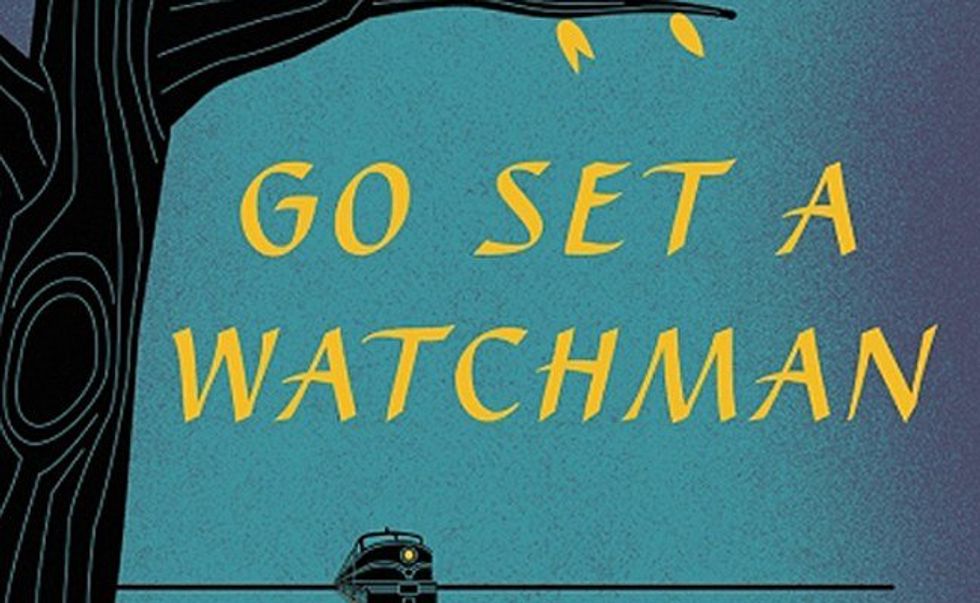
Sometime in either middle or high school, almost everyone was assigned Harper Lee's American classic, "To Kill a Mockingbird." This race novel set in the 1930s follows a young girl called Scout, her brother, and their father, Atticus Finch, a lawyer who is appointed to defend a black man accused of raping a young white woman. This beloved novel deals with the serious issue of racial inequality in the South, and on July 14, almost 55 years after the publication of "To Kill a Mockingbird," Lee's sequel to the story (the author's second novel) was released. "Go Set a Watchman" was on the shelves.
The book instantly flew to the top of the New York Times bestseller list, and with 1.1 million copies sold in a week, HarperCollins announced that it had become the “fastest-selling book in company history.” But as quickly as it sold, the controversy grew. Not only with the characters and story, but with the publication of the book itself.
After the publication of "To Kill a Mockingbird" in 1960, Lee claimed she would never write another novel. She is now an 89-year-old stroke survivor suffering from dementia and living in a nursing home. Her sister and lifetime protector passed away last year. It was Lee's new protector, Tonja Carter, who conveniently claimed to have found the manuscript for "Watchman" attached to another draft of "Mockingbird" not long after Lee's sister passed away. Carter then brought it to the attention of HarperCollins. Maybe just a little too convenient. It has been insisted to The New York Times that Carter has had the manuscript since 2011, not 2014, and has been holding onto it until the death of Lee's sister, putting her in charge of Lee's affairs.
So now the question becomes whether Lee actually wanted "Watchman" to be published or if lawyers were taking advantage of an elderly woman. The state of Alabama launched an investigation earlier this year, and although no evidence of abuse was found, it's still very difficult to rule out. The sequel was bound to be a huge success with all the lovers of "Mockingbird," and with the many crimes and controversies concerning race over the past few years, there was no better time for a Civil Rights novel to emerge.
There's a huge question as to when "Watchman" was written, and it's doubtful that it's even a sequel at all. It is said that the manuscript found was what was first written and originally sent to Lee's editor Tay Hohoff, who then told her she needed to rewrite the book from the view of Scout as a young girl. This draft then became "To Kill a Mockingbird."
I read "Watchman" this past week, and the thought that this might have just been a rough draft instead of a sequel actually made me feel much more comfortable. It's not that I didn't enjoy it. I thought it was entertaining, warm, and had a powerful message about racial inequality in the South, just as the first did. Set in the Jim Crow South shortly after Brown vs. Board of Education, it gives you a different view and understanding of some Southerners' points of view and opposition to the case's decision. Not only does it express their beliefs of the black race being inferior, but also their importance of keeping their Southern identity and not having such a strong control over them by the national government.
My comfort comes from the character of Atticus Finch. It's not a secret that the father from "Mockingbird," whose morals and actions seemed perfect for a lawyer, is portrayed as a racist in "Watchman." He is in support of segregation and even attends a Klan meeting. I felt almost betrayed at this, thinking that Atticus wasn't the hero I once thought he was in school, and he was protecting the black man in "Mockingbird" for all the wrong reasons. However, when learning that "Watchman" is possibly a rough draft, I felt better knowing this childhood hero might not have suddenly taken a turn for the worse, but his character was instead recreated altogether.
But if that's not the case and Atticus truly was a racist all along, the novel is still very much worth reading. Even with the sketchy beginning of the publication, "Watchman" is still an important work of American literature and history. It teaches not only the wrongness and consequences of racial inequality, but also the importance of realizing that everyone, including our heroes, family, and even Atticus Finch, is human and will have flaws and sides we will not agree with. Accepting this, while also standing up for what we believe in, even to those we most idolize and love, is an important part of entering society and understanding the world today.

















