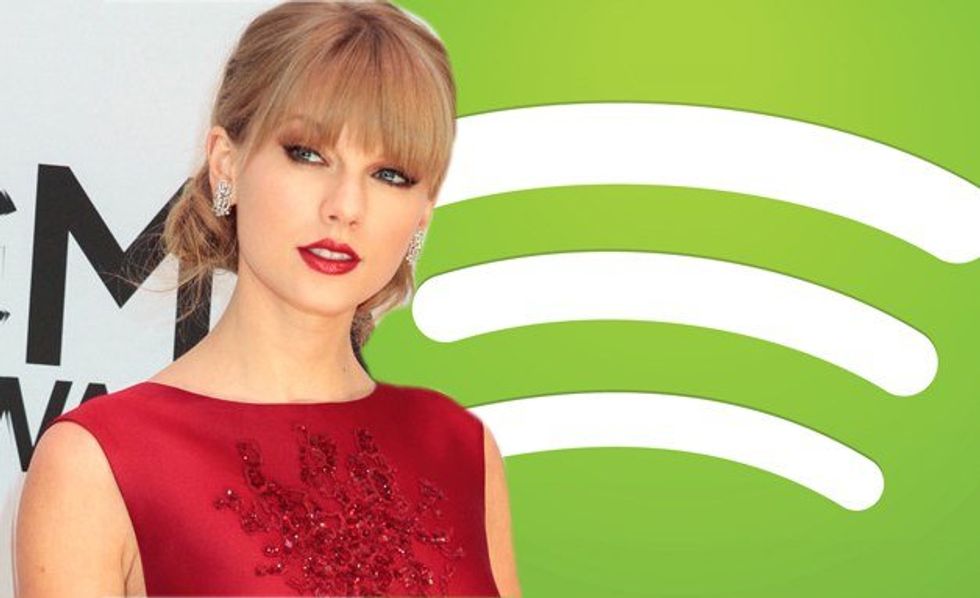
Everyone and their grandmother knows Taylor Swift, the young Country turned Pop music star. Almost a year ago to the date, Taylor Swift made the business decision to pull all of her albums from Spotify and essentially boycott the service completely. Upon doing so, she made comments alluding to the fact that the music industry has lost billions of dollars to piracy, file sharing, and streaming. One year later since the event, researchers may disagree with her statement on how streaming services can negatively impact her paycheck.
Upon first researching Spotify and how the company distributes their royalties to artists, it seems as though the service is robbing the artists blind. Spotify Artists, a site that explains how Spotify works in distributing royalties, states that it pays musicians less than one cent per stream. With an astonishing $0.006 to $0.0084 per stream paid to the artists, it seems as though Spotify is taking advantage of the musicians utilizing the site. But in reality, the streaming revenues earned from Spotify, that were given to artists, was up to $1.9 billion in 2014, as mentioned by the Recording Industry Association of America. Also the CEO of Spotify, Daniel Ek, said that the company's streaming model is promoting music sales overall.

Many argue whether Spotify, and streaming services in general, boosts or reduces sales in music. Luis Aguiar and Joel Waldfogel, two economists, ran a study during 2013 to 2015 regarding the impact on unpaid consumption of recorded music. The study titled, "Streaming Reaches Flood Stage, Does Spotify Stimulate or Depress Music Sales?" came to the conclusion that services such as Spotify neither improve nor worsen music sales. The conclusion was made by looking at the top 50 or top 200 songs in a country by week, through a span of two years, and then using the results to estimate total streams for each country. After the researchers compared the song level streaming with sales of the album and saw a positive correlation. This means that Spotify is improving music sales which is due to people streaming popular music, and in turn purchasing popular albums. The research has shown that streaming popularity correlates with album sales.
But just because Spotify is not lowering profits for musicians does not mean their raising it. Aguiar and Waldfogel estimated that for every 137 streams on Spotify, there would be one fewer sale. So at the end of the day, both the negative and positive aspects of Spotify and other streaming services cancel out.
Researchers still debate on the effects music streaming has on the music industry. When pop culture figures, such as Taylor Swift, make comments on issues that affect the masses, they bring light towards real problems that affect not only them but also the other 99 percent. It is important for celebrities to bring awareness to issues that affect those who are less fortunate. This leads to research being done and improvement to contemporary business structures.