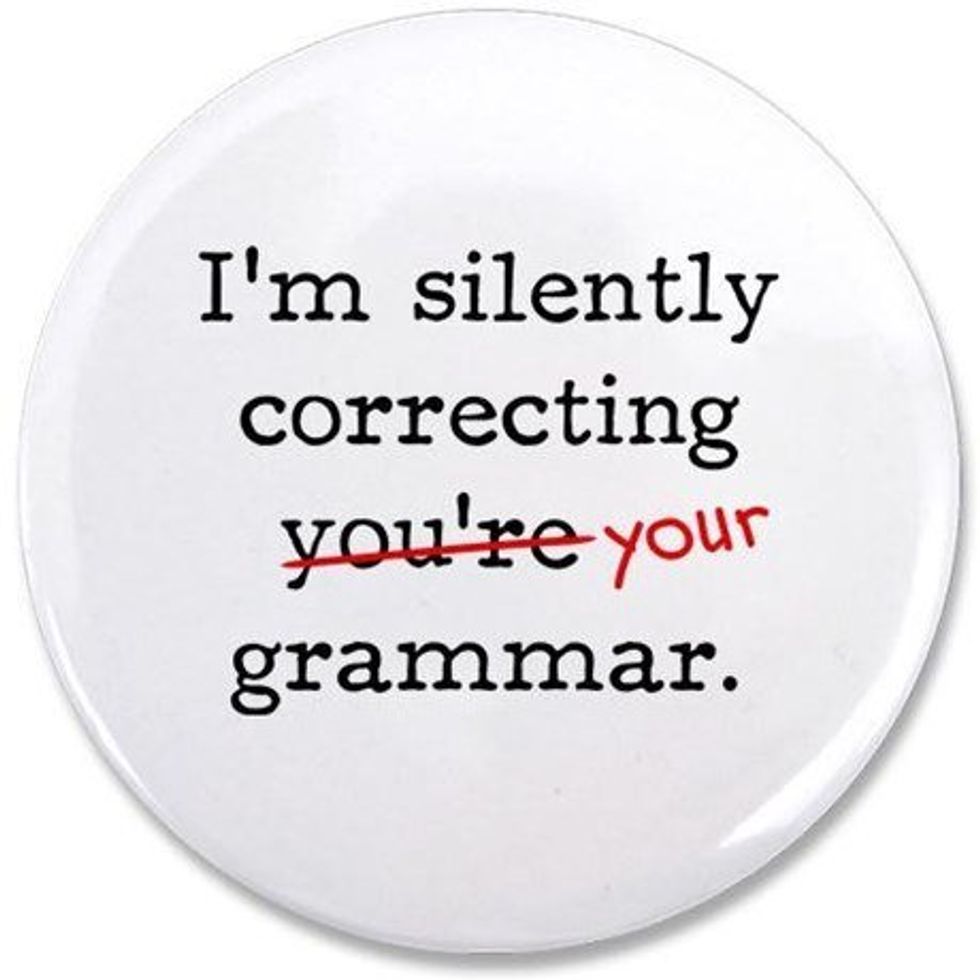
Everyone has a pet peeve, something that bothers you, and you just can’t let it go. Well, for me, it is bad grammar. English has always been my thing, and I guess that’s why the repeated misuse of grammar makes me cringe. I know I’m not perfect, but I do my best to make sure my grammar stays in tip-top shape. I’m here to give you a few much-needed grammar lessons.
1. Homophones: They may sound the same, but they do not have the same meaning.
Shocking, I know. It is not okay to use them interchangeably. • “There," “their," and “they’re” are ALL DIFFERENT WORDS. “There” refers to location. “Their” is possessive. “They’re” is simply a contraction of the words “they” and “are.”
- They’re upset that their parents went there without them.
• “Too," “to," and “two” are another set of homophones that are quite often used incorrectly. “Too” is used when you can replace it with “also” or you are talking about an excessive amount. “To” is used when you are referring to a place, direction, or position. “Two” is a numerical value.
- Two girls went to the movies and their sisters wanted to come, too.
• “It’s” and “its” also do not have the same meaning. “It’s” is a contraction of the words “it” and “is.” “Its” is the possessive form of “it.”
- The dog is playing with its toy but it's not having fun.
• “Your” and “you’re” are different words as well. “Your” is a possessive form of “you.” “You’re” is a contraction of the words “you” and “are.”
- Your mother told me that you’re sick.
2. I know everyone likes to combine the words “at” and “least.”
Well, news flash: they are two separate words and never do they ever belong together as one word. This also goes for the words “a” and “lot.” “Alot” is not a word.
3. Making last names plural is something we all struggle with, especially during the Christmas season.
By the countless apostrophe errors on Christmas cards, something unknown to many people is that plural last names do no require apostrophes. Do you want to make the last name Smith plural? Just add an s. Well, you ask, what if my last name ends in an s? Just add –es, as with last names that end in x, z, ch, and sh.
4. This is not a huge one, but capitalization involving family relationships is frequently misused.
When family terms are used as proper names, they are capitalized. However, when the terms are used as common nouns, usually following a possessive pronoun, they are not capitalized.
• Hey Dad, Mama told me she would take me out to lunch.
• My sister had a dance recital last night.
So the next time you want to rant on Facebook or Twitter, or you’re sending out thank-yous, holiday cards, and wedding invitations, make sure your grammar is correct.