

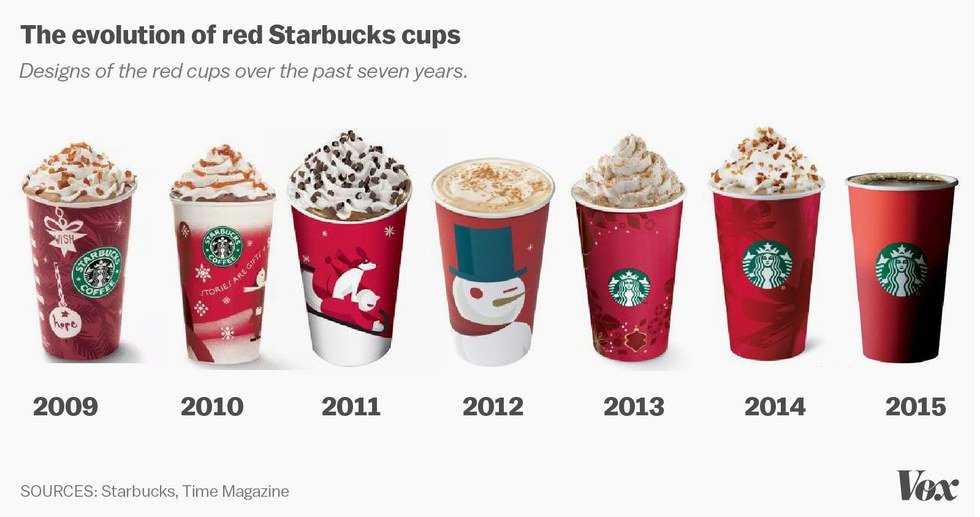
On November 2, I saw my first holiday Starbucks cup of the season. Unlike the other complainers, I did not feel offended by the lack of decoration and design, nor I did not suddenly feel disdain for Starbucks because the Christmas holiday wasn’t properly appreciated. Actually, my objection was due to how quickly Starbucks released their Christmas-esque cups—they barely waited for Halloween to end. I hold a very firm belief that we should celebrate our holidays in order: Halloween, Thanksgiving, Christmas—not Halloween, Christmas, and Christmas.
When I first saw a red Starbucks cup, I told its owner: “I can’t handle that red cup. It’s too early for Christmas.” Subsequent Starbucks consumers toting around the cup received similar sentiments from me. I thought my frustration justified, that I had a right to be annoyed over the lack of Thanksgiving cheer. However, despite my irritation, I did not once think to myself: “Starbucks doesn’t represent the holidays correctly. I will stop going there.”
For about a week, I remained ignorant of this so-called “War on Christmas.” When I noticed an article on my Facebook newsfeed, I thought it was a joke—maybe the Onion wanted to push people’s buttons. Nope. People were legitimately angry with Starbucks for not embellishing their cups or for saying “Happy Holidays” rather than “Merry Christmas.” Tweets began rioting #WarOnChristmas and asking people to rebel or boycott. After reading those articles, I wished that I had clicked on an Onion link, because the controversy seemed so pointless. How does getting mad about a coffee cup’s color actually benefit society?
That was my “Oh…” moment. I may not have agreed with the population chanting “War on Christmas!” and changing their names to “Merry Christmas” so Starbucks employees were forced to say the phrase, but I had still felt annoyed over the color of a coffee cup. I had become frustrated over something that was just going to end up in a trashcan. People don’t buy coffee for the cup; they buy it because they want their frappuccino or latte or tea. If we really wanted to get political about this controversy, we should have considered the monetary side of Starbucks’ cup embellishment: Does anyone realize that it costs money to decorate cups? Like T-shirts, cup designs boost production price. Starbucks is expensive to begin with; we don’t need them to boost the prices more because we want a snowman or snowflakes on our cup. In this case, we should be happy Starbucks took away those designs.
Stephen Colbert and Pastor Greg Locke put the situation in perspective for me the most. Colbert’s jabs hit home: Do Christmas CDs and holiday-themed gift cards mean nothing? Starbucks wouldn’t sell that merchandise if they planned to scorn the holidays. Locke (who I discovered by chance on my Facebook newsfeed) made some poignant arguments as well, pulling in a Christian perspective: Red is a significant color—it can represent the blood of Christ, the blood of the veterans we so recently honored, and be a symbol of the Hallmark holiday. Basically, Starbucks isn’t rejecting the holidays by handing people a simple red cup; they’re broadening their consumer reach. Just as Starbucks claimed in their public statement, customers can in fact express their beliefs on their cups, whether they do so through silly doodles or through abstract interpretations like Locke’s.
The color of our coffee cup does not signify our religious beliefs or our interest in the holidays. No one will look at a red cup and think, “That person must be Christian,” or, “She must love Christmas.” People will just think, “She likes Starbucks coffee.” We don’t need a cup to validate our opinions.