


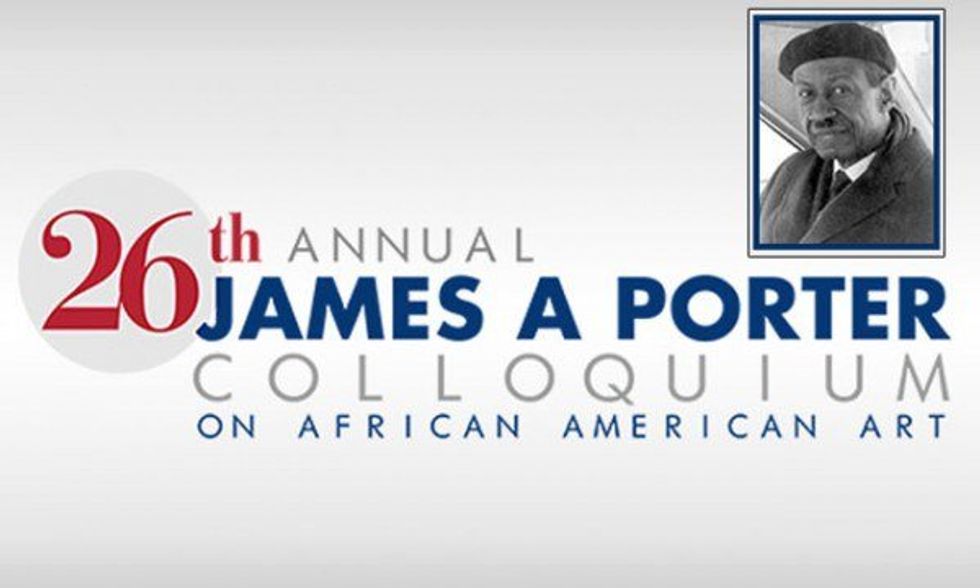
Howard University’s Department of Art established the Colloquium in 1990 and named it after the Art Historian and Professor, James A. Porter. His work created the foundation for the field of African American Art and Visual Culture, which has allowed scholars and artists to continue to build on what he started. In honor of his contributions to the world of art, the Colloquium is held annually to celebrate his life through extensive scholarly research, programming, artistic development and leadership. The Colloquium consists of many lectures and sessions that are open to the public and free of charge. Most of the lectures and sessions are held on Howard University’s campus except for a couple, which are held at another location. I was introduced to the Colloquium by my Art Appreciation Professor and attended one of the lectures.
I attended the James A. Porter Distinguished Lecture entitled “Afrofemcentrism Now,” which was held on April 11, 2015. The speaker was Andrea Barnwell Brownlee, PhD. She is the director of the Spelman College Museum of Fine Art and served on the Hambidge Center for the Creative Arts and Sciences and the Metropolitan Atlanta Arts Fund. In her presentation, Brownlee defined Afrofemcentrism, discussed the characteristics of Afrofemcentrism, and shared a few Afrofemcentric images from exhibitions including her 15 x 15 Acquistions Initiative. The 15 x 15 Acquistions Initiative was an initiative to acquire 15 works of art for Spelman College Museum of Fine Art’s 15th Anniversary. The 15 works of art featured in this exhibition were all produced by Black women. The 15 artists who were selected for this exhibition included Carrie Mae Weems, Maria Magdalena Campos-Pons, and Renée Cox. The purpose of this exhibition was to honor art about women of the African Diaspora that was created by Black women artists.
Brownlee defined Afrofemcentrism as a Pan African ideology that particularly focused on women of the African Diaspora. In the visual arts, Afrofemcentrism is a consciousness that is Afro-female centered. I learned that this consciousness allows Black women artists to assert their sex, race and ability as artists to produce works of art that define their existence. I also learned that Afrofemcentrism art depicts the realities of Black women and portrays Black women as primary and actively engaged. It also depicts the artists’ ideas and messages that they wish to convey to their target audience. Overall, Afrofemcentrism is a view of Black women by Black women.
By attending this lecture, I learned the characteristics of Afrofemcentrism. The characteristics of Afrofemcentrism are the black woman is the subject as opposed to object, the subject is contextually exclusive or primary, the subject is active rather than passive, the subject conveys the sensitivity of Afro-American women’s self-recorded realities and the subject is imbued with aesthetics of the African continuum. In Afrofemcentrism, the black woman is the focal point which is emphasized in the works of art. According to Brownlee, Afrofemcentrism is not just a style in art but it is a position for people, mostly Afro-American women.
Brownlee mentioned that Afrofemcentric images have a unique focus on and presentation of black women. She also shared a number of Afrofemcentric images from various exhibitions such as Renée Stout: Tales of the Conjure Woman, Material Girls: Contemporary Black women artists, and the 15 x 15 Acquistions Initiative. Two Afrofemcentric images that she shared were Carrie Mae Weems’ self-portrait, I Looked and Looked and Failed to See What So Frightened You and Maria Magdalena Campos-Pons’ installation, Spoken Softly with Mama. Both of these images were featured in the 15 x 15 Acquistions Initiative and accurately portrayed the lives of Afro-American women and how they were often viewed by others.
In the installation, Spoken Softly with Mama, Maria Magdalend Campos-Pons’ use of media allows her to achieve her desired effect by combining fragments of memories from her personal experiences in one space through photography, sound, video, fabric and sculptural objects. Her artistic palette was not limited in terms of her choice of media. The materials she used in this installation were embroidered silk and organza over ironing boards with photographic transfers, embroidered cotton sheets, cast glass irons and trivets, wooden benches, six projected video tracks and stereo sound. Media supplies artists with multiple options to create a work of art and Maria Magdalend Campos-Pons uses the various media to her advantage.
I would recommend Howard University students and individuals to attend a lecture or two because there is plenty of information to absorb about African American art and the period or era that influenced pieces of African American art. Each presenter in every lecture is either a scholar or an artist, possibly both, who has committed themselves to informing others about their research, selection of images, installations, and media. Each presenter is also interested in sharing the knowledge they have acquired about African American art to ignite any ideas or thoughts in the minds of their audience members. This year, the James A. Porter Colloquium will begin on April 8 and end on April 9 for those who may be interested in attending. This year the Colloquium will honor the anniversary of the Black Arts Movement and investigate how the Blacks Arts Movement had an influence on the course of African American art. I would encourage people to attend this event especially if you are interested in art and plan on being a part of the continuum.















