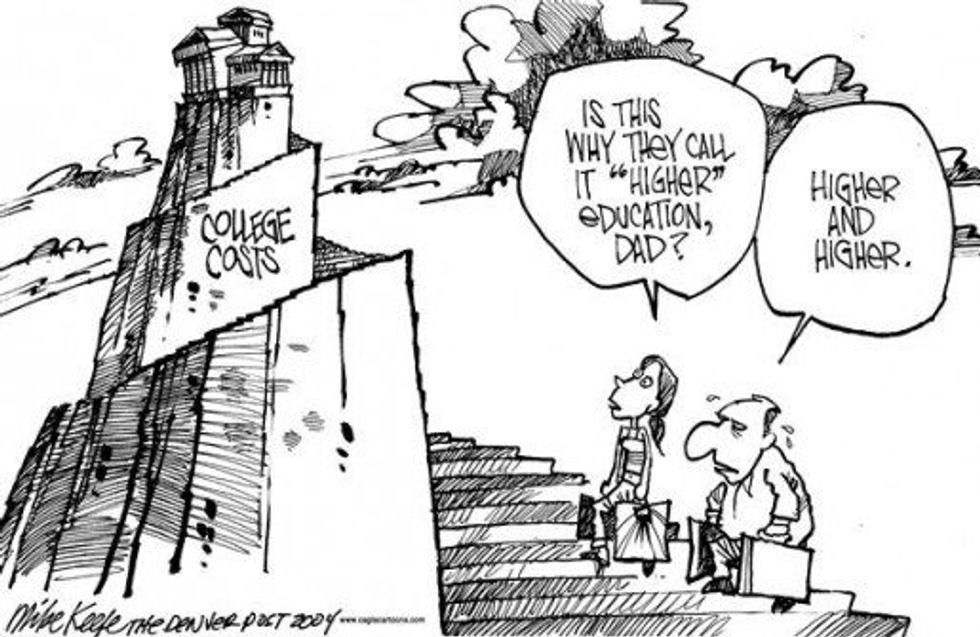
Going back to college brings about the dreaded payment of tuition. I know I'm not the only one who looks at that number and can only think: DEAR GOD.
And even though pretty much every college student complains about tuition, we rarely ask why the price is so high. So I put on my Nancy Drew gear and did some research.
First off, college prices have been steadily increasing over time because the increase is a natural trend; everything has increased over time (hello inflation). However, we see a significant change in tuition around 2008, which is unsurprising when we consider the market crash and recession. This statistic is even more frustrating, however, when we see that although students began paying more themselves, the average money spent per student began decreasing. This can mostly be attributed to the decrease in government funding of colleges, which again can be traced back to the financial crisis in 2008.
Just a few fun facts: The rate at which college tuition has increased is greater than the median family income and inflation. According to Forbes, "Since 1985, the overall consumer price index has risen 115% while the college education inflation rate has risen nearly 500%."
With all this money flowing into our universities, you have to wonder what they're spending it on. The short answer? Stuff.
Academic instruction is still the greatest cost universities face. Paying geniuses to come teach when they could be making millions in the private sector creates the need for incentive. This usually means a healthy paycheck and sabbaticals. Although this cost is the greatest for colleges, it hasn't increased enough to explain the boom in tuition costs.
The sector that has increased the most out of all is student services. This includes tutoring centers, concerts, fancy gyms, and on-campus Starbucks. This all sounds silly, but the truth is that these things weren't around until recently. In the words of Hank Green, "Colleges are acting more like businesses and treating students more like customers."
Anyone who has gone on college visits can tell you that the college is trying to sell an experience. You look at the fancy grounds and big libraries and fun parties and go, "I could live here."
This is all well and good, and college is an experience, but not because of the amenities. At the end of the day, students are taking part in higher education to learn the skills they will need for jobs later on in life.
The good news? College is still worth the expense. The return on a bachelor's degree is higher than that of the stock market and gold. Even dropping out of college can be a good deal, with 18 months of college also yielding a higher return than stock and gold.
Even so, students and non-students alike can agree that college shouldn't be about monetary growth or business, especially those that aren't private. Education is the end goal, and preventing the education of our citizens by creating outrageous prices is a disservice to our country. About 70% of students graduate with some debt, and the average of that debt is $29,000. Main Street says, "According to Citizens Financial Group, 49% of college students considered dropping out of school on the heels of high debt levels."
It is safe to say that there needs to be change in the business of college, specifically to make it less of a business. Understanding the complexity of why we pay the costs we do is the first step.