


I collect old yearbooks. A strange hobby, perhaps, but very useful for me—as I write mostly young adult fiction that takes place in the past, these yearbooks let me in on fashions, trends, names, figures of speech, and youth (and adult) culture in general. They’re fascinating resources that I can stare at for hours.
My family knows about this collection, and so every Christmas I usually get another yearbook or two. This year I happened to get three, much to my surprise and delight. They’re all wonderful, but to keep this article reasonably short I will focus on one. I thought I would give some of my thoughts and comments on a yearbook, simply because such a topic is unique and maybe, maybe, someone other than me might find it interesting.
So, here it goes.
Little Rock Central High School 1977: “The Pix”
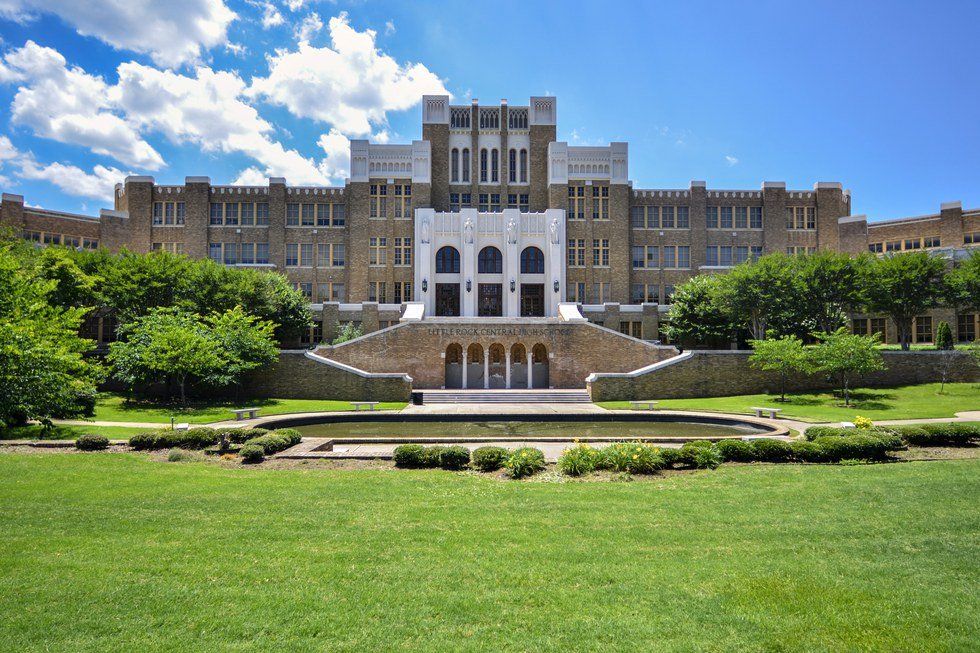
Most of my yearbooks I have specifically because I have set stories in their locations, and I want to better get to know the culture of my characters. This yearbook is no exception. One of my novels is set in Little Rock in the mid-seventies, and I thought it would be neat to get a yearbook from my protagonist’s high school. Even better if it could be from 1977, the year the story is set.
And here it is. “The Pix.” First of all it’s huge, a college-sized yearbook, and very thick and heavy. But you soon see why it’s so heavy—it’s filled, I mean chock-full, with details. This is the most detailed yearbook I have ever seen. There are pages devoted to fads, fashions, weather, race relations, and the visit of Geraldo Rivera.
Yes, apparently Geraldo Rivera, the ABC news reporter, visited Central High in 1976, to report on how Central was a “model” school as far as race relations went. Rivera was “very impressed” according to the yearbook (p. 77). I must admit this surprises me a little bit. It’s not that race relations in a Southern city couldn’t improve over twenty years, but honestly I think there must have still been some tension in Little Rock. The yearbook emphasizes the fact that race relations at the school are very good, and indeed, the nationwide coverage the school got for this is impressive. I don’t doubt race relations were good, but I wonder what the relations were like outside of Central—in everyday life in Little Rock. Was housing still segregated (de facto)? I have to think it was.
As far as Rivera goes, he has not changed one bit—he looks the same now as he looked in 1976, except of course he has gray hair now. There’s a very entertaining shot on page 85 of him being interviewed by the editor of the school newspaper, with his shirt, in typical 1970s fashion, unbuttoned nearly to the waist.
Anyway, this is one detailed yearbook. In the back, in the midst of all the advertisements from local businesses (one of my favorite elements of vintage yearbooks), different students are quoted on various topics. A little box every two pages shows a picture of the student, the topic (e.g., “Politics” or “Smoking” or “Cars”), and the student’s thoughts on the topic. It’s really fascinating. One guy, asked about smoking, shared how he had tried to quit multiple times and was scared by the PSA ads on TV, as he knew smoking was bad for his health. I have never seen a yearbook as personal, detailed, or so reflective of the school’s specific culture as this yearbook.
Not only is it detailed, the yearbook admits that the student body isn’t perfect—it actually mentions flaws. For instance, the sophomore class had some issues with discipline; and students were frequenting the Campus Inn, a food store behind the school, more than the cafeteria, which raised concerns about the consumption of snack and junk food.
A big deal was the major amount of snow Little Rock got in January, which apparently delayed two out of three days of semester tests. The snow also resulted in lots of snow days, as well as a loss of spring break to make up for those snow days. (No one ever thinks about making up the days. Way to make a snowstorm a dreadful event for teenagers.)
Also, there is a picture of a student’s schedule card. I have never seen that before in a yearbook, but it excites me to no end. What a perfect resource—exactly what I need to confirm that my protagonist’s schedule is realistic (or not). It’s also simply a great historical detail. Just what were students’ schedules typically like at Central in 1976? You can actually find out.
I’m sure there’s more stuff I’ll find in it as I read through this yearbook time and again; every read-through reveals different things. But already The Pix leaves me very impressed and quite delighted. It’s my personal opinion that yearbooks began to decline in quality after about 1970, for multiple reasons, but this yearbook is stellar in grammar, spelling, and otherwise. In fact I would say that just as the school was a model for race relations, its yearbook was (and still is) a model for other schools’ yearbooks.















