
As my first semester of college draws to a close, I am brimming with happiness, excitement, and hope. College has been a new, great adventure for myself, filled with stress, self-doubt, and an array of other challenges as I navigate living away from home, making new friends, and succeeding in classes. But it also has been filled personal growth, and has taught me not only the topics of my chosen courses, but also the importance of being courageous in trying new things, creating new friendships, and how to take initiative as a young adult. From all of this, I am left feeling hopeful for my next semester, and whatever challenges and adventures it may bring.
As a new, young college student, I also have a new identity. I am no longer a minor in high school; I am responsible for myself and my actions. And as a college student, I have had the privilege to take incredibly engaging classes which have broadened my mind, challenged my perceptions, and increased my critical thinking skills immensely. I can already feel myself beginning to look at the world through a completely different lens, if not multiple, every time I watch the news, read a book, or engage in a conversation with a person who has vastly different opinions or beliefs than myself. From this, it surprises me to come home to my family for the holidays, and hear from older adults that college students are “coddled” and “overly sensitive”. Initially, I was confused, and partially hurt by this. I identify as being fairly liberal, and am an atheist with an ironic passion for learning about religion. But, in contrast, some of my best friends are Christian, conservative republicans. And it isn’t that my friends and I simply avoid conversations surrounding our religious or political beliefs, but we have a mutual respect for each other’s opinions, and can almost always find middle ground in the midst of a discussion or debate. My friends and I are not unique in this either; in college we all have had the opportunity to be exposed to literally thousands of new people, all with various different sets of beliefs, morals, and values. And big surprise: many of us live, eat, sleep, study, and converse in close proximity with each other, inevitably forming amiable acquaintances and close friendships.
In my brief experience of college, living on campus at a four-year liberal arts university, I have never felt so limitless. By this, I mean that I have never before been so freely exposed to topics that otherwise would have been considered to be taboo while I was in high school. My classes, and the professors that teach, them tackle topics such as racism, white supremacy, classism, sexism, rape culture, misogyny, sexuality, homophobia, religion, world conflicts, islamophobia, etc. These are topics which have extensive histories and viewpoints. They are also topics that our mainstream media may occasionally dabble in, but will never plunge head-first into, grappling with all the facts, stories, themes, and opinions that make these topics important.
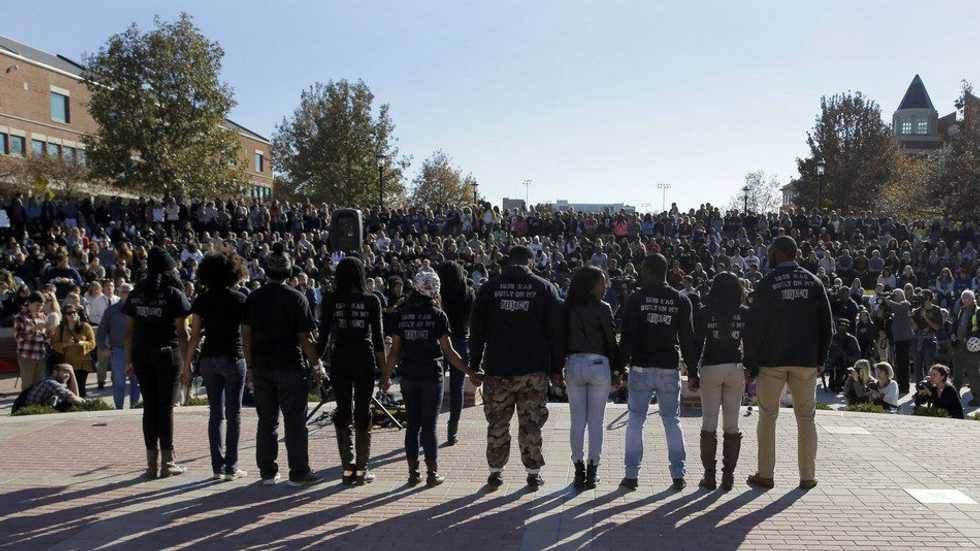
For example, when speaking about racism and police brutality, our media calls the “Black Lives Matter” protestors “rioters” without acknowledging how the media once portrayed Martin Luther King Jr. as a “trouble maker” and a “liar,” although both Black Lives Matter and MLK Jr. endorse and follow the philosophy of nonviolence and passive resistance to achieve justice. Just compare the events of the recent I-94 shutdown, as well as the 4th Precinct shutdown in Minneapolis, Minnesota, to that of the historic sit-ins during the Civil Rights Movement. In both events, the protestors were primarily young people, college students and other adults ranging from 20 to 35 years old, and both used nonviolence as a tactic.
But this article is not about Black Lives Matter. This article is about how grown adults continue to use infantilizing language to make college students believe that they are inadequate. Words such as “coddled” and “oversensitive” are used to describe students like myself. According to the Oxford Dictionary, the word “coddle” means to “treat in an indulgent or overprotective way.” However, in being exposed to a variety of new ideas, theories, beliefs, and opinions, all while maintaining the right to my own, I have experienced being “coddled”, but instead have learned to listen and appreciate other perspectives, including those which I do not agree with.
I cannot advocate for all students in the United States, but I would like to assure older generations that while they argue over allowing refugees fleeing war into our country, using their own ignorance regarding a major world religion as an argument to reject families who have lost everything, I’m confident that a large portion of my generation will fight to for these refugees with compassion and work towards eradicating islamophobic rhetoric from the conversation. It is the men and women who blindly believe that Islam advocates violence and extremism who are coddled. While older generations argue that LGBTQA+ couples marrying each other, adopting foster kids, or being in the very presence of their own children will somehow corrupt them, I know that many people of my generation will continue to acknowledge that sexuality and gender both run on spectrums, and that being anything but cisgender and heterosexual, does not make a person “dirty” or mentally ill. It is the people who argue that any kind of love that isn’t composed within their own terms who are coddled.
There are thin lines between levels of protection. It is easy to see how media portrayal can influence audiences to perceive our generation as selfish; when we go to a professor to question them about a low grade, some of us simply want a higher score, while some of us are seeking constructive criticism so that we can learn how to improve. Many young people are egocentric, and many are self-serving. But it is important to keep in mind that many are not, and for those who are, have likely been conditioned to be. Generalizations of cohorts are convenient, but they are not accurate.
One of the most common arguments I’ve seen for the “coddling” of college students, is that we have things called “safe spaces”. Many professors and counselors on campus have “safe space” stickers outside their offices doors, and many faculty even go to “safe space” trainings. From these arguments, some key points include the belief that safe spaces shield students from ideas and concepts which they disagree with or that offend them. However, according to the Safe Space Network, a safe space is: “a place where anyone can relax and be able to fully express, without fear of being made to feel uncomfortable, unwelcome, or unsafe on account of biological sex, race/ethnicity, sexual orientation, gender identity or expression, cultural background, religious affiliation, age, or physical or mental ability”.
On my own college campus, I’ve seen many doors with “safe space” stickers, including my university’s Women’s and LGBTQ Resource Center. According to the Centers for Disease Control and Prevention (CDC), LGBT youth are at an increased risk for suicidal thoughts, behaviors, attempts, and are more likely commit suicide than their heterosexual peers. And it isn’t just LGBT youth who are at risk, but people who are of color as well. According to the Office of Minority Health Office at the U.S. Department of Health and Human Services, African Americans are 20% more likely to experience “serious psychological distress” than non-Hispanic Whites. This begs the question: what makes safe spaces bad? Why do they carry such a negative connotation? Suicide is the third leading cause of death among college students, and it is no secret that mental health is prevalent in student’s ability to perform academically. However, according to UCLA’s 2014 study, which surveyed over 153,000 students on college campuses across the U.S. about their mental health, nearly one in ten reported feeling frequently depressed. Their assessment of students’ overall mental health level is the lowest reported since UCLA began the annual study. Another study, performed by the American College Health Association reported that over half of college students said they’d felt “overwhelming anxiety” in the past year.
From this information, we must ask ourselves: are safe spaces the problem, or is it the lack of knowledge of the relevance of mental health? Are we, as students, truly being coddled, or are older generations ignorant to the importance of acknowledging psychological health issues? From their beginning, safe spaces have been implemented into schools and workplaces with the intention of serving people of marginalized groups. The negative connotations surrounding them are not only an insult to mental health professionals who have created them, but to the countless students who they’ve helped in their time of need. By insulting students of marginalized groups for asking for help, we not only send the message that their mental health is not important, but that they, as human beings, are not important. It reinforces age-old white supremacist, heteronormative ideals that if you are not like the rest, then you are weak, and therefore inferior.
To conclude, from my firsthand experience of being a college student today, I cannot advocate that college students are coddled, because they are actually quite exposed. It is college students who are leading movements, traveling abroad, and developing their own personal identities at incredible rates. It is college students who will grow into this country’s future generation of educated individuals and who will become government officials, teachers, police officers, scientists, activists, artists, doctors, and so on. Small acts such as placing a trigger warning on a graphic lesson isn’t luxurious for anyone; it is small but thoughtful way to allow a survivor of abuse and/or rape to mentally prepare themselves for any major anxiety or flashbacks. Creating safe spaces for students who may struggle with depression, anxiety, etc, is not coddling, but a way of acknowledging the importance of mental health on campus, and in doing so, ensuring that students perform well academically and that our universities produce the greatest graduates possible. Instead of using condescending language to attempt to bully younger generations of college students, we all should encourage personal growth, and in doing so, seek to challenge our own perceptions as well. One of my professors once told me this: “It is far easier to teach an uneducated person how to hate than an educated person.” That being said, it is also easy to come to the conclusion that all young people are “coddled," “spoiled” and “brats," but it is much more difficult to do your own research, and to form your own opinion, rather than blindly living by the words of someone else. After all, if you do that, perhaps then you are a coddled individual.