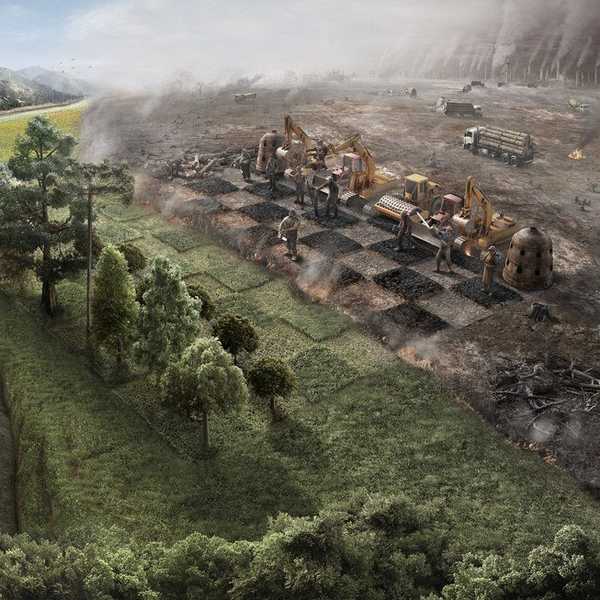


Climate change is an important phenomenon that has the potential to greatly impact human life in the coming years. Think of unpredictable weather patterns, unexpected droughts, water scarcity, crop failure, decreased biodiversity and economic crisis throughout the world. Despite the scientific community's overall consensus that human-caused global warming is a real threat, many Americans are unsure if global warming is even occurring.
This trend of not believing the experts who dedicate their lives to understanding Earth sciences is really disconcerting. Even if people do see climate change as a problem and believe it’s caused by humans, they seem to think that climate scientists are over-exaggerating the effects.
Americans need to learn more about how Earth systems function and develop a better understanding of how they fit into the greater ecosystem the live in.
Climate Change: The Mechanics
The Earth is an open system that gets most of its energy from the Sun. Many people like to point out that energy is not created or destroyed, which is true, but it can be distributed in many different ways. As the Sun’s energy enters our atmosphere, it gets either absorbed by the land and oceans. Ice sheets in Greenland and Antarctica reflect the Sun’s energy (called the albedo effect.) Greenhouse gases, such as methane, carbon dioxide and water vapor can absorb energy radiated from the Earth’s surface. This energy is trapped in the form of heat, which, in excess, is a very unhealthy form of energy for our planet. Carbon dioxide is proven absorb more energy (in the form of heat) in our atmosphere and its concentrations have increased from around 270 ppm in pre-industrialized society to around 410 ppm today. Due to this increase, the global average temperature has risen about 1.3 degrees Celsius since the industrial revolution. This may not seem like very much, but as weather patterns and temperatures change, the climate stays impressively constant. One degree is a significant change.
Energy Problem
Most of the energy we currently use and have used (natural gas, oil, coal, charcoal, propane) results in carbon emissions, which trap heat and cause global warming. Other forms of energy, such as solar, wind and hydro, are much cleaner and renewable. The problem is that we unfortunately do not have technologies that make using these types of energy easy and accessible. For example, the average person probably would not know how to install a solar panel or where to get one. Instead, we are trying to develop ways to obtain more oil and natural gas. We also don’t hear many politicians talk about solar and wind energy in any amount of detail.
Many people worry that the private sector has not felt motivation to contribute research and development to creating technologies that make using renewable energy accessible. Another, more subtle, problem with energy revolves around waste and products. The United States is a society that consumes a lot and wastes a lot. In fact, the EPA estimated that we accumulate around 236 million tons of solid waste per year. Most developed nations have economies that depend on consumption and production, which are two vehicles that produce a lot of waste. Every time we buy something, we are taking ownership of the energy that was used to make that product. Every time we discard something, we are wasting the energy that was put into making that product. However, it is safe to bet that most people do not realize that they are wasting energy.
The New Ecological Paradigm
In order for Americans to experience the shifts in attitudes toward the environment that are needed to save it, there needs to be a fundamental change in how we view the environment and an increased understanding of how we depend on nature.
Riley Dunlap and W. Catton, Jr., two environmental sociologists, studied the attitudes Americans possessed about their relationship with the environment. In their article, Environmental Sociology: A New Paradigm, they developed a concept called the Dominant Western Worldview (DWW), which encapsulates some common assumptions Americans make about human nature, environmental constraints and the context in which we live..
The Dominant Western Worldview states that humans are much different from other creatures, we are masters of our destiny, the world is filled with unlimited resources and opportunities, and humanity always progresses and will continue to progress without ceasing. The DDW is accompanied by another idea by Dunlap and Catton: the human exceptionalism paradigm. This idea states that human affairs are determined by culture and technology; the environment is irrelevant.
These attitudes, if accurate, are extremely damaging. Humans depend on land, water, fresh air and natural resources. Pretending like we are not connected to those things and refusing to learn about them could perpetuate our exploitation and destruction of the natural world. This worldview has the potential to fuel our skepticism of climate science and evidence of climate change. It could also be contributing to our consumer driven, energy intensive culture.
The New Ecological Paradigm, the third part of Dunlap and Catton’s work, describes a new way thinking that could help people develop healthier attitudes toward the environment, which could in turn, aid in motivating people to save it.
It goes like this: humans live among many other creatures and are a part of the ecosystem that surrounds them, so human actions can have great impacts on the environment. Humans are dependent upon finite resources (water, food, space), which put constraints on human affairs. Humans are subject to a population carrying capacity, like every other organism. Our population cannot continue to grow and we cannot continue to take every resource around us and carelessly release greenhouse gases into the atmosphere, without facing serious consequences in the future. Lastly, our empathy for fellow humans should extend to future generations. Adopting a different worldview, such as the New Ecological Paradigm, could lay the foundation for forming better attitudes about the environment and global warming. A person who doesn’t believe humans are superior to everything else and realizes there are constraints to human affairs imposed by the natural world, is going to have an easier time being convinced that climate change is a problem.
If Americans adopt a different (and more accurate) worldview, like the New Ecological Paradigm, as well as utilize higher quality information that doesn’t come from news anchors or politicians, this could be the foundation we need to have form better attitudes about climate change. If we add to this a basic understanding about how the climate works, even as basic as the information mentioned earlier, more people would have the ability to independently reason through environmental issues by drawing from their background knowledge.
Our environmental crisis is driven by consumption, fossil fuel energy and most importantly, the idea that everything on the planet exists for humans to use and capitalize from. To solve our environmental problems, we need to adopt the New Ecological Paradigm, which includes the following:
1. Increase environmental literacy;
2. Give scientists more respect and consideration when unpacking issues such as global warming;
3. Realize that nature supports our existence;
4. Empathize with people all over the world, not just our friends and family;
5. And lastly, put more value on living organisms and less value on material objects.
As Americans, we have historically valued economic growth, development, production, consumption and advancing technologies that help us maximize our resources. The problem is that, these notions are not helpful to us when it becomes imperative that we do the exact opposite to save the planet.