
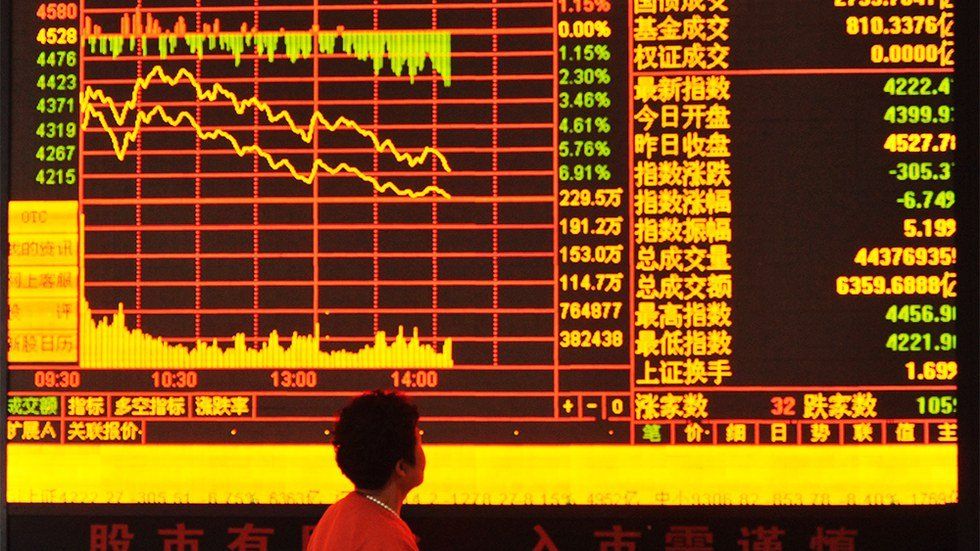
At the beginning of 2015, the Chinese stock market was the fastest growing market in the world. Investors spanned from corporate business owners to regular citizens like taxi drivers and teachers. Now the bubble has officially burst for this market, and it has resulted in a free fall of billions of dollars.
The cause of this has been attributed to a financial "bubble" that developed when investors were convinced that the Chinese stocks were a "can't miss" opportunity. At the beginning of 2015 the market had soared 150% while being fueled by investors, despite the fact that the actual economy, along with profits, was low and stagnating. A weak economy alongside rapid investment put pressure on this bubble, resulting in a burst that cost billions of dollars.
Since the crash on June 12, the Chinese government has implemented several procedures in an effort to save the market and hold onto investors. Before investors could even pull out, the Chinese government froze half of the share listings, resulting in 2.2 trillion dollars being held to sustain the market. Additionally, initial public offerings have been temporarily banned, which prevents the initial sale of a new stock produced by a corporation. In its most desperate attempt, the Chinese government as loaned brokerage firms $42 billion while also adding a $40 billion stimulus package.
Who is really being effected by this crash? Retail investors, small local business, and average middle class workers. Most of these individuals borrowed money to invest and are now at risk of losing everything.
Despite government reassurance of long term investing and several attempts at support, people are still left feeling angry.
The Guardian reports, "Not surprisingly, the unofficial press and the Internet had erupted with the sentiments of people furious about both their financial losses and what they regarded as the Communist party’s poor leadership."
For China, the crash has brought issues to the surface that revolve around more than just money. On a global level, the crash has done only minor damage. In regards to the United States, stocks have taken a hit due to the global uncertainty in the market; you may see the effects in your 401k.
However, the current position of the market could spark a buying opportunity for eager US investors, since there are Chinese companies that trade right here on American soil (like NASDAQ, for instance).This opportunity is something that only investors who are willing to deal with the current volatile state of the economy can take on. For the global economy as a whole, it is still too early to asses the damage. China is the second largest trader with the U.S. and Europe, and if the country's economy continues to slow down, in addition to the crash, it could cause a significant global deficit.
In more recent weeks the market has begun to recover. The Shanghai Composite added 2.5 percent and is in the process of re-building. Companies are slowly beginning to trade again on the market. As of now, people are investing, but are still extremely nervous of the fragile state of the market. Only time will tell if government efforts will hold and the Chinese market/economy will balance out.