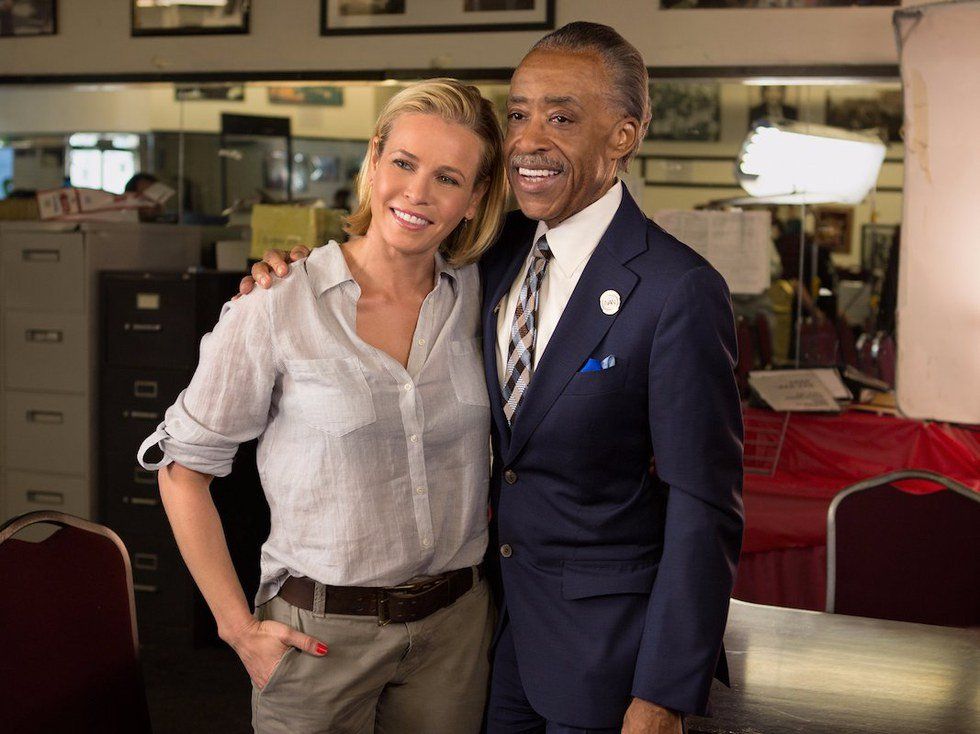
In Chelsea Handler’s new four-part Netflix documentary, "Chelsea Does," she investigates topics that heavily affect our society, but aren’t fully understood. In one of the episodes called, “Chelsea Does Racism,” Chelsea investigates the status of racism in the United States and elsewhere.
Partly because Chelsea is unafraid of being offensive, or blunt, we get to see layers peeled off what is, whether it should or shouldn’t be, a subjective matter. “I come from the school of making fun of as many people as possible all the time, no political correctness, and I think that’s helpful,” said Chelsea, explaining her style of comedy.
During the episode, Chelsea takes a trip to South Carolina, where she visits Middleton Place Plantation. At the old plantation, white staff explain and pretend to do the jobs that African American slaves would have done in the past as a sort of reenactment activity.
Chelsea and the man in charge of the plantation describe the plantation as being an “upbeat kind of environment.” The man did not see an issue with this pleasant vibe surrounding a place in which people had once been enslaved, but it is clear to Chelsea, and “anyone else visiting the place unless [they’re] a moron,” as she put it, that there should be, at the very least, some recognition of the history of the place. Many would agree that it is certainly offensive for white people to be profiting from and re-appropriating this plantation that was once the location of so much injustice and pain.
Nevertheless, the situation clearly doesn’t seem offensive to the owner, the workers, or any of the countless people who have had massages there, swam on the property’s pool, or held their wedding ceremonies there. Here the episode highlights the difficulties of having a conversation about race. Reaching any sort of mutual understanding surrounding the debate seems highly improbable when people are coming from such different viewpoints about what is or isn’t racially offensive.
In this instance we find Chelsea to be on the side of the politically correct, but later in the episode we find her on the other side of the issue.
In line with Chelsea’s fearless spirit, she sits down with six leaders from various organizations who focus their attention on the way that certain minorities are portrayed in the media, some of whom had taken issue with Chelsea’s comedy in the past.
One man, Guy Aoki, a part of the Media Action Network for Asian Americans, expressed his anger with Chelsea for some jokes she made about Angelina Jolie’s Asian son, Pax, in which she stereotyped Asians as being good at doing nails and being bad drivers. Chelsea, however, did not see an issue with her jokes, and maintained the idea that she thought they were funny. "Listen, I'm just bring it up because you asked" said Aoki. Chelsea responded, "No, I appreciate it. This is an open discussion."
A similar situation happened to one of Chelsea's friends, Margaret Cho, in which she was called out for a comedic performance that she thought to be funny, but others found offensive. At a dinner party with Chelsea and some of her comedy friends, Margaret, a comedian of Korean descent, talked about a role of hers at the Golden Globes in which she played a North Korean spy. “A lot of people said that it was racist and that it was yellowface, but I actually have a yellow face, so I was really confused by it. The people who were against it were mostly white people,” said Cho.
Chelsea and Margaret Cho are both LA-based, liberal comics, and yet they both found themselves to be on the back end of some harsh criticism for what some deemed to be racist material. Although some took offense, neither comedian took responsibility for being racist. What is off limits for comedians regarding race is generally a heated topic spawning various opinions on the matter; however, the bottom line here is that the two situations highlight this continuing theme in Chelsea’s episode that what is considered racist is subjective for better or (most likely) for worse.
What does this inconclusive discussion mean then? How do we create a standard by which we can hold people accountable for racist actions and words when we cannot agree on what is or isn’t racist? Who gets to create this standard?
At the very least, I think we can conclude the following, and perhaps follow Chelsea’s lead for that matter. We owe it to each other to be willing to discuss and listen to the ways in which our actions and words affect other people. While many will not agree with all of Chelsea’s philosophies on race and PC culture, she did listen, which is more than one can say for many people. Claiming you are not racist or offensive without stopping to listen to the people who may feel otherwise perpetuates a culture of ignorance and guarantees that social equality will never be reached. We may never be able to come to an agreement, but we can always lend our ears and open minds to those whom we have hurt.