
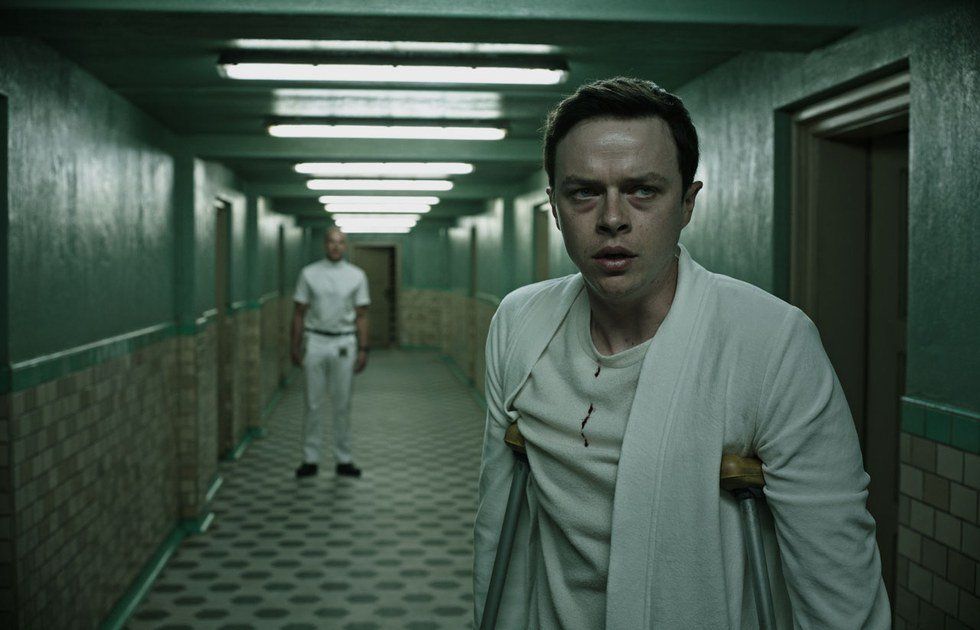
It seems that Don Draper took a trip to Dennis Lehane’s Shutter Island in Gore Verbinski’s 2017 film “A Cure For Wellness” when main character Lockhart, played by Dane DeHaan, finds himself at a remote retreat in the Swiss Alps.
Lockhart is sent by his superiors to retrieve the company’s CEO, Roland Pembroke, to close an important deal. He travels to the mysterious wellness center, but quickly finds himself stuck there when a car accident with a deer leaves him with a broken leg. Lockhart is the only “patient” that wants to leave the spa and it seems that the staff is working tirelessly to keep him there.
Dr. Heinrich Volmer, played by Jason Isaacs, tends to Lockhart as well as the other patients, portraying odd and, especially by the end of the film, questionable and gruesome tactics.
Viewers should be especially wary of eels and dental procedures.
As Lockhart continually questions these treatments, the rest of the patients seem to be totally infatuated with the doctor and his medical advancements, which is surely one of the eeriest pieces of the film. Especially as Lockhart begins questioning his own distance from this “disease” that is plaguing the patients.
Early in his stay is when Lockhart meets Hannah, played by Mia Goth, who is Dr. Volmer’s “special project.” He doesn’t know what that entails, and not even Hannah really knows, but it adds to the mystery that surrounds the establishment.
It is this sense of mystery that drives the plot of “A Cure For Wellness.”
There are endless motifs that are a part of the plot: eels, a reliance on water, a vial of vitamins in a cobalt bottle, and the mention of the incestuous relationship between the baron, who built the castle hundreds of years ago, and his sister.
The story of the baron and his sister is worth noting from the beginning, as it plagues Lockhart and very quickly becomes a driving point in the plot. While on the surface it seems like just an origin story for the castle, it becomes the central crux of the plot.
The continuity of these motifs throughout the entire film is what makes the rather farfetched plot as realistic as it could be, no matter the odd twists and turns.
Besides visible, almost tangible pieces of the story, “A Cure For Wellness” keeps a strong focus on how the film was produced.
In The New York Times’ Anatomy of a Scene, Lockhart’s first exploration of the spa is analyzed by Verbinski, himself.
The points that Verbinski made in his comments, really, explains the tone for the technical aspects in the entire film.
“We tried to put a certain sickness into the soundtrack,” said Verbinski. “Like a black spot on your x-ray.”
For the spa scene, the audio producers actually took tracks of wheezing breaths and slowed them down to create the abstract, sickly sound.
As for camera technicalities, that entire scene was shot in one sequence with an orbiting camera angle and a rushing team behind the scenes to create a sense of claustrophobia- very reminiscent of the 2011 film “Silent House,” an entire film shot in one take.
Verbinski skillfully uses these tactics to ensure that his film remains relatively coherent. All a viewer needs is an ounce of attention and observance.
For a film with so many twists, turns, and a story that has potential to be far too abstract, Verbinski executes “A Cure For Wellness” incredibly well with his focus on both plot continuity and technical attention.