I have always agreed that college or university is not for everyone. There are many jobs, careers, and skills that people can excel in and never need to step inside an institution of higher learning. Unfortunately, many students at the K-12 level around the United States have experienced a lack of preparation to become productive members of society who can think critically and creatively. Society has put an imposing demand on attending college because of this reason, as it has become a requirement of many jobs to have some form of a degree.
However, according to a study by the Pew Research Center, 75% of adults over 18 say college is too expensive for most Americans. So how do we require less college education but still turn out divergent thinking individuals ready for the workforce? Change the K-12 public education system!
Rather than dive into every problem our public education system may have, here are some big challenges to K-12 in America:
It Stifles Creativity
Many of you have probably heard that school stifles creativity before, but proof of this happening in schools across the country is growing at an alarming rate. For example, a study from the book Breakpoint and Beyond: Mastering the Future Today, asked over 1500 kindergarteners what kind of uses can you think of for a paperclip? If you are able to come up with enough examples, you will score in the genius level of divergent thinking.
A whopping 98% scored in the genius level. The same test was given to the same children at age 15 and only 10% of them scored that high. Further, in tests of over 200,000 adults, only 25% of them scored in the genius level (if you're interested in this study, I would highly recommend watching this video in which Ken Robinson explains it and the implications of what this means in greater detail).
While it may not be definitive proof, it does raise the question that, as these children and adults further their education, why do they lose more and more of the ability to think creatively?
Lower Order Thinking
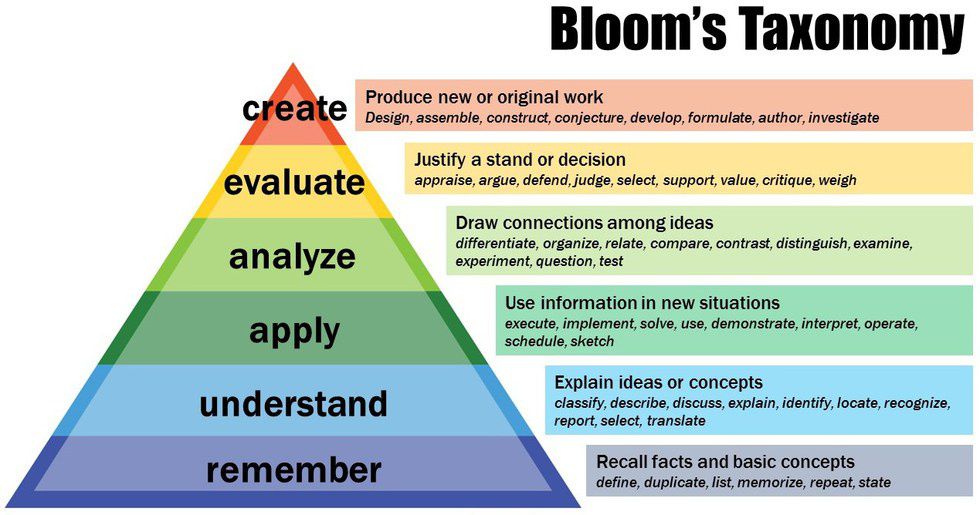
Have you ever seen this triangle before? This is Bloom's Taxonomy. It is the idea that some learning requires lower level thinking, (the bottom three sections), and as learning becomes more advanced it requires higher level thinking, (the top three sections). This is important, because it has been widely accepted by psychologists and educators around the world that this is the most accurate way to achieve mastery level in any area of learning.
So why does this matter? Well our current curriculums in American public education focus on the lower three parts, and sometimes not even that many. We rely on our students to be able to memorize fact after fact for a test with no real retention of the information after it's completed. Some teachers take it a step further and ask student to be able to describe the concepts they memorized, or identify them in a crowd of other concepts. While that is great, we don't start to reach more divergent thinking, (remember, it's all about that creativity), until we ask our students to question their learning and concepts, decide whether they are useful, and then ultimately create new ideas based on them.
In colleges and universities across the country, future educators are learning to challenge their students in these ways, as these children are a lot smarter than many might give them credit for. However, many curriculums and more traditionalist teachers refuse to push their students to even attempt these higher order thinking skills, and this needs to change.
Underfunded
Our federal government pays for approximately 10.8% of the cost of public education in elementary (K-8th) and secondary (9th-12th) schools. That means it is each state's responsibility to come up with almost 90% of the funding. This is largely contributed from property taxes which already does not contribute enough to the needs of our students in education today, but what about the areas of predominately lower income families? These schools are even more severely underfunded because the property values are significantly lower, but the cost of each student remains similar to any other school. How can you tell a child that because he was born to a lower income family he doesn't deserve the education that wealthier children get?
Some people might think that this is a result of teachers making too much money and that schools need to just "work with what they got." First, the average starting salary for public school teachers in America is only about $35,672. Would you want the person educating your child to make any less than this already absurdly low salary? Second, schools need to spend money on areas of education you might not think of. Some students cannot afford to eat, as they may come from low-income families. Public schools assist in paying or pay for in full breakfast and lunch for many students so that they have the ability to learn as any other student.
Further, schools are responsible to pay for the services that students with disabilities require. Students with disabilities need these services in order to achieve the same education as any other student, and it would be unfair to tell those students they cannot learn because there is not enough money in our budget. There are many other expenditures schools must pay per student in order to assure every child gets the education they deserve.
These are only a few of the many problems our education system faces. Of course there are many good things happening in public schools: teachers who strive to connect with their students and push them to do their best both in and outside of their academics, as well as schools that are doing exceptionally well with new technologies to help students achieve their maximum potential. However, the current problems need to be addressed not just by teachers, but by everyone in our society. These problems are unfair to our teachers, unfair to our society, and most importantly, unfair to our children.