


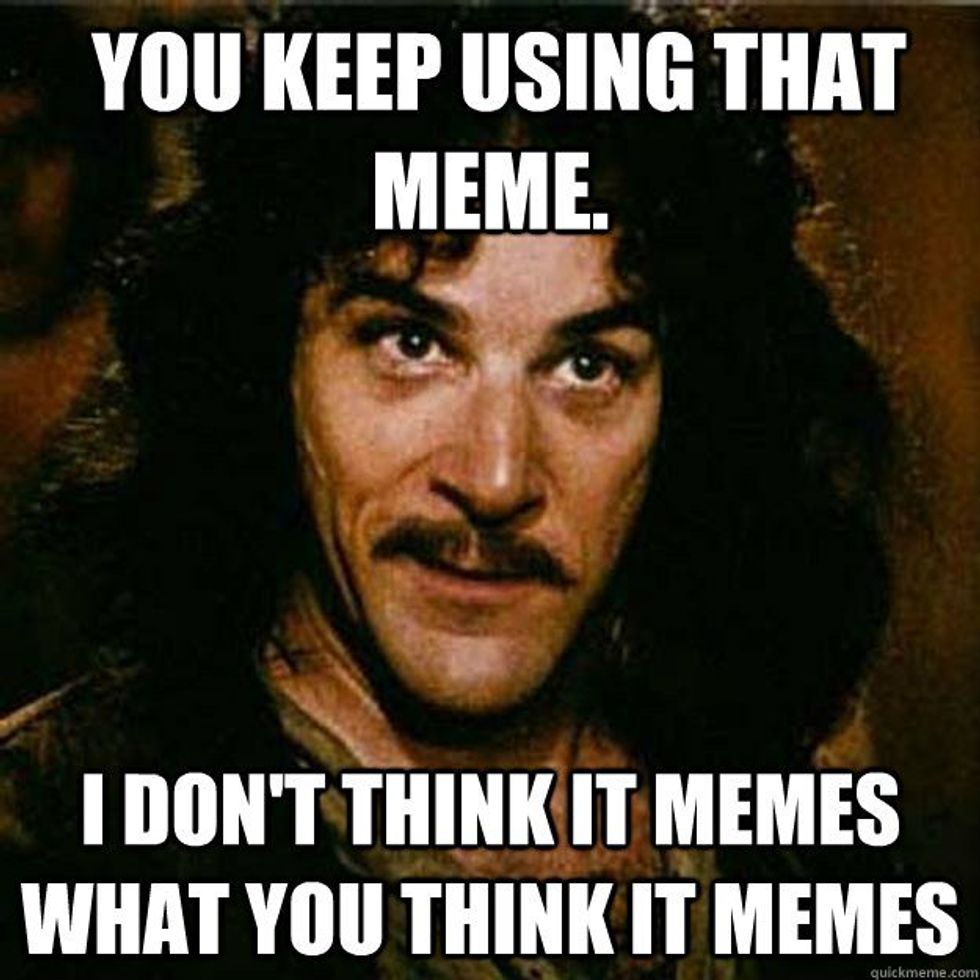
Fear not, this article will not be written in French. Nor will it be about French, despite it being the language of love. But also wine, cheese and fine perfume.
This article, will be about memes.

The word 'meme' comes from the word 'meme' in French, which means 'same.' So a meme uses a situation seen in a movie or television serial or some other element of pop culture with a wide enough appeal. Perhaps the most succinct way to put this across to someone would be to use Boromir from Lord of the Rings, played by Sean Bean in the movies.

The scene in the movie is when Gandalf and the entourage are discussing destruction methods for the One Ring, and the only viable option is to drop into Mount Mordor, a volcano in the land of Mordor, which is the base of operations for the main antagonist of the series, the delightfully named Sauron. Boromir dismisses even the probable chance they have by saying 'one does not simply walk into Mordor', and then the rest was history as Boromir has now been immortalized on the Internet as one of the most basic memes one can encounter.
(Pet peeve disclaimer : In myhumble opinion that I now voice on the Internet, Sean Bean should tell people that his name is pronounced as 'Seen' Bean, not 'Shawn' Bean. Come on, Mr. Bean, you must simply try and do better than that!!).
But the word meme does not come about simply from the French language.
Meme hypothesis is actually a scientific term proposed by Richard Dawkins, a scientist but also possibly the most famous atheist in the world, in his 1971 book The Selfish Gene.
To emphasize commonality with genes, Dawkins coined the term "meme" by shortening "mimeme", which derives from the Greek word mimema ("something imitated"). Dawkins states that he did not know of the "mneme" and said that he wanted "a monosyllable that sounds a bit like 'gene'". Dawkins wrote that evolution depended not on the particular chemical basis of genetics, but only on the existence of a self-replicating unit of transmission -- in the case of biological evolution, the gene. For Dawkins, the meme exemplified another self-replicating unit with potential significance in explaining human behavior and cultural evolution.
(the above paragraph was taken from that infallible fount of all knowledge on the Internet - Wikipedia https://en.wikipedia.org/wiki/Meme )
'A self-replicating unit with potential significance in explaining human behavior and cultural evolution' may be the most scientific way an Internet phenomenon has ever been explained. That is exactly what a meme is. One way to look at it from the perspective of a tangible literary movement could be widespread, template based satire deriving off of scenes from popular entertainment that are 'in the know' of the vast majority of the people it already targets, while also maintaining ease of translation for people who as yet haven't encountered the piece of entertainment the meme comes from.
If music is the universal language of what feelings sound like, memes are the universal way of telling someone a joke.
















