Close your eyes and imagine yourself walking on your toes. Halfway through, you slowly lose your balance because your heel muscles are a little too weak to lift your feet off the ground. Then, you proceed to walk, dragging each step behind you as you struggle to maintain your energy without having fatigue. You pant and puff your way through, trying to breathe slowly. If you are not careful, you are most likely to fall and scrape your knees or hands
Or in the most severe forms, you are bound to a wheelchair, unable to care for yourself. You may have other medical conditions as well as a feeding tube embedded in your tummy to keep your hunger and thirst at a stable level. You may also be visually-impaired or have low intelligence levels or even deaf and hard-of-hearing. You may have autism as a combination as well.
In the slight cases, you may be capable of doing regular schoolwork or have high IQ levels. You are one of those who can persevere despite the odds of anyone who doubts your abilities. You have your limits but you smile through the pain. You may have a thousand hours of visits to the Department of Orthopedics, Medical Therapy Units, X-ray rooms, and etc. at the hospital while growing up.
What medical condition am I specifically talking about here? I am talking about a medical condition that affects the motor functions in your body as a result of a traumatic brain injury from birth or in the womb-- or even afterwards. The medical name for this unique condition is known as Cerebral Palsy. Cerebral palsy affects the motor functions of your arms, and legs, resulting in tight muscle spasms and seizures in childhood. It is not curable. It is treatable with intensive physical and occupational therapy methods as well as surgeries to help relieve the impact of stiff muscles, which make walking much harder for a person with CP than someone who does not have CP. It is not contagious and does not progress over time.
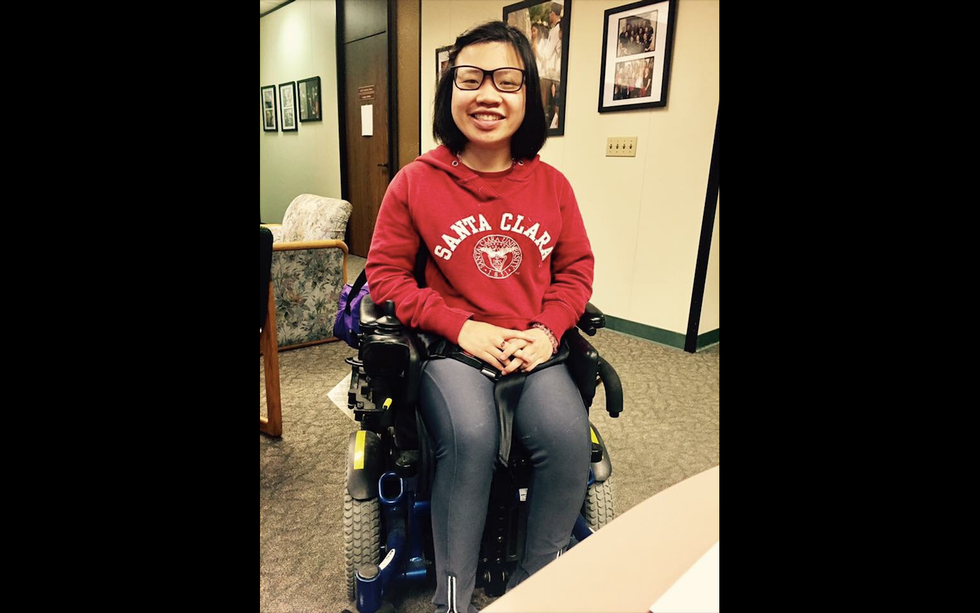
Would you believe it if I told you, that I have it? Would you still treat me and other people who suffer from it the same way you would treat your best friend? One of the issues I am constantly on guard is how people perceive me if they see me in a wheelchair versus when they see me, occasionally not using my wheelchair.
How are those two situations different? One scenario might be- people might ignore those in wheelchairs. Or some might offer to help push it. Or an abled person might start making false assumptions without first getting it to know the wheelchair- bound person’s abilities. I am one of the bunch who can walk a short distance before my fatigue hits.
My daily routine includes getting up every morning and making sure the batteries in my wheelchair are fully charged before heading to school. I participate in a mainstream education setting with reasonable accommodations that allow me to succeed at the university level. I am as capable as someone who can walk. Maybe my tasks might take a bit longer to do, but I do not give up. My perseverance keeps me going. My family and friends support me. I am blessed in ways that I cannot express in just a mere short article.
However, there are still a lot of stigmas out there about people with disabilities. On a universal level, whether it is cerebral palsy, or any other types of hundreds and thousands of disabilities yet to be discovered by scientists, doctors, and researchers around the world, I am one of those people who constantly have to prove to myself and others around me that I can and will surpass my obstacles. Actually, I would not call them obstacles but rather blessings in disguises. Those with disabilities are a unique bunch-- because of their unwavering strength and zest for life. We strive to find unique ways to adapt and belong in this world of the unknown premises. We may look, behave, and have unique abilities on the outside -- but on the inside, we are all humans with feelings of pain, sadness, joy, excitement, anger, frustration, and yearning for others to understand us with a little more compassion.
Here is a challenge for you this week: Hug a friend or relative with special needs. Tell them words of encouragement and commit to one act of kindness toward them. Be open to listen and learn. They have the wisdom of a sage, and eternal maturity that you will find that may change your outlook on life.