Today, no genre of film dominates the cinemas quite like the superhero/comic book genre. One of my favorite heroes on the big screen is Captain America. The Captain has had a good 2016 (he's probably the only one) with his third film, "Captain America: Civil War", which has made over a billion dollars at the worldwide box office and is the highest grossing movie of the year so far. However, I am hear to discuss the second film in the series "Captain America: The Winter Soldier". This, like the third film, is also a great action movie. After watching the film recently, I noticed that certain action scenes had more impact because they were built up through a subtle combination of sound effects, visuals, and music. (Spoilers ahead.)
The two primary examples of this effectiveness come in the elevator fight scene and the Nick Fury's attempted assassination in Steve Rogers' apartment. The apartment scene happens first in the movie. Steve Rogers/Captain America (Chris Evans) is walking to his apartment door at night. He stops to talk with his neighbor Sharon (Emily VanCamp) and she mentions that he left his stereo on before she walks back into her apartment. Steve, suspicious of this, enters through his window instead and holds his shield up ready to attack a possible assailant. He turns to discover his boss Nick Fury (Samuel L. Jackson) sitting in a chair in the darkly lit room. Nick and Steve share some witty banter, while a slow dance song from the 1940s plays in the background.
However, tension starts to rise when Nick uses the text on his phone to tell Steve that he bugged his apartment "Ear everywhere" and that his fellow S.H.I.E.L.D. agents might be untrustworthy "Shield compromised." Nick Fury stands up and continues to discuss the situation in hushed tones. Suddenly, loud gunshots are heard and three bullets explode through the apartment wall and strike Nick in the back. When I saw this film in the theater that scene made me jump in my seat from surprise. The music and the hushed dialog lulled me into a sense of security for a period of time. The text on Nick's phone begins to bring you out of that lull by conveying the seriousness of the situation. Finally, the loud gunshots completely take you from calm to shocked in seconds. This makes the scene more surprising and gives it a greater impact.
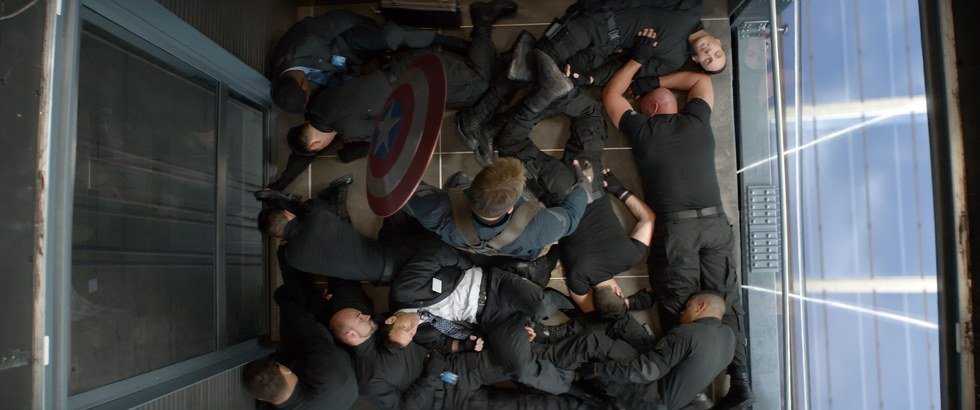
The second scene, the elevator fight, takes place after Nick supposedly died. Steve meets with the new leader of S.H.I.E.L.D., Alexander Pierce (Robert Redford). Steve enters an elevator alone. The door is about to close when three S.H.I.E.L.D. troops join him in the elevator. Steve notices that one of the soldiers looking out the clear elevator has his hand on a holstered weapon, at the ready, despite them being at S.H.I.E.L.D. headquarters. The elevator goes down a few more floors, stops, and a few troops and men in suits enter the elevator and flank Steve from both sides and the back. Steve notices that one of the suited men is sweating as if he's nervous.
Every time the elevator goes down a floor a low passing sound is heard that almost resembles a muffled heart beat. The elevator stops, more men enter, and Steve notices that he is surrounded in the elevator. Steve has figured it out; they are hear to capture him. Steve lets out a witty jab ("Before we get started, does anyone want to get out") then one of the soldiers lunges at him with a stun baton and the fight begins. The visual clues that Steve gains through the soldiers' behavior coupled with the rhythmic low beat of the floors passing gives the audience an ominous and uneasy feeling. It's as if you're hearing your heart-rate increase from the tension. As a lover of the art of film I love how these feelings of tension are built through sounds and visuals, and how they effectively made me care about the action taking place on screen. All someone needs is an ominous sound or suspiciously calm behavior from another character to keep an audience on its toes.