


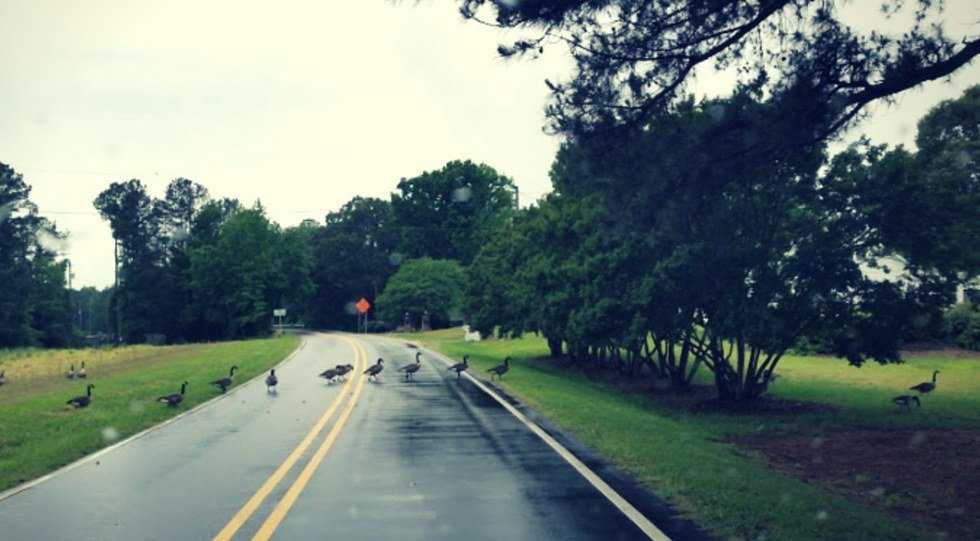
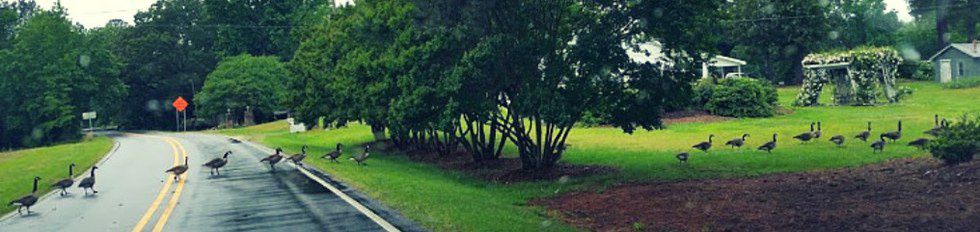
I was driving home from practice one day, taking my normal route home along Morrisville Carpenter Road. It isn't unusual to see Canada geese along the way, especially during this time of year, but never before had I come across them actually blocking traffic. There was a line of geese, perhaps about a hundred strong, slowly crossing the road in a single-file line. I inched my car closer and closer, and while the geese turned to look at me, they kept on walking along. They seemed to know that I wasn't going to run them over.
I had to sit and wait about two minutes (which may not sound like a long time, but think about sitting and watching slow-moving geese cross the road for two minutes) before there was a break in the flock and I was able to scoot through. It was almost startling how unafraid the animals were of my car. I decided to do a bit more research on these fascinating animals.
The Canada Goose
The Canada goose (sometimes called Canadian Goose or Canadian Geese) is a common visitor and resident in many parts of North Carolina. These animals can be quite beautiful to watch as they fly around overhead, swim in the local lakes and ponds, or build nests to raise their goslings. Of course, there are many problems that come with the geese as well, including an accumulation of droppings and feathers, destruction of crops and aggressive behavior, especially while nesting.
Canada Goose Quick Facts
Love 'em or hate 'em, the Canada goose is here to stay. I did a bit more research on these migratory birds and they are actually quite interesting creatures.
1. Three Populations: Did you know that there are three distinct populations of Canada geese in North Carolina? Two of the groups are migratory and are only in NC during the fall and winter. The last population is a resident population with the highest populations found in the piedmont and northeastern part of the state.
2. Protected Bird: The Canada goose is protected under the Migratory Bird Treaty Act of 1918. However, there are still seasons that allow for the hunting of these birds, both migratory and resident populations.
3. Long-Lived: According to National Geographic, the average lifespan of a Canada goose in the wild is 24 years and they can grow as heavy as nearly 20 pounds! The oldest recorded Canada goose lived to be 33 years old.
4. Fast Flyer: The Canada goose is capable of covering over 1,500 miles in just 24 hours, given a favorable wind. Now that's some speed on the wing!
5. Strict Vegans: The diet of the Canada goose includes a variety of foliage, namely skunk cabbage, eel grass, blueberries, corn and increasingly domesticated grasses as those are becoming more and more common in the areas where the geese tend to migrate.
6. True Lovers: The Canada goose mates for life and pairs tend to stay together throughout the year. "Divorce rates" among Canadian geese are low, though not undocumented.
Got Goose Problems?
Do you have a flock of unwanted Canada geese in your yard? NC Wildlife offers some suggestions to keep the geese out of your yard. It should be noted that relocating the geese rarely works as the geese have been known to sometimes fly hundreds of miles back to the place they were trapped at. So if you're looking for some options to get rid of your unwanted guests without killing them, try a few of the following methods:
Don't Feed Them: This may sound obvious, but make sure that you—or your neighbors—aren't feeding the geese. On top of that, feeding the animals conditions them to be less wary of humans which could lead to confrontation in the future.
Mylar Tape: Using mylar tape is a good way to disperse geese and other nuisance birds without violent or cruel means. Tie some tape to a stake about 10 inches off of the ground and then attach that to other stakes every 20 feet or so. Twisting the tape in between the stakes can increase the amount of shimmer in the tape which confuses and scares off the birds. You can find mylar tape in the lawn and garden section of most stores.
Exploding Devices: Exploding devices might include propane cannons, exploding shotgun shells and scare pistols. These devices are meant to scare off the geese as they try to come in and land in your yard, farm or pond. Make sure that you inform your neighbors if you intend to use such loud devices, as well as local law enforcement. Some areas require permits to use these devices.
Overhead Lines: Thin lines of wire or tough string over a pond is usually a pretty effective way to keep the geese at bay. The lines interfere with the ability for the geese to land or take off, and usually they will abandon these areas quickly. You can also attach some mylar tape to the lines to discourage the geese from trying to land at all.
Chemical Repellents: For the most part, chemical repellents have not been very successful in keeping geese at bay. There is some evidence, though, that a new product that smells like grape might prove to be more effective but more tests are needed.
Habitat Modification: If you have a pond that geese are prone to swim in, try letting the vegetation around the edge grow higher as the geese don't like to have to climb over foliage to get to the water. The geese like to walk from place to place, so if you have some sort of obstruction in their path, they may be discouraged from hanging out on your property. Also, be aware that having domestic geese on your property may attract the Canadian geese as well.
Other, more violent options for ridding yourself of a goose problem include egg addling (you need a permit for this) and hunting (be sure you check season dates and areas where it is legal). I would advocate exhausting all of the non-violent methods first.

















