
As a child, Easter was one of my favorite holidays. Every year, my mom took my sister and I shopping for a frilly new dress, white straw hat, and delicate little white gloves. We would dye eggs beautiful jewel tones in the days leading up to that sacred Sunday,and when it finally came, we would dash out of bed to see what the Easter Bunny had brought us. He never let us down, and we would sit, joyfully unwrapping chocolate rabbits and shaking those little plastic gift eggs in an attempt to decipher what was inside. After ample time to consume our spoils, we would be carted off to Easter Sunday church, where the pastor and congregation vibrantly celebrated the resurrection and re-emergence of Jesus.
Our day usually concluded with a family dinner at my Uncles' house, and an epic Easter egg hunt with my many, many cousins. While this sounds like a standard celebration of Christendom's most sacred holiday, what most people don't know is that every one of these traditions springs from Pagan religions that pre-date Christ by hundreds, if not thousands of years. The rabbit, the eggs, the descent into the underworld and subsequent resurrection of the deity, even the name of the holiday itself, all can be traced back to those pesky heathens. So let's have a look at the very Pagan roots of a very Christian holiday.The name of the celebration itself, "Easter," has no connection to the Christian mythos. Instead, the word Easter comes from the name of Eostre, who was the Germanic fertility goddess associated with bringing of both dawn and the spring. While there is some debate over the specifics of Eostre, as there is little written about her, the fact that her celebration days fell on the spring equinox and the idea of her as a bringer of light after the long dark of winter definitely ties her into the overarching idea of Easter as the Christians know it. There is some debate as to why the holiday is named after her, but it is suggested that early Western Christians had a hard time letting go of some of their old pagan ways, and the Church realized they had to pick their battles, thus acquiescing to the blending of some customs.

Now that we know a little bit more about the etymology of Easter, what about those eggs? While Christian scholars argue that the genesis of eggs at Easter stems from the fact that they were a forbidden food during the Lent season, therefore making the eggs a long-awaited treat, the idea of the egg as a symbol of spring and renewal goes back much farther. According to the "Encyclopedia Brittanica," “The egg as a symbol of fertility and of renewed life goes back to the ancient Egyptians and Persians, who had also the custom of coloring and eating eggs during their spring festival.”
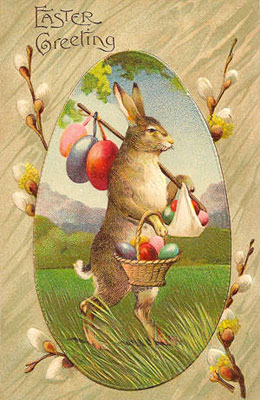
And what about the rabbit that delivers these eggs? The Pagan origins of the bunny are a bit less specific, but still present. Eostre herself is often depicted with a hare, though there are no writings associating the two. However, in his "Handbuch der Deutschen Mythologie," Karl Simrock states that "the rabbit is a Pagan symbol and has always been an emblem of fertility." So the bunny, with his propensity to procreate, became a symbol of this holiday that celebrates new life. How did he come to deliver eggs on Easter morning? That part of the tale comes from the Germans. In the 1700s, when they migrated to the U.S., they brought with them the tradition of the Osterhase, an egg-laying hare. Children built nests to receive the colorful eggs and left carrots as a snack for the magical creature.
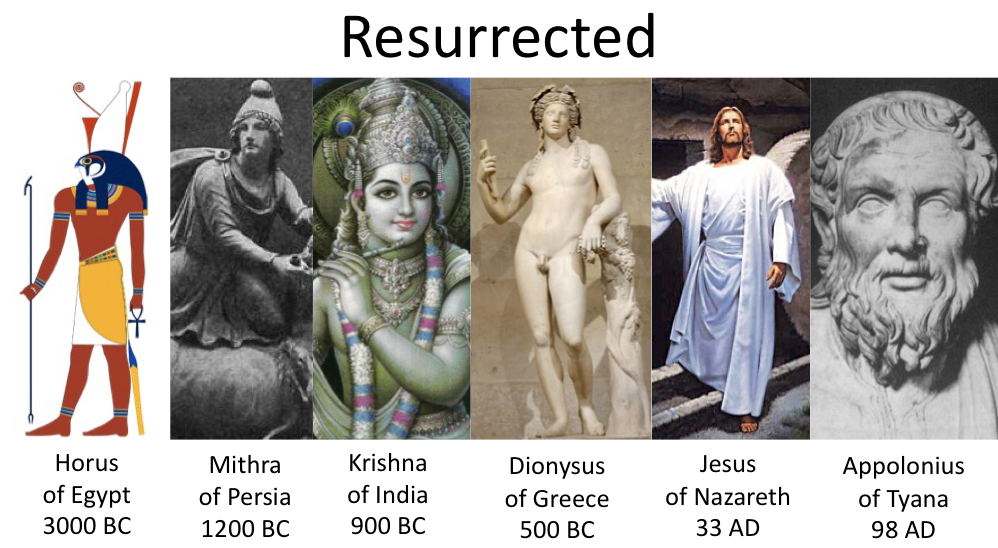
We've covered the name of the holiday, we've discussed the eggs and the rabbit. Now, on to something more controversial. As previously stated, Easter is one of the most, if not THE most important festival in Christian religion. It celebrates the resurrection of Jesus Christ after his crucifixion and three-day descent into hell. If anything, one would think that this part of the holiday is specifically Christian and has no ties whatsoever to the old Pagan ways, right? Right? Apparently, not so much. In fact, Jesus was the last in a long line of deities that were struck down and then re-emerged. Beyond that, most of these predecessors are celebrated at the exact same time of year: the beginning of spring. Their stories, while fascinating, are too numerous to include here. It is safe to say, however, that key elements of the story of Jesus' life, death and resurrection are present in the tales of the Mesopotamian goddess Inanna, the Hindu god Krishna, the Egyptian god Horus, the Egyptian god Osiris, the Greek god Attis, the Greek god Dionysius, and the Greek/Persian hero Mithras. All of these predate Christianity, some by thousands of years. While there is little question as to the existence of historical Jesus (Josephus and Tacitus, two reliable ancient sources, confirm such) it is easy to see how the idea of his divinity could have been cobbled together from these deeply rooted ancient beliefs.
There you have it. While it is fairly common knowledge that most Christian holidays are, in fact, re-interpretations of Pagan festivals, Easter appears to be the worst offender, snatching nearly all of its aspects from religious groups that the Church tried so hard to stamp out. Please feel free to utilize this information to bring some excitement to your holiday dinner conversation. Go ahead and ask your family members what they think about the Jesus/Dionysius comparison, or about the fact that the rabbit is a symbol of the celebration simply because it breeds, well, like a rabbit. I'm sure it will make for one memorable Easter.