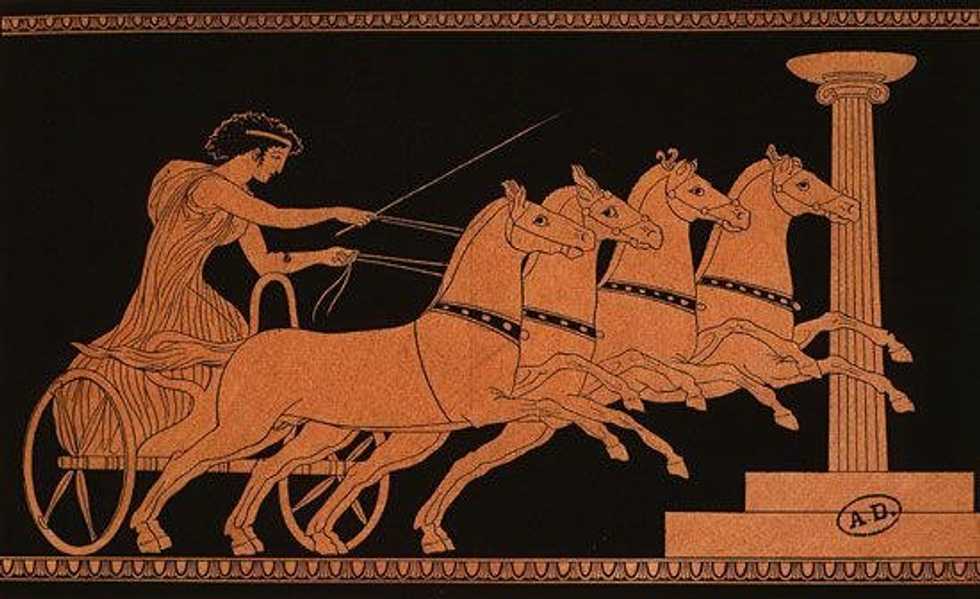
Back some time ago, long before Nascar and the Indie 500, folks used to crash the Circus Maximus to watch the good old sport of chariot racing. Although there is a general similarity between drag races and chariot races, the two events differ insofar as drag racing involves handling a vehicle powered by a mechanical agent, while the art of charioteering involves handling a vehicle put into motion by living agents.
Ancient Hittite artifacts show evidence of the chariot existing as early as 1500 B.C. It reached its climax as a form of public entertainment in the Roman and Byzantine empires, right before it went out of style in the sixth century, when the Germans invaded the western Roman provinces. According to Trevor Bloom, an historian specializing in ancient athletics and the history of Circus Maximus, the last recorded chariot race took place in 549 A.D.
The decline is attributed to Christian opposition, as can be seen in Tertullian’s writings, since chariot races were closely associated with pagan rituals. In addition, arena events often occasioned riots before the fall of the Roman Empire, so public entertainment as a whole eventually declined in Rome. Although jousting eventually became a public attraction in Medieval Europe, charioteering never made a comeback. It disappoints me that this wonderful tradition remains a lost art to this day. I am of the opinion that it should be brought back into our modern culture as a form of entertainment and historical education.
For charioteering, the house rules of Circus Maximus were simple:
1) No more than ten horses allowed per team
2) At all costs, stay in the inner lane of the track for the greatest advantage; if a rival drives too close or decides to cut you off, feel free to ram him
3) Be the first to complete the designated number of laps around the track and you’ll be crowned as victor
One can see from these rules that the game must have been quite dangerous. Ancient records make it clear that fatalities were not rare. In fact, they were probably one of the chief attractions for spectators, as “crash ‘n’ burn” scenes are for drag racing fans today.
Fair enough, so the charioteer and his horses would be very much liable to injury. Many may very well object to the reinstitution of the event, due to the imminent danger that would be involved. High risk factors, however, haven’t caused other life-staking sports to become obsolete. Take motocross and motorcycling, for example. A study showed that, during 2003, among persons aged <19 years, at least 245 died and an estimated 56,870 were treated in U.S. hospital emergency departments (EDs) for injuries sustained while riding a motorcycle.
According to national statistics, fatalities in motorcycle accidents averaged 4,008 per year by 2004, and have been steadily increasing ever since. Nascar has reported 30 deaths since 1948. In horse racing, 150 professional American, Mexican, and Canadian jockeys have died from the sport since 1940, according to the US Jockey’s Guild. Furthermore, the rate of horse fatalities in US racing currently averages 24 deaths per week, due to overexertion and head/neck injuries when falling. What I’m trying to show here is that mankind doesn’t mind risking his life (as well as the lives of animals) by participating in extreme sports. We know that certain activities are dangerous, but we do them anyway.
I suppose some modifications could be made in order to ensure better safety during the event. One of the main causes of injury in chariot racing used to be that the reins would get twisted so tightly around the driver’s wrist, that if he crashed and fell from the chariot, he would get dragged off by the frantic horses. To counteract this problem, the charioteer was trained to carry a knife, so that he might manage to cut the reins and free his hands.
I was thinking that, for the chariot of the 21st century, reins could be designed as cables with some kind of detachable handle. That way, if you crashed, you could just push a button or pull a trigger on the handle so it would disconnect from the rein, and you wouldn’t get dragged to your death around the arena. The driver would wear a helmet and safety gear, perhaps some sort of suit made of padded armor, similar to what is used for sparring in Taekwondo.
It might also be a good idea to design the modern chariot as an enclosed cabin with a heavily padded interior and multiple airbags, to protect the driver during a collision or crash. There would be an opening in the front of the cabin for the reins to come through and be handled by the driver inside. As for the horses, well, I fail to see how we could make them be any better off than their fallen ancestors. But, as we can see from edging-on-inhumane activities such as horse racing, hunting, and agriculture, the life of an irrational animal isn’t always meant to be all that warm and fuzzy.
So why not bring back the glory of this lost tradition? With a little organization and a bit of financial investment, I’m sure it can be done. There’s hope for Circus Maximus II.