
One of the most interesting case studies that I got to study during my first semester of college was on Patient H.M. and his contribution toward our understand of how memory works.
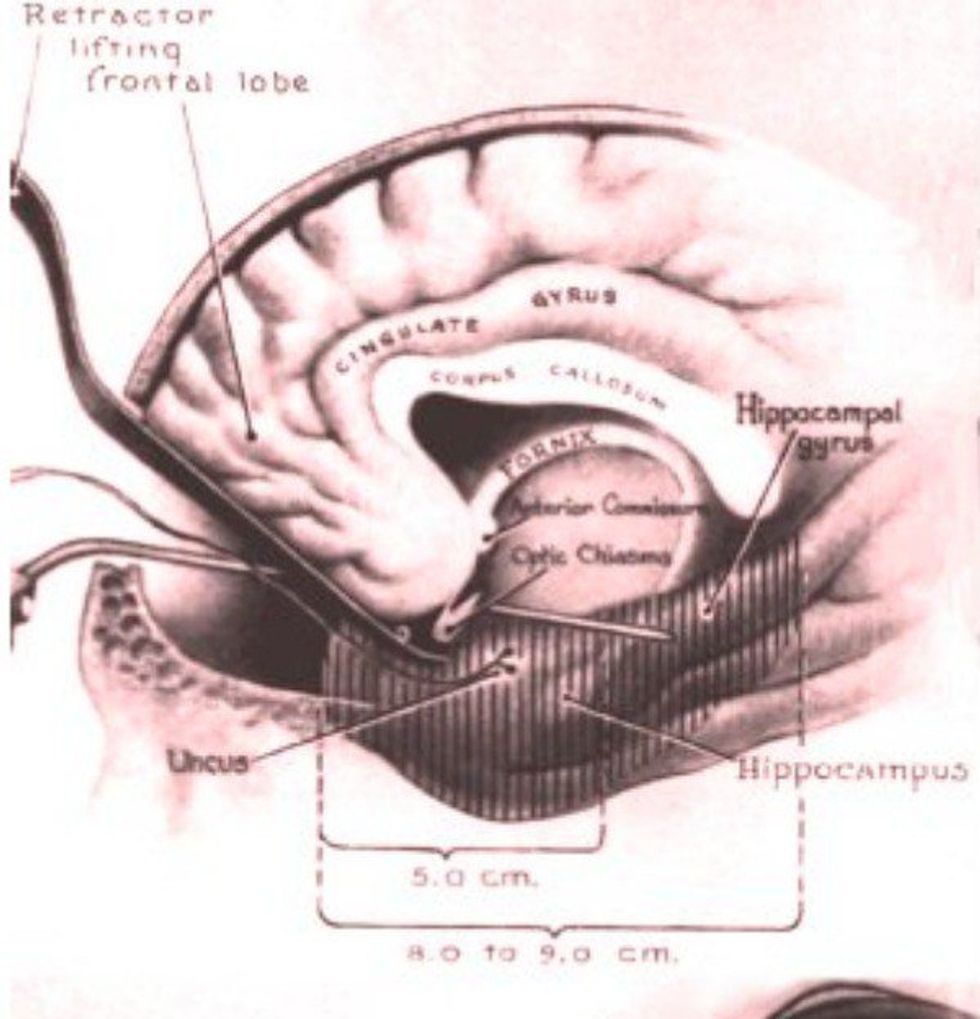
HM’s real name is Henry Gustav Molaison, he was born August 28, 1894. He had a terrible biking accident as a child left him suffering from epilepsy. At first his seizures were minor, but by the age of 16 they became increasingly severe. By the time Molaison was 27, he was unable to work. Molaison died on December 2, 2008 at the age of eighty-two from respiratory pneumonia. He underwent an operation in 1953, preformed by Dr, William Scotville, to remove the part of the brain doctors believed to be the cause of the seizures. Dr Scoville performed a surgery called a bilateral medial temporal lobe resection. This involved removing a part of Henry’s temporal lobe, including parts of the hippocampus and amygdala, from both sides of the brain. The hippocampus is responsible for short term memory storage and is important in the making of new memories. Mollison developed severe anterograde amnesia shortly after the surgery. He could only remember things that he had already learned or knew. He could tell you about his childhood and about his family but he couldn’t store new facts or faces.
Molaison’s procedure furthered our understanding of learning and memory. Dr. William Scoville decided to preform the surgery even though there wasn’t any evidence showing focal damage or abnormalities. Some of the factors that played in Scoville's decision to preform the risky surgery were that Molaison’s seizures disrupted his daily life drastically, the anticonvulsant medications’ couldn’t bring the seizures under control or preventing them from progressing, the likihood that the seizures MIGHT have an origin in the temporal lobes, and that the lack of seizures in a similar area lobotomy groups previously preformed by Scoville and colleagues.
HM was only one of two cases out of the two hundred-and-thirty cases that developed memory problems after the removals of varying degrees of medial temporal lobe. He and his team of doctors could not have begun to imagine the advancements that would preserve his brain nor the advancements in neuroscience that would come from his operation.
The procedure that HM received is not longer preformed today due to the the severe risks that it brought about. There is one similar called a Temporal Lobe Resection in which the brain tissue in the temporal lobe is cut away to remove the seizure focus. The surgery today has more advanced tools that make it safer to be preformed due to advanced brain imaging and a detailed knowledge of the brain.