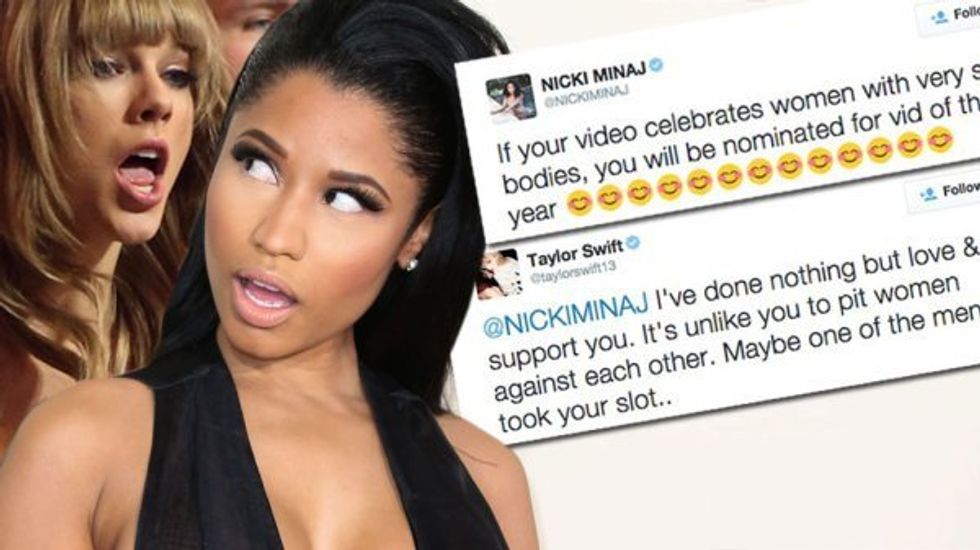
There was recently controversy regarding a lack of a nomination for Nicki Minaj's "Anaconda" music video for the VMA’s. In a tweet, Nicki Minaj made a statement about racial bias as well as the unrealistic and unfair expectations of women's bodies in the media, stating "if your video celebrates women with slim bodies, you will be nominated for vid of the year." Taylor Swift, who was nominated for her "Bad Blood" music video, took this as a direct attack on herself, assuming a connection between the tweet and her own skinny frame. Swift responded with her own tweet, saying, "I've done nothing but love and support you. It's unlike you to pit women against each other. Maybe one of the men took your slot."
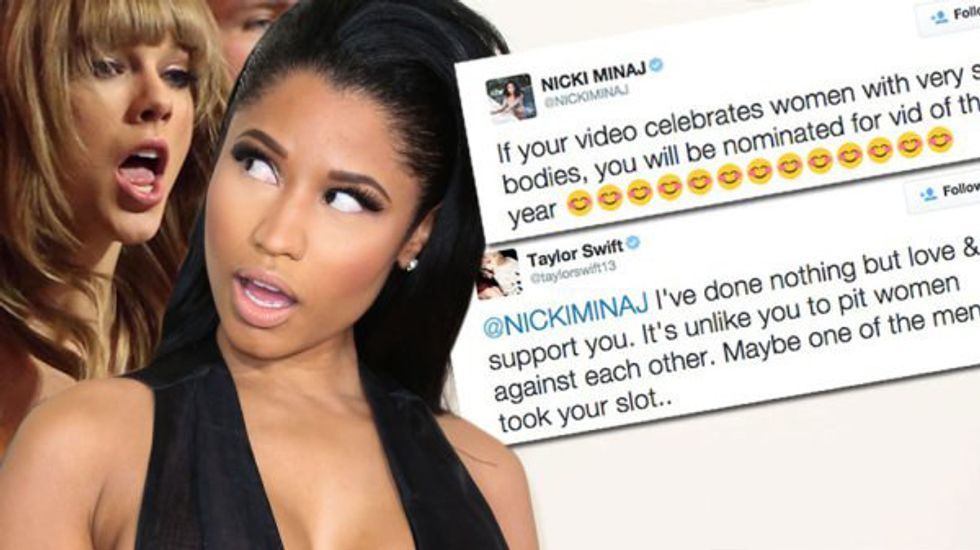
[Photo via okmagazine.com]
Since the issue occurred earlier this week, Nicki and Taylor have publicly stated that they have made up and all is well between the two; however, the issue sparked several discussions in regards to the media, race, and women's bodies, among other problems with today’s society. What I think is important to focus on and take away from this particular celeb argument is that we should be building women of all shapes and sizes up, not down. Nicki made a valid point; curvy women are not as respected or represented in the media as skinny women are, which, most of the time, exist solely to be over-sexualized for the benefit of sales or commodity.
Need an example? Look no further than Instagram’s recent new removal of the hashtag "curvy," their reasoning behind this being that there is a lot of explicit content on their service associated with that hashtag. All the while it is still perfectly acceptable to search for "skinny." This ban of the hashtag created major controversy online, and has since been reversed, but the original actions still stand as a reminder to the perspectives associated with certain ideas of body image.
Pitting the curvy women against the skinny is not a new concept. Several hit songs in the past few months have contained content that supports curvy women, while seemingly bashing skinny women. Examples being Nicki Minaj’s “Anaconda,” where she repeats the line “f*ck them skinny bitches” several times over, as well as Meghan Trainor's “All About That Bass.” The argument justifying these songs in most cases is that there is not nearly as much cultural backing of curvy women as there is for skinny women. You can walk into any store, look towards pretty much any outlet of media, and find examples of skinny women. You have a much harder time doing so with women of more curvy figures.
Regardless, in order to make a real impact with the way ALL women are portrayed in the media, they must all work together to change it, and treat all body types as body positive whether skinny or curvy. United, so much more can be accomplished towards equal representation and a better future for the women of tomorrow and their perspectives of themselves.
[Photo via tumblr.com]
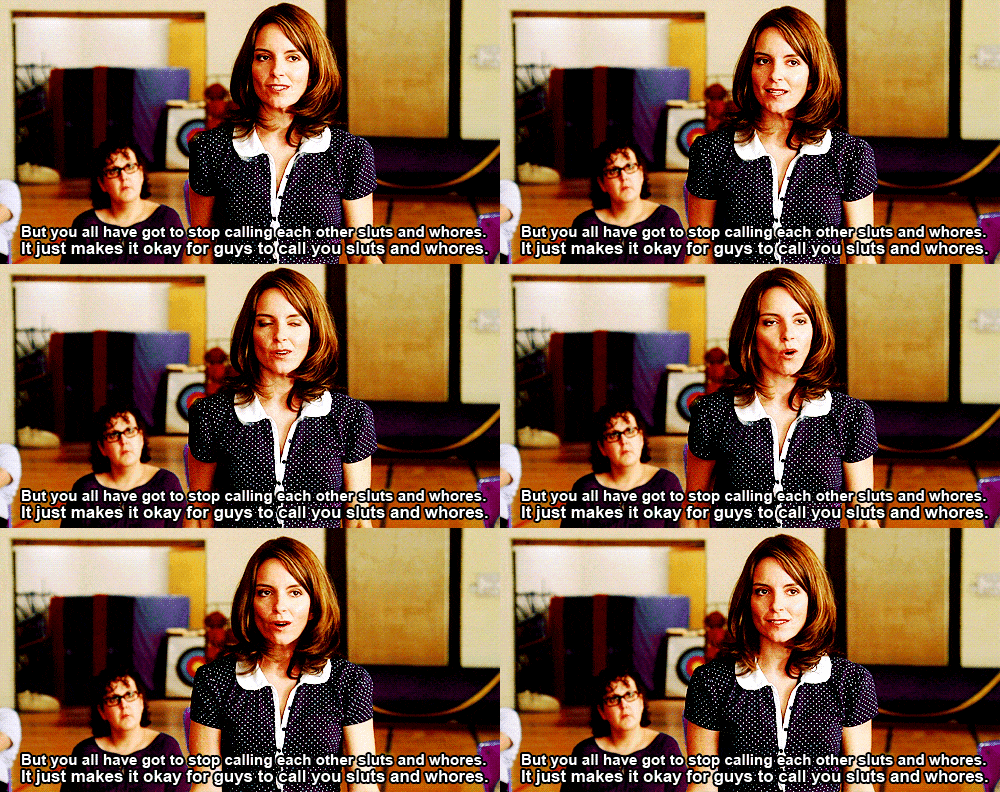
It’s like what Ms. Norbury from the movie “Mean Girls” said: “You’ve got to stop calling each other sluts and whores, it just makes it okay for guys to call you sluts and whores –” how can women expected to love their bodies, and be respected for loving them, when different body-typed women are battling it out amongst one another instead of towards the media?
It’s women’s job to turn the tables on the media for acceptance of who they are, make our society understand that each and every woman is beautiful and fabulous for exactly who and how they are, and that they will not allow any form of representation to change that.