


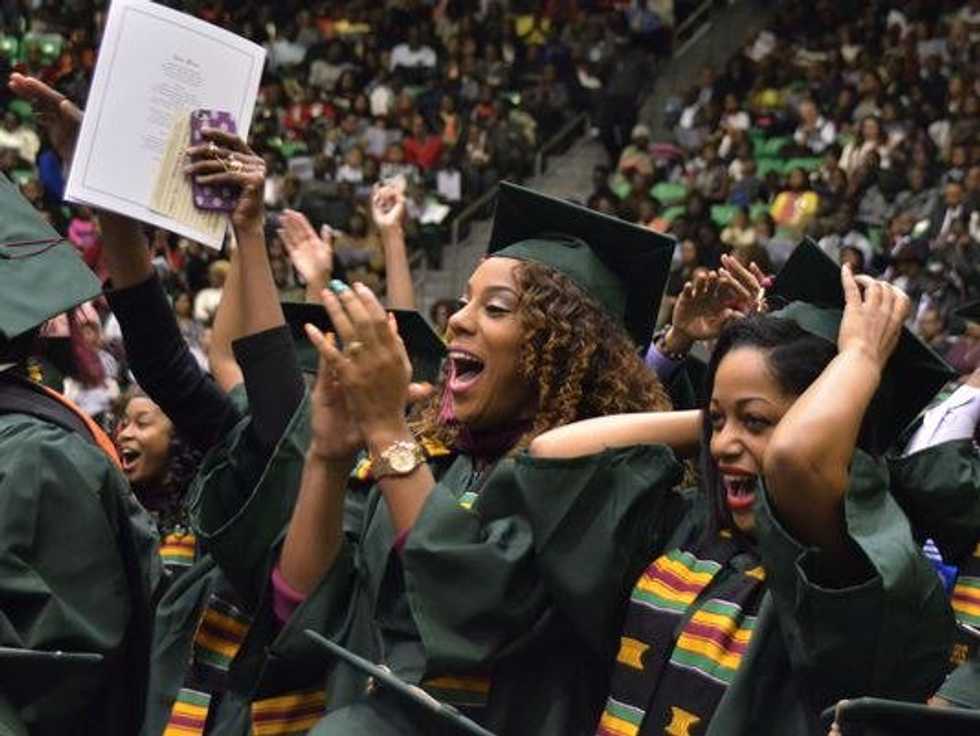
“If we have the courage and tenacity of our forebears, who stood firmly like a rock against the lash of slavery, we shall find a way to do for our day what they did for theirs.” – Mary McLeod Bethune
Knowledge is power, and one knows the way to obtain such power is through higher education. A large and fast-growing majority of degrees earned by African-Americans have been earned by black women. In 2004, black women comprised 59.3 percent of all first-time, full-time black students attending four-year institutions, compared to 54.5 percent in 1971 according to the results of a study conducted by the Higher Education Research Institute at UCLA’s Graduate School of Education & Information Studies. The study also displays that black women attending both historically black colleges and predominantly white institutions were more likely than men to enter college with “A” averages.
Fast forward to 2015. In order to get a job that pays well, the minimum requirement is a bachelor’s degree. According to the Journal of Blacks in Higher Education, black women currently earn about two thirds of all bachelor's degrees awarded to African-Americans, 70 percent of all master's degrees, and more than 60 percent of all doctorates. Black women also hold a majority of all African-American enrollments in law, medical, and dental schools. At the undergraduate higher education level, the latest Department of Education figures show that black women account for 63.6 percent of all African-American enrollments.
The progression of higher education among African-American women is essential for the development of black communities. African-Americans have to continue motivating, engaging and assisting our young women to reach their highest potential. Two percent of African-American women are represented in science, technology, engineering, and mathematics, or STEM fields, while women in total make up less than 25 percent of the STEM workforce. Black women earned more than half of all science and engineering degrees completed by African Americans— surpassing their male counterparts. Of course the STEM workforce is not the only field African-American women excel in; they are performers, athletes, caregivers and teachers too. When you educate one black woman, you’re educating hundreds of black children. The only way the statistic will rise is if black women pursue higher education. Even the First Lady of the United States, who happens to be African-American, is a Princeton and Harvard graduate.
Due to the educational gap and socioeconomic conditions of black communities, the focus to ensure the progression of black women in higher education should be placed upon achievement, self-awareness, communication, engagement, and networking and developmental skills. Each focus area acts as a guide to maneuver the students towards their journey of higher education. Substantial support has to continue to be given in order for the statistics to rise. Educated black women are needed; it's essential to plant the seed of knowledge and water it with the ascension of self and support, and in due time a flower from concrete will excel and reach higher.

















