
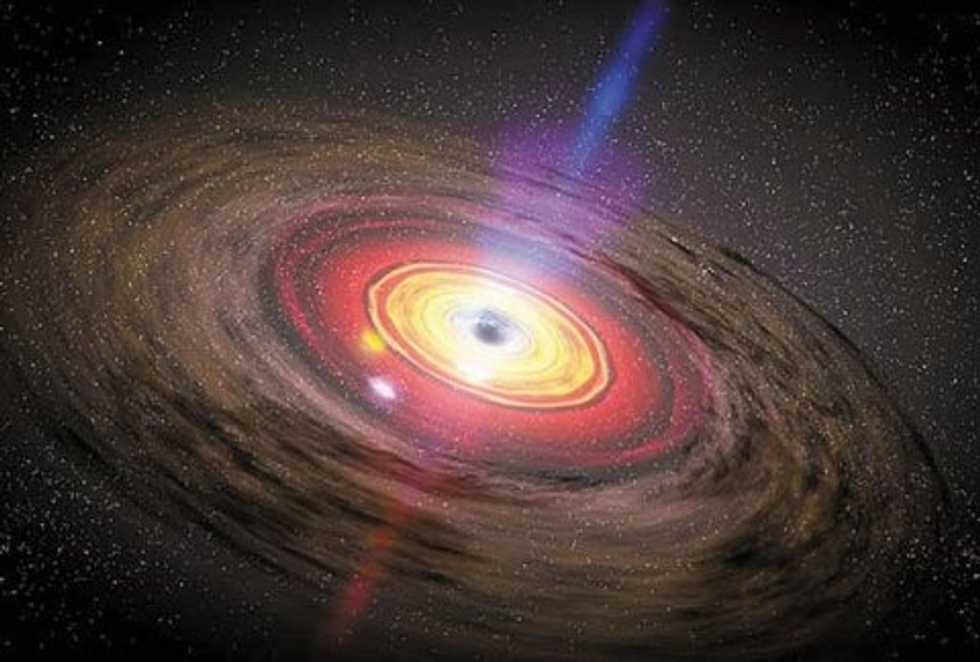
A favorite of science fiction and a cosmic wonder to scientists, black holes are one of the most puzzling and fascinating things our universe has to offer. Simply put, they are the second phase in the life of a star after its initial death. When a star’s core becomes too massive to withstand its own gravity, it implodes and shrinks, concentrating all of its mass to that lesser area. Well, black holes are dead stars compressed to such a state that not even neutrons (a part of an atom) can stay intact. They seem almost too strange to be real, and to this day, we still are unable to go exploring for the real facts and must make guesses as to what goes on inside a black hole. There are however a few things we have been able to figure out, and they’ll probably blow your mind.
1. It is believed that each galaxy contains at least one supermassive black hole at its center.
And yes, even our galaxy has one – Sagittarius A*! It’s estimated that about 100 million black holes reside within our galaxy, but we have only found a handful of them thus far. Who knows how many are really out there, or even what else is out there, if black holes — impossible as they seem — exist?
2. Spaghettification – not as fun as it sounds.
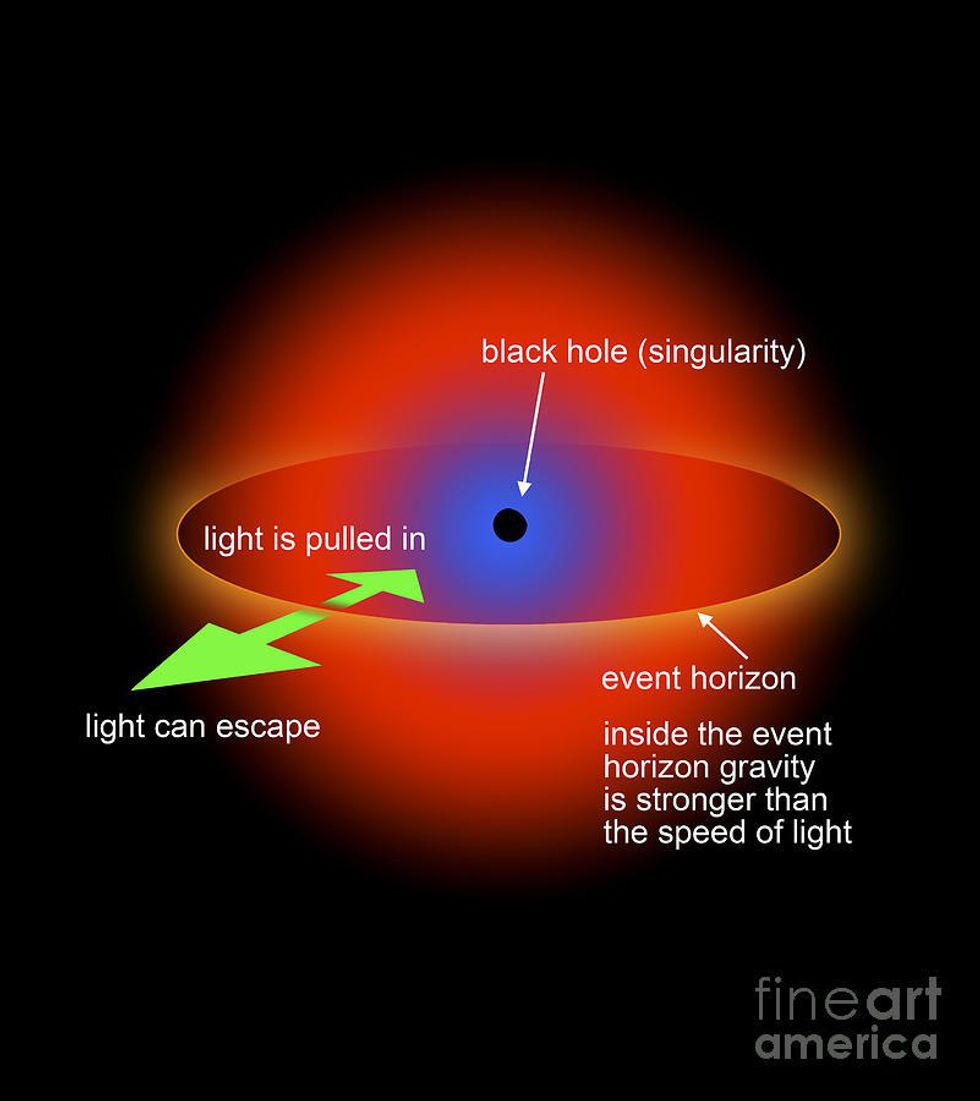
Theoretically, traveling to a black hole, once reaching the event horizon (the point of no return), you would be stretched into pieces by tidal gravity, starting with whichever part of you is closest to the black hole. This is referred to as “spaghettification”, a term coined by Neil Degrasse Tyson. But to an outside observer, you would simply appear to be frozen there forever.
3. Albert Einstein predicted their existence.
Years before the first discovery, with his theory of general relativity, he speculated about small and very heavy (concentrated mass) stellar objects that could bend the fabric of space and time into a bottomless hole, though he personally didn’t believe they could be real.
4. Resolving the mystery of the singularity could help us understand how the universe might have come to be.
At the center of a black hole, gravity and density are infinite and time stops. Essentially, space no longer makes sense. This is called the singularity. The laws of physics can’t predict anything about a singularity – this is the complete unknown. There are only two places in nature where singularities occur: the center of black holes, and the beginning of time — the Big Bang.
5. We can’t actually see black holes.
Instead, we locate them through their interactions with other interstellar objects. X-ray images can reveal large objects orbiting, being sucked into or heated up by a black hole.
6. Not every star has what it takes.
Only extremely massive cosmic objects (~25 times heavier than our Sun) have the potential to become either neutron stars or black holes in their death. In fact, only about one out of every 1000 stars that forms is large enough to become a black hole.
7. There are two types of black holes:
Stellar-mass and supermassive. They can be categorized by their mass, how fast they spin, and their electric charge. If two black holes met, they would violently merge, sending ripples called gravitational waves through space-time fabric of the universe.
8. Time isn’t the time around them.
The thing about time is that it is all pretty relative, and it’s affected by gravity. Since the gravity near a black hole is very intense, a minute by the event horizon would be something like a 1000 years back on Earth.
9. They will outlive us all.
The lifespan of our universe is said to be billions and billions of years, however over time, eventually objects like planets, stars, comets, and all sorts of other cosmic objects be disintegrated into tiny particles. Theoretical physicist Stephen Hawking suggested that black holes can eventually evaporate, but it would take an incredibly long time - trillions and trillions of years. At some point, black holes may be the only things left in our universe.
In conclusion, black holes defy the laws of the universe and despite our attempts to understand and explore them, they will likely forever remain a mystery. Anything that gets too close will never come back – and the truth is, we have no idea where they really are going. Space is totally wild.