It's 1:22 a.m.
Grief that I've never felt before had burdened my everyday life. Each night as I lay my head down to sleep, I think of the fallen. I think of the way their eyes will never again open, the way their children will never again hug them, the way their families will never again laugh with them and of the way this world spins on without them.
I've lost sleep over my lost sisters and brothers, but still there are people telling me not to think about it as if their blood was a sacrifice to a vengeful and thirsty god--as if their deaths would make the rain come and all would be well in the morning.
After Michael Brown, I kept moving. After Tamir Rice, I stumbled, but kept moving. After Rekia Boyd, I needed to rest, but kept moving, knowing that the only way to get better was to go forward. But as I mourn for Alton Sterling, traumatized from the picture of a knee and gun holding him against the ground, I come across a video. I immediately see a Black man slumped in a car seat, red spread so far up his shirt that it looked like it was meant to be there. I see him struggling to breathe, his eyes gazing into the distance. Instinctively, I know he is dying.
I close the browser faster than I've done anything in my life.
My heart beats loudly in my chest and I am acutely aware of my Black heart thumping, thumping, thumping, and I am acutely aware of the Black heart no longer thumping, thumping, thumping. Shaking, my hands reopen the browser and search for details on this man's murder. I find reports of his toddler comforting her mother from the backseat. I find reports of the mother being paraded before a machine gun held tightly against her back.
Just when I think I can take no more, I see an article my sister posted. Days after a KKK rally in Piedmont Park, Atlanta, Georgia, a Black man was found hanging in a tree. The sound of breaking glass filled my ears as my facade fell to the ground. The grief I'd been holding behind a thick wall of scar tissue broke its bounds and flooded my eyes. Tears fell from my eyes and each tear had a name and a story to tell.
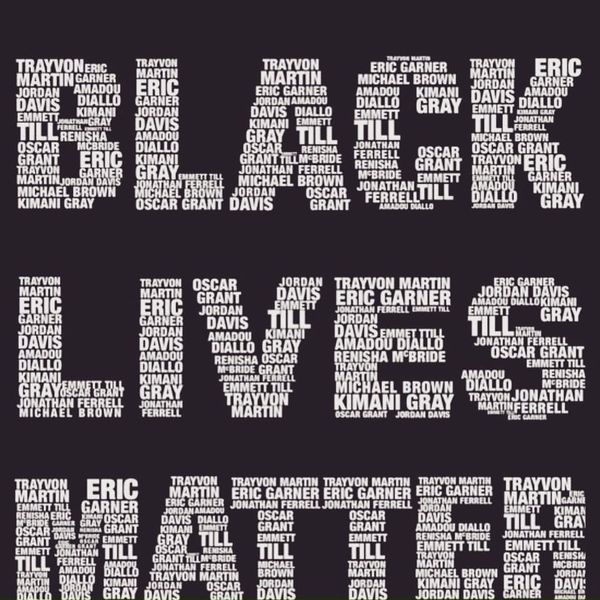
I am irate, I am devastated. Lying in bed, I feel, more than anything else, helpless. I feel like a girl forced to her knees under the weight of the world. Immediately I begin searching for protests, for government action, for GoFundMes and analyses of the murders. I look for sense in the madness and realize with a sinking feeling in my gut that this was not senseless, it was systemic, that these murders will be given no more consideration than Trayvon Martin's.
A day later I get reports that another Black man has been killed, except he was killed after he was found sniping officers in Dallas, Texas that had been protecting protesters. A rare occurrence happened: Black officers stormed social media with grief and frustration, expressing their disgust with the murders perpetrated by and against police. I was stunned by these people caught in the middle who had remained silent for so long. Whether for better or for worse, I was glad they stepped out, spoke up.
Their testimonies left me with more questions than answers. First off, why did the media show the shooter in a dashiki with his fist up instead of the shooter's military picture they originally posted? Secondly, why was a bomb sent to the shooter of five on a robot when the Colorado shooter of twelve is allowed to walk himself to a squad car? Thirdly, where were these officers when Sterling and Castile were killed? Why did it take a man targeting their profession to convince them they needed to stand up?
As the days passed, I became increasingly disgusted with the Dallas coverage. While the nation's media largely glossed over the deaths of Sterling and Castile, they sensationalized and headlined the Dallas shooting. I couldn't even mourn the regrettable loss of life in Dallas because everywhere I turned, there were people using their deaths as a reason to ignore and discount the deaths of the two Black men (and the 134 deaths in 2016 before them).
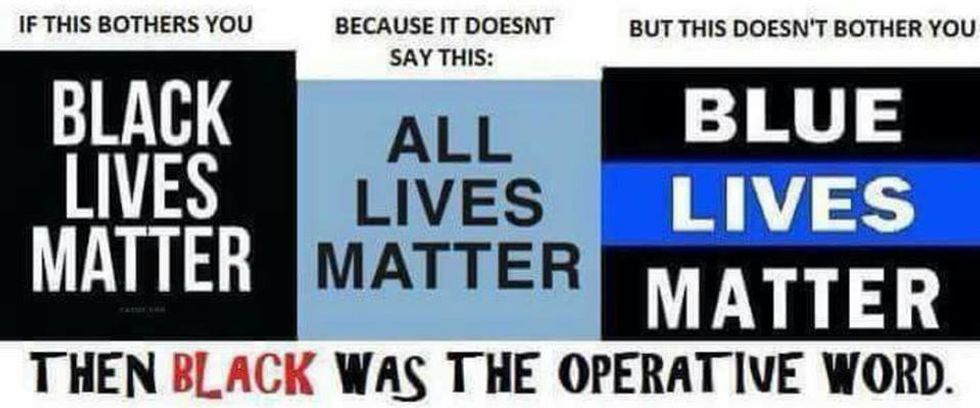
There have been 19 police officers shot so far in 2016--compare that to 136 Black deaths that have come under scrutiny at the hands of police. Suddenly more of my friends became wary of Black Lives Matter, a group that was in no way affiliated with the shooter, and posted Blue Lives Matter instead. As if we didn't know that police lives, an optional occupation, mattered. We teach our children to give officers respect without question. We tell the nation that our police are our heroes. In fact, according to the narrative we preach, blue lives matter more.
Lately, all of my energy has been poured into attempts to explain and justify complex social theory that I am in no way qualified to be teaching. Any time I set aside for mourning and just reflecting on what needed to happen was spent desperately trying to convince people that Black Lives Matter is not bad, that Black Lives Matter is necessary, that something in this country has got to change.
Never have I encountered people so ready to take unsourced statistics out of context or so unwilling to believe government sourced facts presented to them. People I went to school with are suddenly telling me that we, Black people, can't protest about police brutality when there is "black on black" crime. They tell me that systemic racism isn't real because random statistics they don't understand show that Black people don't get killed in larger numbers than other ethnic groups, completely forgetting to adjust numbers into ratios or take into account the span of time we've been getting murdered by police in a systemic way--completely ignoring that for half of the country, the origins of the modern police force was from the Slave Patrol.
They tell me my grief is unfounded.
Their statistics are unfounded. I quote FBI reports--they don't quote anyone.
Their beliefs are unfounded. We can trace the system of police brutality back to 1704 and back to 2016 again. The systemic nature of American racism has been proven by scholars time and time again.
Their resistance to a movement pleading for human lives to be treated with dignity and respect is unfounded.
We the People will not tolerate this system of brutality, this blatant disregard for human lives, this decision that some lives are worth more than others, this belief that some are worth less. If you truly believe that all lives matter, then you should be making sure the Black ones do too. Because if Black Lives Matter offends you, but Blue Lives Matter doesn't, then Black?
"Black was the operative word."