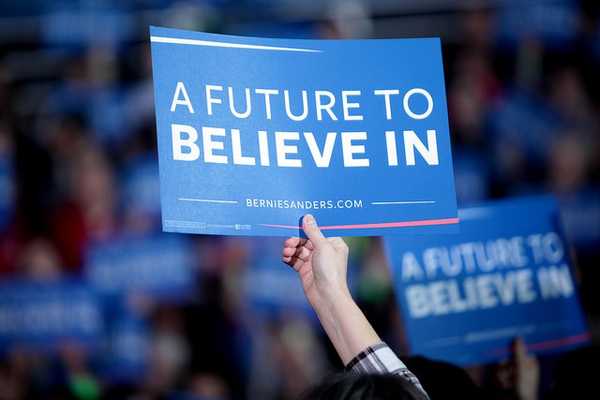
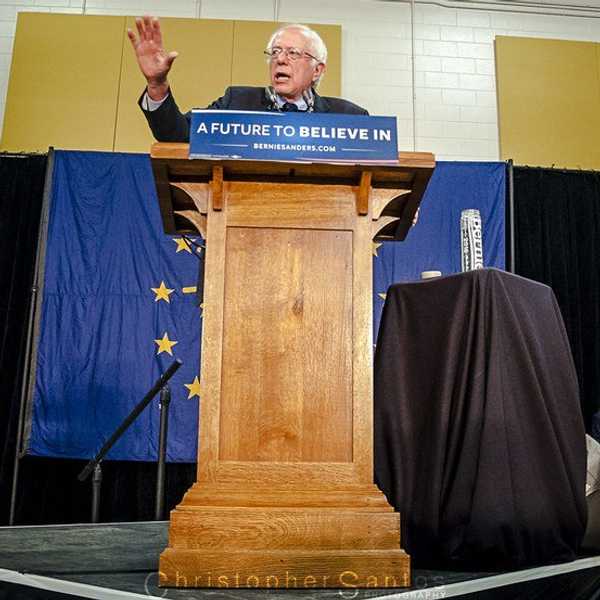
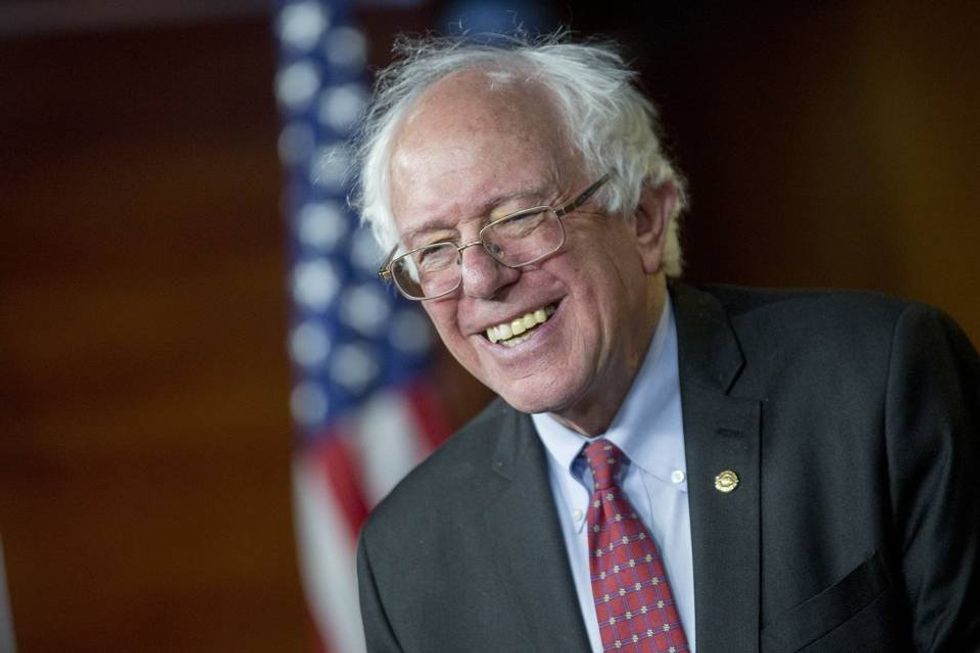
Though 74 years old himself and a member of an increasingly important and large demographic group (40+ years old), it is no secret that Senator Bernie Sanders appeals to and relates to millennials and college students like no other candidate running for president in 2016. Exit polls in New Hampshire (Sen. Sanders' strongest win to date) showed him winning 83 percent of voters between 18-29. That is an amazing number considering most candidates are lucky to win even 40-50 percent of any given demographic group.
So what is it about Sen. Sanders that makes him attract young voters on such a huge scale? Would his policies work? Does he have a realistic chance of still winning the Democratic nomination for president? These are the questions I intend to answer.
Young Americans are naturally more left-leaning and idealistic than their elders. When we're young, we believe we can be anything and achieve anything. Many times, though not always, as people get older and acquire more experience in life, they become more conservative and realize that is not always true. We're not all going to be millionaires, or have our dream job and house, or live the dream life that we envisioned for ourselves.
This generation of millennial voters has been through a lot, though. We are old enough to have witnessed the Great Recession and the hard times it brought to some of our lives. As the cost of attendance at universities continues to grow, college students take on more debt to get through their undergraduate and graduate degrees. Many of us are scared for the future and our ability to get jobs to provide for ourselves and our families, and pay off that debt that we have accrued.
This is the sophisticated reason for the millennial support for Bernie Sanders. I believe there are, for lack of a better term, dumb reasons why some are supporting Bernie Sanders. Much like Barack Obama in 2008, Sen. Sanders has become a bit of a pop culture icon among young people. Everyone remembers the posters and songs about Obama, right? Fast forward eight years, and we have dank Bernie Sanders memes. While I would like to believe his supporters have a deep understanding of his policies that don't have to do with free college and legal weed, I can't believe that in good conscience.
But would Mr. Sanders policies work? According to many economists (who are left-leaning), Sen. Sanders policies are wishful thinking. Hillary Clinton estimated Sen. Sanders plans would increase the size of the federal government by 40 percent, but many respected economists believe it could climb even higher, even over 50 percent. They note that Sen. Sanders single-payer health plan could cost twice as much as what he has proposed. A fact that many don't know is that single-payer health care modeled on European nations has been attempted once already in the United States, albeit in only one state, Vermont, ironically enough the home of Bernie Sanders. But unfortunately, it failed—as Governor Peter Shumlin admitted—it would cost too much and be too much of a tax burden on residents and businesses.
So, if it failed already on a small scale, with a mostly homogeneous population with roughly the same ideals and values, why exactly does anyone believe that it would work on a huge scale, in a country like the United States with so many different groups with varying beliefs and lives? We have all seen the struggle to get Obamacare passed and part of law with overwhelming Democratic support. Sen. Sanders seems to believe he can remake a quarter of the nation's budget with Republican and Democratic opposition. Excuse me if I don't believe it.
Single-payer health care also does not work as well as some seem to think it does. A 2014 study found that wait times for medically necessary treatments are already bad and getting worse over time. 90 percent of the population of Canada is within driving distance of the U.S. border, and many Canadians come to northern U.S. cities to get treatment for this reason. Studies done in Scotland where they have socialized medicine also came to some interesting conclusions. They found that you were much more likely to die of diseases like cancer if you lived in Scotland rather than the United States. So while we like to talk about the broken health care system in the United States, we are still better off as a whole than essentially every other country in the world.
As far as free college tuition goes, there is also something Sen. Sanders is not admitting on the campaign trail that can be found in his actual plan, which probably most of his supporters have not read. Over the last 15 years, states have continued to cut higher education spending in favor of goals like increased Medicare and K-12 spending. Sen. Sanders' plan is based on the idea that states would pay for roughly a third of college tuition while the federal government would pay for the other two-thirds. Many states will almost assuredly not be willing to pay for this, as currently states only have to pay a ninth of the cost for increased Medicaid and yet many still refuse to do it. If they won't pay a ninth, what makes Sen. Sanders think they will pay a third, a much higher fraction of the cost?
Sen. Sanders' plans could also add $2 trillion to $3 trillion a year to the federal budget, which could make the total budget somewhere around $6 trillion to $7 trillion a year. Spoiler alert, the United States does not take that much tax money in every year. This means our $19 trillion and counting national debt would grow even faster. Mr. Sanders likes to talk about saving the planet for future generations, which I agree is an admirable goal. But saddling them with unimaginable amounts of debt seems just as likely to hurt them, at least, to me.
I won't argue with Sen. Sanders that if his plans somehow got implemented (they would not) that the average American family would save some money. Health care is expensive, we all know that. But my personal view is that I won't sacrifice future generations' financial well-being to save myself some money in the present.
The last question I want to answer is whether Bernie Sanders still has a realistic shot at winning the Democratic nomination for President. In short, no. Because of a dysfunctional Democratic convention system that overwhelmingly supports establishment candidates, super delegates are decidedly in favor of Hillary Clinton at a roughly 18-1 rate. So, while the delegate count seems close with only a difference of 300 as of March 25, it's really a difference of 746 when including super delegates. Even if Bernie Sanders wins delegates at a 58 percent rate (roughly what Mrs. Clinton has achieved so far) he could still only tie her, and with her decided advantage at a convention, Mrs. Clinton would still win. So while Sen. Sanders can continue to pull the rhetoric to the left, there seems to be no path left to the nomination for him.