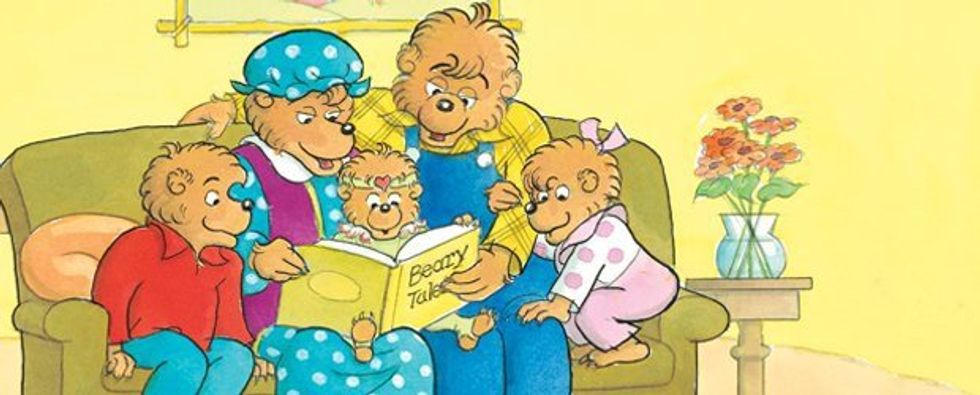
There are a lot of books that I remember reading as a child before my "Harry Potter" and "A Series of Unfortunate Events" days. They were kid's books such as "Goodnight Moon," "The Very Hungry Caterpillar," "Rainbow Fish," "If You Give a Mouse a Cookie," and so many more. But there is only one children's book series that has been on my mind lately: "The Berenstain Bears."
How did you pronounce the bear family's name when you were younger? Or if someone else read the book to you, how did they pronounce it? Don't answer that. I can't hear you. But just think back to when you read the series, if you did, and try to remember how you thought the name was spelled.
If you remember the name as “Berenstein,” with an E towards the end, you're wrong. Sorry to tell you. Don't worry! You are not alone in thinking that. Nearly everyone remembers "The BerenstEin Bears," not "The BerenstAin Bears," Even I remember, quite vividly, pronouncing it with an E and even imagining it being spelled with an E. Yet the books are clearly printed with the name "The Berenstain Bears," with an A, which should make sense, considering that the authors' last name is Berenstain. So why do so many people misremember the name? Well, in 2012, a blogger by the name of Reece came up with a chilling explanation: that we are living in our own parallel universe.
According
to Reece's theory, there are two universes parallel to each other.
There is the one we are living in now, in which the name is spelled
with an A, and another that exists parallel to ours, in which the
name is spelled with an E.
If
you are a fan of science fiction, the idea of parallel universes is
probably not foreign to you. In case it is, just think of the
possibility of there being multiple universes that can exist parallel
to each other – meaning, there could be another version of Earth in
a different universe that is almost exactly the same as our Earth,
down to the minuscule details. But there could also be some minor
differences on this other Earth. For example, instead of a college
student, I could be a
best-selling author on my second book tour in the parallel
universe. On that Earth, something happened – maybe I made a
decision or an opportunity was given to me – that did not happen in
my life here, that changed the course of the rest of my life. But on
this Earth, I did not make that life-changing decision or that
opportunity was not given to me, so I am but a measly college
student.
Now, getting back to the books. One of the minor differences could be the spelling of this bear family's last name. It is in some other parallel universe that the books are titled "The BerenstEin Bears." Reece believes that we were all in that universe in the 1990s. At some point, we switched over to our current universe, in which the books are titled "The BerenstAin Bears." We think of the name as being spelled with an E because we have retained our memories from the original universe.
Basically,
the theory is using parallel
universes to explain why so many people collectively remember it
being spelled one way, when it is really spelled another way. As much
as I would like to believe that parallel universes exist, I do not
think that this conundrum is evidence of their existence. It is
simply an example of “
The Mandela Effect,” a phenomenon in which
many people misremember the same detail. The phenomenon is so named
because a lot of people believe that Nelson Mandela died in jail in
the 1980s, when he, in fact, did not. He actually died
recently, just two years ago.
In
my opinion, what we have here is also a testament
to the
imperfect human brain.
The ending -stein sounds much more familiar to us, especially in a
last name, than the ending -stain. So
even if we read Berenstain, and we can see the A, it still might
register in our brains as Berenstein, because it sounds better. Now,
15 or so years after reading those books, we remember the name
Berenstein, because that's just the name that we remember the clearest. And sometimes we're wrong. We're human like that.