Given the state of drought that California is currently in, it’s only natural that people are discussing the scientific issues behind it: how much water per capita is used on lawn care, statistical data on agriculture and its inefficiencies, and of course, our overall carbon footprint. This palpable discourse of scientific enterprise, intermingled with ethical debate, and the facilitation of that discourse via new social media technology (you can carry all of it around in your pocket) means that the facts of the matter are adequately available. That is, it would be difficult to claim ignorance in the matter of water use when it’s thrown at you every time you access the capital “M” Media. Anyone who doesn’t know the facts can easily acquire them. Therefore, it is not my purpose in this article to persuade anyone of anything based on statistical matters of fact. What I mean to discuss is a simple idea that may give us a softer solution to the problems arising from water use in landscape maintenance – namely, natural landscaping.
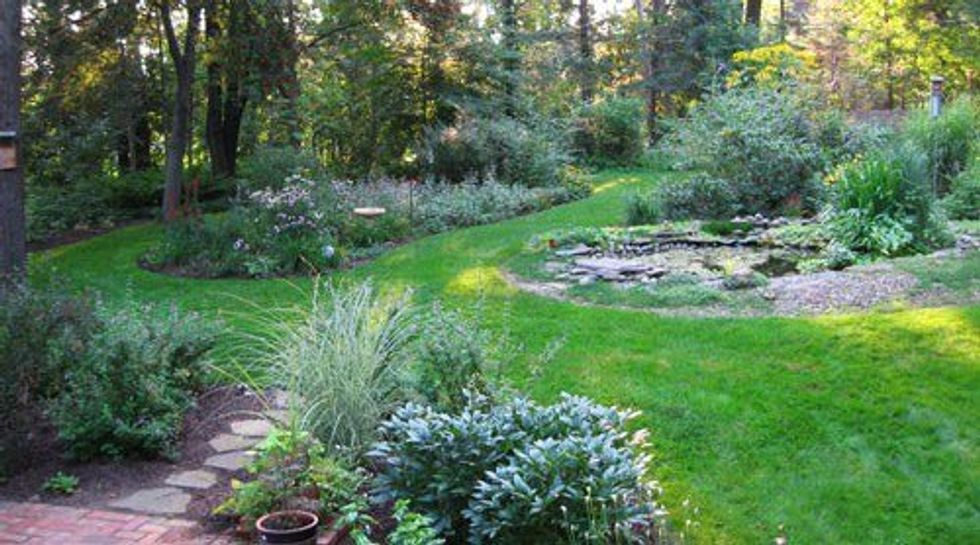
What is “natural landscaping,” you ask? Quite simply, it’s the use of native plant species in landscaping. Why should it be considered superior to traditional lawn care methods? For one, it requires far less water – in fact, if one were to create an entirely native ecosystem in their backyard, why would it even need a substantial irrigation system when the flora you’ve planted has been conditioned and adapted to survive in your particular area for thousands, perhaps millions, of years without the support of artificial irrigation systems.
Another point to consider is the logistical impacts of shipping large quantities of non-native plants to nurseries. Raising the plants themselves obviously requires a substantial amount of water, but there is also the question as to how much unnecessary carbon emissions are being released through the transportation process.
Now, I do not wish to disenfranchise nursery owners – I merely mean to suggest that stocking native plants in nurseries has the potential to be far more economic for the owners themselves as well as for the consumer. Selling local plants means local harvest and therefore reduced shipping time and cost. By purchasing shipments from local enterprises, you are also supporting local infrastructure (buy local!). Of course, plant nurseries will likely need some irrigation to prevent drought from destroying their assets – but even so, with plants conditioned for natural rain patterns, it is also likely that they will require less artificial irrigation to begin with.
Most importantly, however, are the ecological benefits. Fauna relies on flora in an important way. Bees and other pollinators need flowers to thrive. These particular ecological functions are critical for a healthy ecosystem. Imagine the detriment if there existed massive gaps (large cities) where the system that has been in place for countless ages is disrupted by non-native plants, not to mention the alarming disappearance of bees.
Following the famous words of John Muir, that “everyone needs beauty as well as bread,” we should consider the aesthetic benefits of natural landscaping. A movement to work with the environment in this fashion would allow us to celebrate our physical world in a new way. Having locally natural elements present along your commute to work or your afternoon walk may not only improve your mood, but give one pause to consider the intricate, underlying phenomenological aspects of the physical world, those aspects which are only indirectly captured by artificial structures (e.g. planted lawns, artificial landscaping, etc.). Surely this would be preferable to the gray din of the sidewalks, streets, and all-too-meticulous white picket fence lawns.
Native plants throughout urban landscapes could also result in a more seamless transition from the “natural world” into the urban one. For instance, wouldn’t you feel more connected to the natural environment if you were surrounded by it, if you in fact lived in it and not merely a manicured representation of it? Think of how our children might benefit from growing up in a world where the majority of people interacted directly with their physical environment, without having to drive to the city limit. “Nature,” in other words, could be not merely something “out there,” but harmoniously and to our mutual benefit, interconnected with artificial structures. Additionally, architectural designs stand to benefit in a similar manner, but that is another discussion entirely.
Perhaps the greatest advocate for this sort of wild landscape appreciation comes from the Victorian poet, Gerard Manley Hopkins, who asks us, “What would the world be, once bereft of wet and of wilderness? … Long live the weeds and the wilderness yet.” (Inversnaid, 1918).
For more information on how you can start your own natural landscaping project, you can consult the following sites:
http://findnativeplants.com/plains/montana-native-plants/
http://www.nrcs.usda.gov/Internet/FSE_PLANTMATERIALS/publications/mtpmcpunatland.pdf