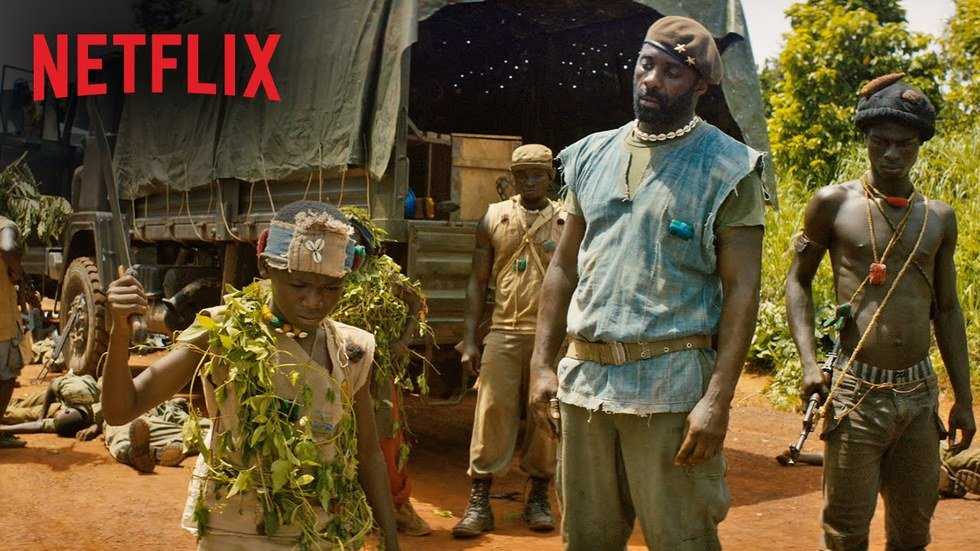
"Beasts of No Nation," a Netflix original film, has been available to stream since Oct. 16. Perhaps it is too late to write a review of this film, but I do so anyway because I doubt very many people have watched it. Why would you? Doubtless on those occasions when you have enough free time to watch a movie, you’re looking for something to entertain you, to rejuvenate some of the energy spent during the week.
"Beasts of No Nation" does not do those things. It is an unyielding story about child soldiers in a West African state shredded by civil war.
A hallmate walked in on me while I was in the middle of it and asked me if I was enjoying it. “No…” I said, “But it is very good.” In a film about senseless killing and the spoil and callous rape of youth, I find there is little enjoyment to be had. What there are, however, are a lot of things to get right. So, let’s segue to where "Beasts of No Nation" is successful.
The cast mostly consists of solidly performing “non-actors,” with the standout exception being Idris Elba, whose brand convinced me that the movie was worth eschewing a few hours of calculus homework. He mostly earns that trust (as an actor) throughout the film. He plays a bombastic, charismatic, and somewhat unhinged platoon leader who inducts Agu into generic freedom fighter group number 127 after the slaughter of the latter’s family at the hands of rebels. Agu is played sparingly by Abraham Attah, who is hands down the true star and center of this story. His performance is small, personal, simmering, and plays very well next to Elba’s sometimes overly exuberant one.
The scoring is equally subdued, consisting mostly of gradually mounting waves of synth sounds that swell between the audience and the images on screen, serving to subtly enhance the sense of alienation as Agu becomes something other than human. It is hardly the emotionally sweeping soundtrack one might expect of a film covering such emotionally packed subject matter. Instead, director Cary Fukunaga lets that subject matter, and what transpires in the story, speak for itself.
The voice of these events is a matter of fact one, similar to the narrative of "A Long Way Gone:" stark and crude. A human life is not even worth the cry of a violin. This is not propaganda. The primary message encapsulated within the movie is not a political one. Even the names of the various conflicting groups seem ridiculously vague, and unimportant as they’re all doing more or less the same thing. The state in which the aptly named "Beasts of No Nation" occurs is never even given a name. It makes sense that the music does not try to play with your feelings. It doesn’t indulge your expectations because it is not concerned with you. This movie does not really care how the audience feels, but about Agu, and that lends it the freedom and narrow scope to be honest, and puts the pressure of sorting through emotions on the watchers.
The location and the cinematography are exceptional, especially considering (or perhaps because) much of the camera work was done by the director himself. The film was shot in Ghana, a prima donna more troublesome and ungovernable than perhaps the biggest names in Hollywood. The filming schedule was fraught with setbacks due to the environment, but the film does not noticeably suffer. It is difficult to assign any character in the movie the title of protagonist or antagonist outside of Agu. Each in their turn are a savior in one frame and a Judas in the next. The environment is no different. It always beautiful, and rich, however, and is responsible for carrying much of the movie. It is not “overshot.” It does not interrupt. But it frames each scene with an additive quality. I couldn’t ask for more.
To wrap up with the plot, I’ll say that there isn’t much of one. "Beasts of No Nation" is based on, or at least inspired by, the book of the same title written by Uzodinma Iweala. It follows Agu from massacre to forest clearing to ruined town to killing field, one disturbing tableau after another as the main character disintegrates in front of us with Elba as his tutor and tormentor.
The purpose? There isn’t one. At least none readily presents itself. That is kind of the point. This is the story about life that struggles to preserve itself under the harshest and most unforgiving of conditions. What reason is there? It’s an age old question, one that I do not believe Fukunaga was interested in answering. From reading comments from him after forming my own opinion of the movie, I’ve decided that he more or less accomplished precisely his vision, which shows exceptional talent, skill, and temperance. Well done.
But what of a rating? Five,10, thumbs up or down? Ultimately, the film never quite feels as though it has as much impact as it should, which is likely a function of the director’s goals. There is an emptiness to it that is unsettling and deeply dissatisfying. This is not an entertaining film. You are unlikely to feel better “informed” after watching it.
If you want to watch a movie, however, that sincerely attempts and mostly succeeds to portray an unpopular version of the human experience, without expectation of answers or fulfillment, then this is the film for you. I won’t try to convince you beyond that. I do not believe the director sought a wide audience, but to make art, and to make it from the most rude and ugliest of hues.
Unlike blockbusters, it is not to be measured by its profit. It will not have been unsuccessful should it flounder. Like its characters, it is a wild thing, beyond self pity. A bold move for Netflix’s first original production.