“Are you liking war?”
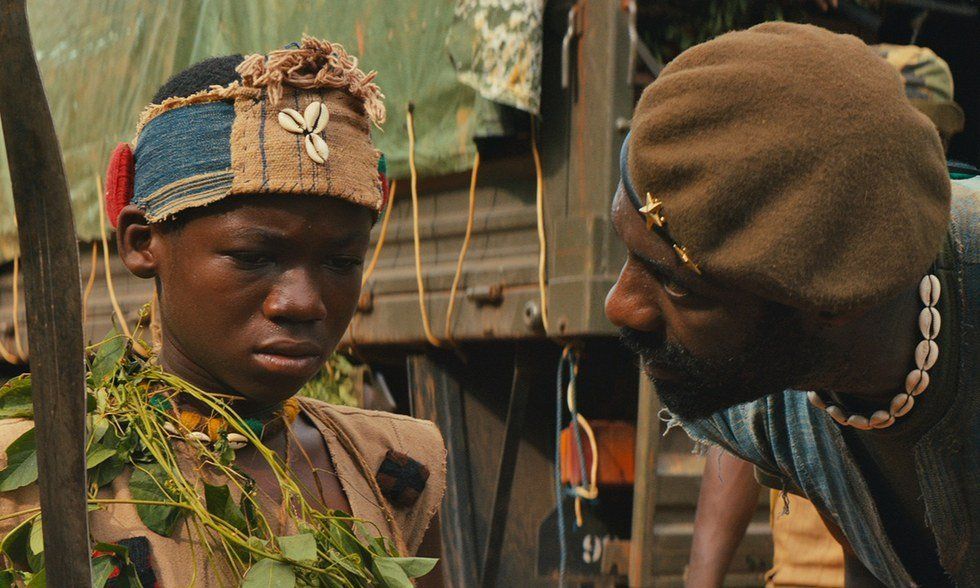
Agu, the young protagonist of Carey Fukunaga’s “Beasts of No Nation,” asks this question to a fellow child soldier near the halfway point of the film. Now fighting for the rebel group of soldiers that killed his father and brother, Agu had just moments earlier been convinced by his superior to beat an innocent man to death with a machete. He’s been taught that what he’s doing is morally justifiable, though his thoughts are caught somewhere in the middle. In a film so unflinching in its depiction of graphic violence, Fukunaga’s script is full of subtle human moments just like this one, which is why it’s one of the best movies about war in recent memory.
For its first venture into original filmmaking, Netflix had the option to make something more appealing for casual viewing. “Beasts of No Nation” is no such film, and it’s all the better for it. Taking place during wartime in West Africa, the plot follows a young boy named Agu who escapes his village following a rebel group invasion. Alone and without his family, he is quickly recruited by the same rebel group under the leadership of a man known only as Commandant (Idris Elba). What follows is a harrowing series of murders, violence and turmoil, much of which is done by the hand of brainwashed child soldiers.
Fukunaga, whose directing credits include “Jane Eyre” as well as the first season of HBO’s "True Detective," takes a documentary approach with the camera. While narrated intermittently by Agu, Fukunaga allows the visuals to do most of the talking. To say that “Beasts of No Nation” has a music video quality to it sounds disrespectful at first, but there is something special about the way its director meshes aesthetically pleasing techniques with the graphic displays of war. This visual approach suitably complements the feeling of watching the innocent children we expect to be the victims take on the role of destructive, ruthless war-mongers.
This documentary approach works mostly in favor of “Beasts of No Nation.” When it doesn’t -- and this is rare -- the montages of war begin to take on the quality of Time magazine images: beautiful in technique, but also surprisingly forgettable. While wonderfully acted, Idris Elba’s character comes close to becoming a prop for rousing speeches, similar to his role in “Pacific Rim.” Thankfully, Fukunaga’s script gives him just enough material to work with.
And when we at times feel at arms length away from Agu, the film hands out much needed doses of smaller, human moments like the one mentioned above. Without these, “Beasts” would have been just another war film. I say “war film” instead of “a film about war” because they’re two separate things. One is filled with action and violence while the other studies those actions through violence. Fortunately, “Beasts” ends up being the latter.
As great as “Beasts” is, the method by which it was released seems to be just as important. Netflix’s first original film isn’t going to change the way we watch movies, and I’m glad it won’t. I don’t believe it’s even Netflix’s intention to do such a thing. With that said, I can’t help but think that “Beasts” was handed a bad card by being released online. While distribution should never factor into your experience, the quality and craftsmanship of “Beasts” is a constant reminder of why it deserves a bigger screen.