

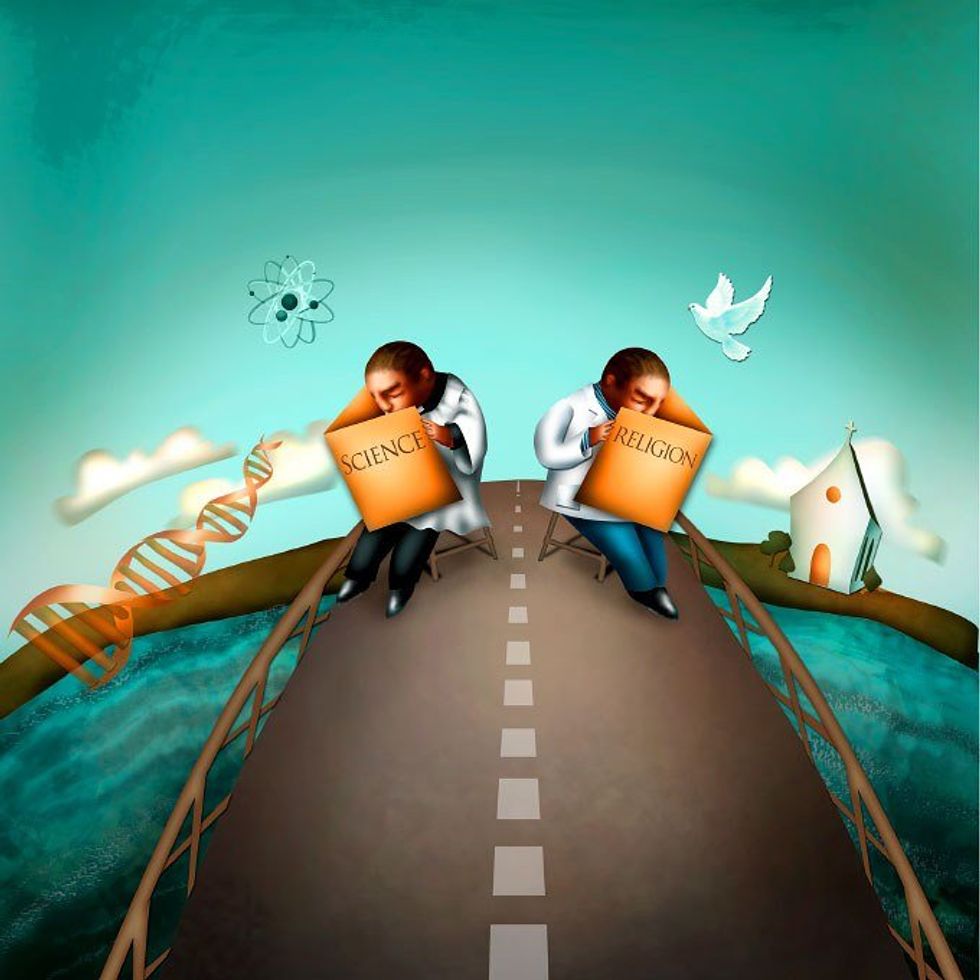
It is hard to envision that there is space for religion in science. I know, I know, religion and science have been battling for years about who is right and who is wrong. As a science educator, I have been battling this idea that religion is wrong. The idea that we should not let people believe that religion explains the worlds natural phenomena because that is science’s job. I am not here to defend science over religion, but to play the devil’s advocate and maybe get us to see differently on a few matters. I mean it’s 2016, Trump was just elected president, who knows what else the United States can decide to do?
First let’s get some definitions under way so we can have a working vocabulary throughout this article. Science, although it can be split up into tens of different fields, explains and studies the physical and natural world by the means of observation and experimentation. In a relative sense, using Democritus (Father of chemistry and rudimentary atomic theory) as our bench mark, science began around300 BCE. Religion, in a very similar sense, is the explanation, worship, and belief in a superhuman controlling power that one pursues in worshiping because they believe they have some supreme importance. Religion, unlike science, predates science by thousands of years due to lack of writing implementations. Archeologists have been able to confirm that religion expands further than 98000 BCE. Most of these ancient religions existed to explain natural phenomena. For example, rain would fall from the sky and our primal ancestors believed that rain must be controlled by someone with higher power than they.
Essentially, science and religion have the same job: they both explain natural phenomena but by different means. Science observes the natural world, makes observations, collects evidence, and explains why phenomena happens based on the reproducible evidence. Religion observes the natural world and asks questions as to why it is happening, hypothesizes, and theorizes why it could happen.
Religion and science have coexisted for years. Arabic science was heavily influenced by the Islamic religion. Without Arabian scientists, the world would have no math, no astronomy, no physics, and no chemistry. Well, the world would still have it, but it would have taken much longer to understand it. Not only that, but many of the founding members of the Royal Society were also clergymen of the Holy Order. (Note: The Royal Society, f. 1660, is a society that recognizes, promotes, and supports the excellence of science such to provide development and use for the benefit of humanity.)
The problem scientists and religious clergy often face in our modern society is who is right? The nature of science lends itself to factual data that can explain the natural and physical world through the collection of facts while religion is often hypothetical, collected over thousands of years with only written stories and accounts. Scientist see a belief without a result as flawed or illogical and claim that religion must be wrong. Religion argues that belief is belief and there can only be one way the world works.
Currently, public schools in America teach evolution, and this is by law. Religious and private schools are not lawfully required to teach the same curriculum as public schools so I cannot provide a general statement about what they do teach in their high school science classes. However, this federal law that requires public high school biology teachers to teach evolution and this can often be an interesting and stressful day for students who are committed to their religion. There is by no means a problem teaching evolution, it is factual data that is supported by all biologists on this Earth. The problem, however, is that students and teachers are not allowing themselves to become fluid in different understandings of similar material. If teachers come off too strong and support the claim that “science is the only way that it can be, and that there is no other possible or plausible explanation to explain physical phenomena.” This sends the message that science is never wrong and it has no room for improvements.
Science education, and science itself, always has room for improvements. There will always be new experimentation, instrumentation, and ideas that come up through the different fields of science. Students and teachers need to be willing and open minded when approaching different subject matter that may interfere with what they believe or have already learned. If a student or their parent is unwilling to learn a new way of thinking based upon their belief, it is their own loss of knowledge. However, we have to embrace the students who are willing to think critically through science while keeping their faith.
There is no more room for bigotry or division in America and if somehow public education can develop students who were once scared or intolerant of science due to their religious views into scholars who are willing and eager to think critically through experimentation and observation, the students, the teachers, and education will win.















