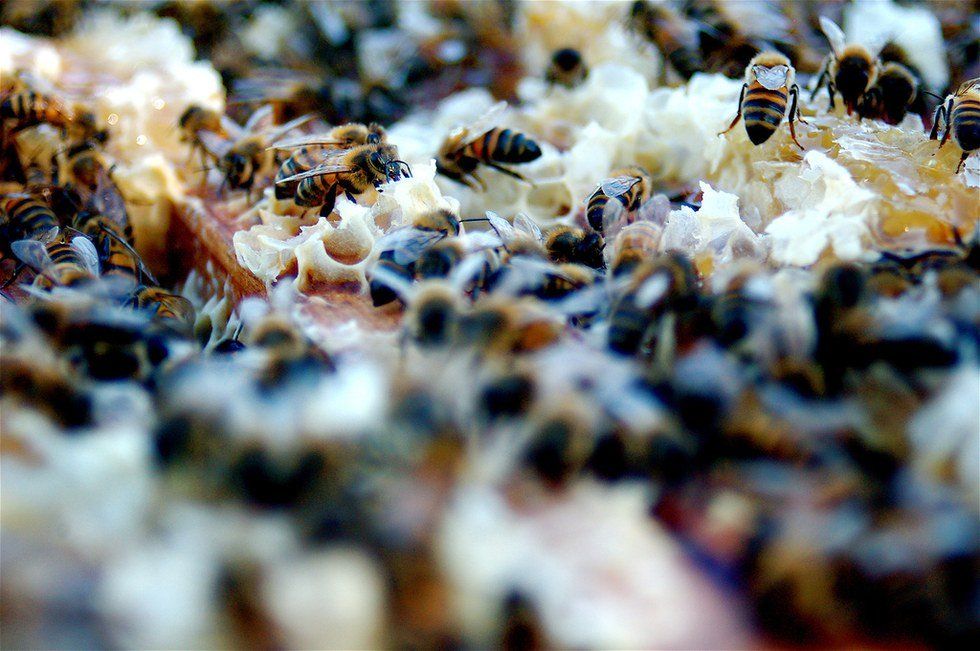
According to an article put out earlier this month by US News, honey bees have suffered another harsh winter. This past winter, bee keepers reported a winter colony loss of 28 percent, up six percent from last years report, and well over the 17 percent that bee keepers consider acceptable. What’s even more frightening is that summer colony loss percentages, which until recently were usually much closer to the acceptable loss rate, have also spiked.
Overall, for the 2015 to 2016 year, the total percentage of colonies lost is up to 44 percent, and the total number of honey bees in the United States is down to half of what it was at the end of World War II. This trend in colony collapse has been observed since 2006 when the Bee Informed Partnership first started collecting data on winter colony loss rates, so why should you care? One word: coffee.
83 percent of Americans consume at least one cup of coffee on a daily basis, and if you’re part of that 83 percent that relies on or enjoys partaking in a daily cup of joe, you should be concerned about the rising percentages of colony loss. Honey bees are responsible for pollinating approximately one third of crops in the United States, including coffee and other crops we take for granted, like apples, strawberries, and almonds.
That being said, we humans are very good at prolonging our inevitable deaths, so a complete die out of honey bees would not mean a total loss of these crops—with the exception of almonds, which rely 100 percent on honey bees for pollination—it would simply mean finding an alternative form of pollinating crops. There are other species of bees, bumblebees for example, which can pollinate tomato plants and plants in the blueberry family.
Butterflies and hummingbirds can also cross-pollinate some plants, and then of course you can always hand pollinate. This is a tedious process but an option, so again you are asking, “Why should I care?” Well, here’s another word: Starbucks.
Anybody who has been to a Starbucks will tell you that their fancy coffee drinks are expensive, but imagine paying double the price—or more—of a fancy Starbucks coffee for just a plain black coffee. It comes as a surprise to hardly anyone that pollination via honey bees and other insects is much cheaper than hand pollination; you don’t have to pay honey bees to pollinate, they just do it.
It is estimated that honey bee pollination efforts are worth anywhere from $10 to $15 billion dollars a year. Compare that to $155 billion dollar estimated price tag for artificial pollination and you’ll see that we really do owe a majority of our thanks for low produce costs to bees.
With the fear of an eternal Starbucks on steroids planted firmly in your coffee-loving mind, you can see that the deaths of honey bees isn’t just an issue among bee keepers, it’s an issue among all Americans who enjoy being able to afford the third of produce that honey bees pollinate.
We know that honey bees are dying and that it’s an environmental and economical issue, but what is causing colony loss rates to climb like they are? Dr. Dennis VanEngelsdorp, professor at the University of Maryland whose research focuses on pollinator health and honey bee health, has collaborated with other scientists on over a dozen articles focused on honey bee deaths, and from those articles emerge two trends: parasites and pesticides. Honey bees fall victim to infestation of the varroa mite.
According to an article by Ric Bessin, an entomologist at the University of Kentucky, “Varroa mites are external parasites that attack both honey bees and brood. They suck the blood from both the adults and developing brood, especially drone brood. This weakens and shortens the bee’s life.
Honey bees are also routinely exposed to a variety of pesticides used to keep other insects from eating the crops they pollinate. Some honey bees are also intentionally given forms of pesticides to prevent them from succumbing to varroa mites. In a study performed by Dr. vanEngelsdorp and five other scientists it was found that honey bees with high levels of a wide variety of pesticides and fungicides, including some of the versions that are meant to protect the bees from varroa mites, were more likely to develop a pathogen known as Nosema, which effects the bees gut health.
As we have learned in recent years, the gut health of humans plays a huge role in our overall health, and the same can be said for bees. Bees effected by Nosema have a reduced ability of digest pollen and a weakened immune system, making them even more susceptible to more diseases.
Pesticides called neonicotinoids are also responsible for colony collapse disorder (CCD) due to the fact that they cause bees to become confused and insane which results in them failing to return to their hives.
The natural assumption to make from these findings is that we simply need to stop using pesticides and fungicides that are harmful to bees, and the European Commission has already banned the use of three varieties of neonicotinoids, but as our demand for more and more produce grows, we continue to use these pesticides in attempt to fulfill the growing needs of our population.
This is understandable. No one wants to be hungry, but it comes to a point where we need to decide whether compromising the health and lives of honey bees and other natural pollinators is worth the cost in the long run.
Remember the eternal Starbucks on steroids? Of course you do, because you don’t want to live in that world, you want to continue whining about Starbucks prices, but at least be able to afford coffee and all the other bee-pollinated produce you enjoy.
A world without humans is a world of vast diversity and natural selection, meanwhile, a world without bees is a world with decreased food diversity and reduced produce conservation. The death of honey bees isn’t a bee problem, it’s a human problem.