
As a sometime-writer, I can personally testify that world-building is the most difficult part of writing a sci-fi/fantasy novel. Creating a world that has a rich background, believable conflicts, and history in which to couch your story is one of the most time consuming portions of writing, as well as one of the most important: without good world-building, your reader will inevitably be bored within the first few pages, as there will be nothing dynamic to keep them interested in your story.
All that being said, however, some authors have absolutely crushed the world-building phase of writing, crafting worlds with background history--unnecessary for the plot but crucial for the reader's immersion--as detailed and convoluted as that of real-world humanity, with varied peoples, memorable landmarks, and original languages, all of which bring the stories a vibrance and realism that they would have otherwise lacked. Below, ranked from worst to first, are my top five best fantasy worlds.
5. Narnia
One of the first fantasy worlds I was ever introduced to, C.S. Lewis' Narnia captures the essence of a great fantasy world extremely well. It has a long history, filled with struggle and battle, and is well-populated by interesting creatures. I rank it lowest here for having the least non plot-related history of all those on the list, the absence of which leaves it slightly under-created in comparison to the other worlds listed here. However, for many young fantasy readers, Narnia is where the first adventure lies, and rightly so--it is a well-created world.
4. His Dark Materials
Next on the list is the world Philip Pullman created for his Golden Compass trilogy. This world's mastery rests partially in its reimagining of real-world locations as fantastical places, but predominantly in the cosmic struggle that Pullman was able to craft. Once again, the characters and creatures in the fantastical world come alive, as do the warring interests of the many factions. The character of the world both adds interest to the story, and serves to convey Pullman's broader critique of organized religion and narrow-mindedness.
3. Harry Potter
My one rule for this list was going to be that the fantasy worlds had to be separate from ours; however, J.K. Rowling's Harry Potter universe is too well-created to ignore. Here is our first story in which, in addition to fantastic creatures and locations, we have non-story history, stuff that is mentioned solely for the purpose of world-building and not to push the plot along. This, to me, is the sign of a complete world, as it gives the story a context within its own world.
2. Alagaesia
It is with the world of the Eragon books that we move into truly masterful world-building. Author Christopher Paolini created an entire continent, with a detailed history, unique races, and very believable conflict. The masterful touch of this world, however, are the languages that Paolini creates--he writes languages for Elves, Dwarves, and even his orc-like characters, the Urgals. That level of detail makes the world about as realistic and immersive as can be, as it makes the world about as realistic as can be. Importantly, through its unique languages and interesting approach to magic, Alagaesia differentiates itself from its obvious comparison, Middle Earth, as both aspects are more fleshed out than they are in Tolkien's world, allowing Eragon to stand on its own as a high fantasy epic.
1. Middle Earth
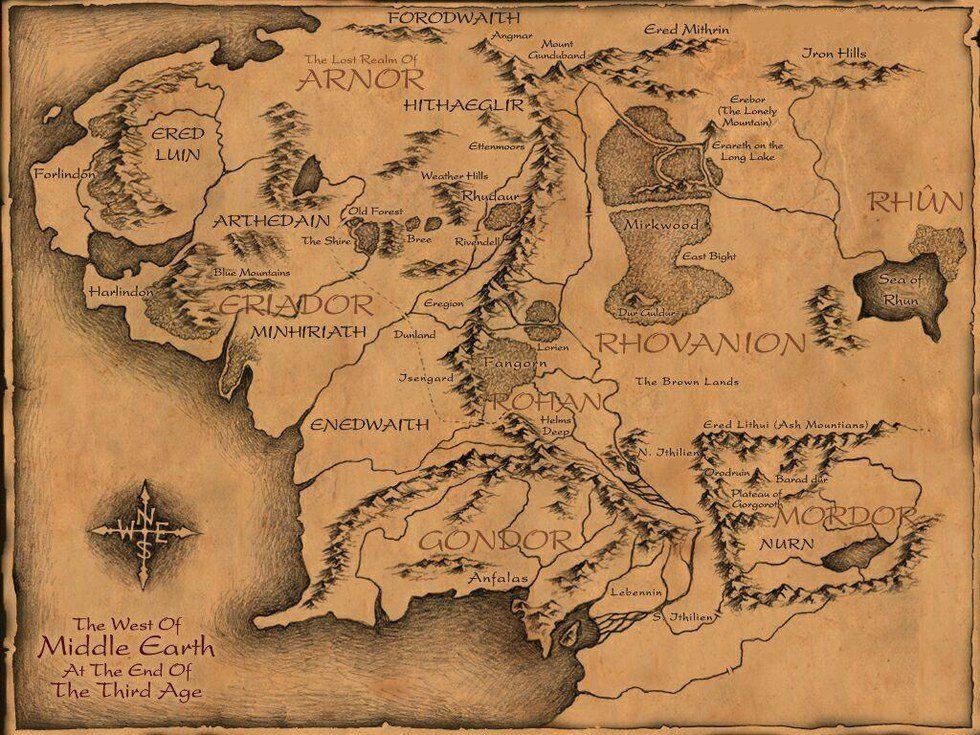
Despite the magic of Narnia, the social commentary of His Dark Materials, Harry Potter's scope, and Alagaesia's rich tapestry of magic and history, J. R.R. Tolkien's realm of evil and heroism takes the crown here. No fantasy world has ever been created in as much depth or detail--Tolkien created a detailed system of gods, multiple ages of struggle between good and evil, a clear geography, languages, and a race (the hobbits) that hadn't been written about before. With Lord of the Rings and his ensuing works, Tolkien had both the first and last word in the epic fantasy genre--the world he created stands as the clear inspiration for all who would follow, simply because it was so complete and contained all the elements of a real world. Tolkien placed his characters in a place we could easily imagine, and so his story was great.