
With the hypersexualization of women in today’s society, you would think that the general population knew everything there is to know about the female anatomy, right? Wrong. From ancient history, and even to modern day, the clitoris and its anatomy is discredited and dismissed, leaving female pleasure out of the conversation almost entirely. In fact, it wasn’t until 1998 that we discovered the full anatomy of the clitoris.
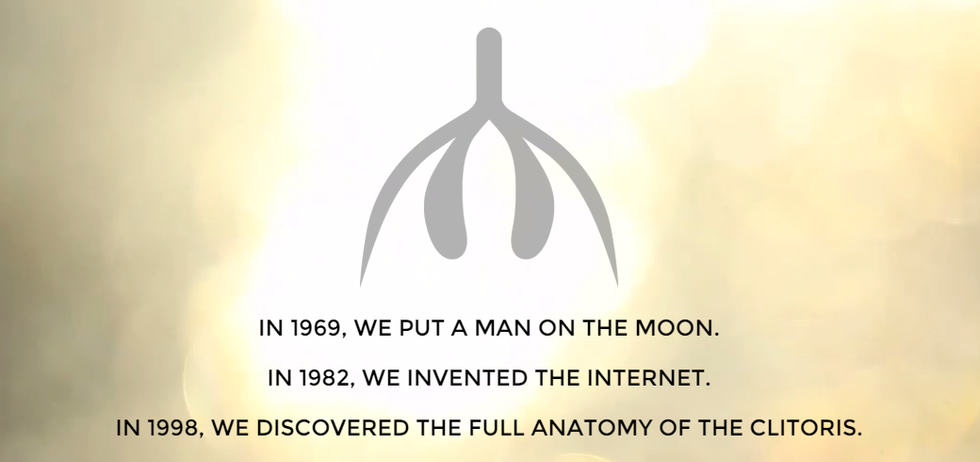
There is no women’s sexuality without the clit, and it’s about time the rest of society gets on board with this mindset.
You might be thinking, I already know what the clitoris looks like! It’s that cute little button at the top of the vagina, duh. But what if I told you that we have been looking at a completely inaccurate representation of the female anatomy? According to dvomedia.com, in the 1990’s, an Australian urologist named Helen O’Connell noticed the fact that there are tons of different machines and devices hooked up to men during routine medical procedures in order to prevent hitting nerve endings in the male anatomy. She began to wonder why there was no female equivalent of these machines to protect a woman’s anatomy during surgery. How did doctors know that they weren’t cutting into clitoral nerves during hysterectomies, and other such procedures? She set out to find these missing details, publishing her findings in 1998.
So, if we know the true anatomy of the clitoris, why doesn’t the general population know that it isn’t just a little pink button?
While we now have the information we need in order to educate society accordingly, the data has yet to make its way pop culture and sexual education. This attitude about the clitoris isn’t simply a situation where we can say, “Whelp, now we know!” It’s much larger than that. It stems from the belief that women are lesser than men, that women don’t need to orgasm during sex, and that women’s pleasure is at best optional.

Enter Sophia Wallace. She, as few people had before her, noticed the misrepresentations and falsehoods surrounding the clitoris, and in response to that, she created an underground art movement that challenges the lies, and questioned the myths surrounding the female anatomy. She works to shine a light on these issues, sparking conversation about the clitoris around the world.
Despite the fact that we have scientific information at our disposal, we continue to spread inaccuracies about the clitoris.
Case in point – I just googled “clitoris definition”.
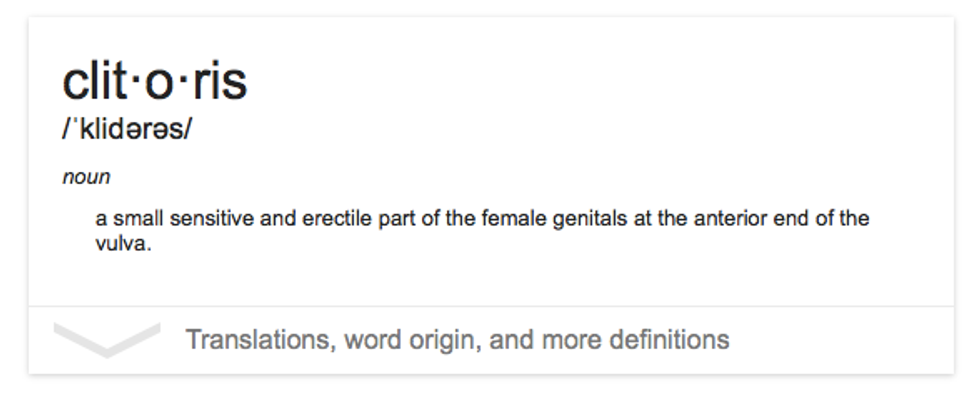
C’mon, google. Get with it.
While there is sooooo much to talk about regarding the clitoris, here are a few fast facts to spark your interest and give you some general knowledge about this amazingly under-appreciated organ. Visit The Huffington Post to find out more about the overdue, under-told story of the clitoris. Let's #getcliterate, my friends.
Most of the clitoris exists as an internal structure
Take a look at the pictures below for the full anatomy of the clitoris.
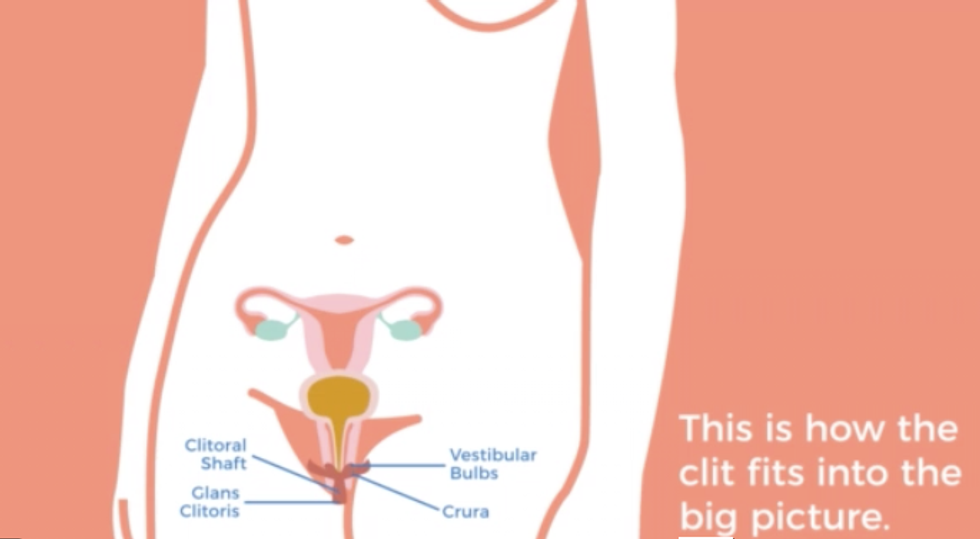
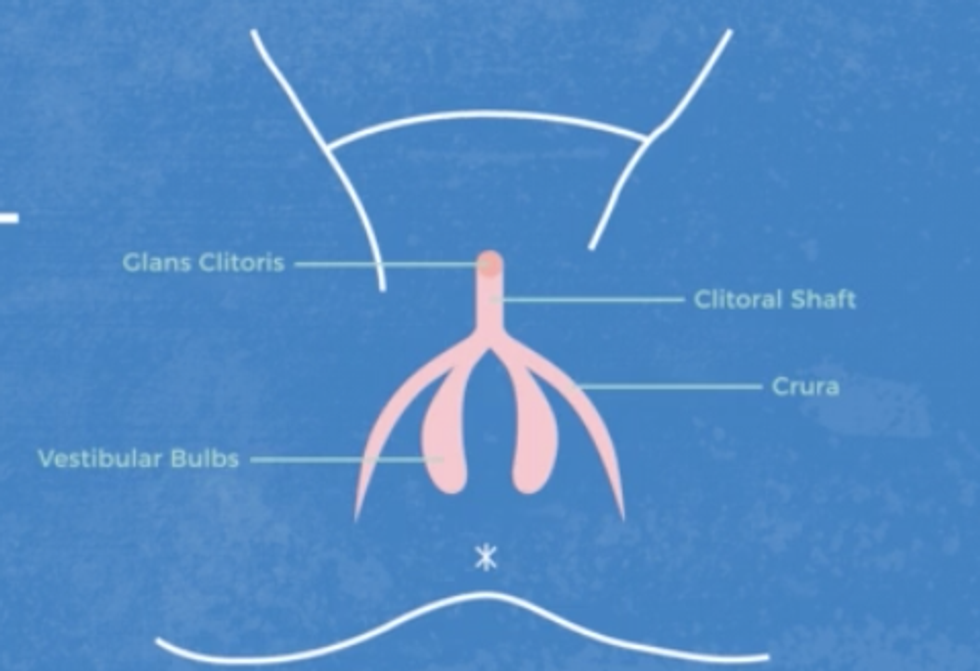
The little external "bean" is just the tip of the iceberg.
The clitoris is the only organ in the human body that exists exclusively for sexual pleasure.
 The vagina is the female reproductive organ, and the clit is the female sex organ. While the penis exists for pleasure as well, it also has a reproductive purpose.
The clitoris is made up of erectile tissue that becomes erect during sexual stimulation and relaxed after orgasm.

The clitoral structure, in its entirety, is actually fairly equal in size to the penis.

Yes, they get hard, too.
The clitoris gets bigger as a woman ages.
 By the time a woman is at the end of puberty, her clitoris has just about doubled in size. By the time a woman is 32, her clitoris is nearly four times larger than it was at the end of puberty. After menopause, a woman’s clitoris is seven times larger than it was at birth. That’s definitely something worth mentioning in textbooks, don’t you think?
The clitoris has about 8,000 nerve endings.

That’s twice as many as the penis.
Only one in four women can orgasm from vaginal penetration.

Things like TV, magazines, even sexual position books, often claim that women should be able to orgasm vaginally, but this just isn’t the case. When it comes to female orgasm, it’s all about the clit.
Porn has it all wrong
 The majority of pornography makes it seem like clit action is only used for foreplay (or even worse, it's an afterthought) instead being of the primary way to achieve female orgasm. It is an important part of regular intercourse, and porn and movies don't portray it accurately.
Women do not take longer than men to orgasm
 When you know what you’re doing, that is. In a Kinsey’s study, it was shown that when masturbating, women orgasm within four minutes – a similar time to the men he studied.