
Living in the United States, being exposed to social media, you see a melting pot of various cultures. Where these cultures and cultural cues come from is less obvious or may even be unknown to the people living here. Contemporary American culture has appropriated Mandalas from their sacred culture purely for vanity, popularity and consumerism. This is the exoticizing of particular aspect of Mandalas, exploiting the sacred Tibetan Buddhist culture.
Mandalas are traditionally used for meditation in Indian cultures. Mandala meditation, in Tibetan cultures, is used for self-spiritualization and enlightenment. If a person is lost or needs guidance, then they seek self-spiritualization and enlightenment. Or if a person is wanting to help others, they may seek these qualities to pass this onto others. Tibetan Buddhist monks create Mandalas with colored sand that is later brushed away. Several monks may work on the same Mandala. They work together by meditating on the same subject. They do not have the attachment to these material items as Western society usually does. Sweeping away a piece of art that they put many long hours of work into is a process of letting go. This process is freeing for the mind and consciousness of the person exercising the meditation. Traditionally, making these extensive works of art takes a great deal of concentration. This concentration is one of their most prominent modes of meditation. This meditation allows for them to get in touch with themselves and solve the personal issues they are dealing with.
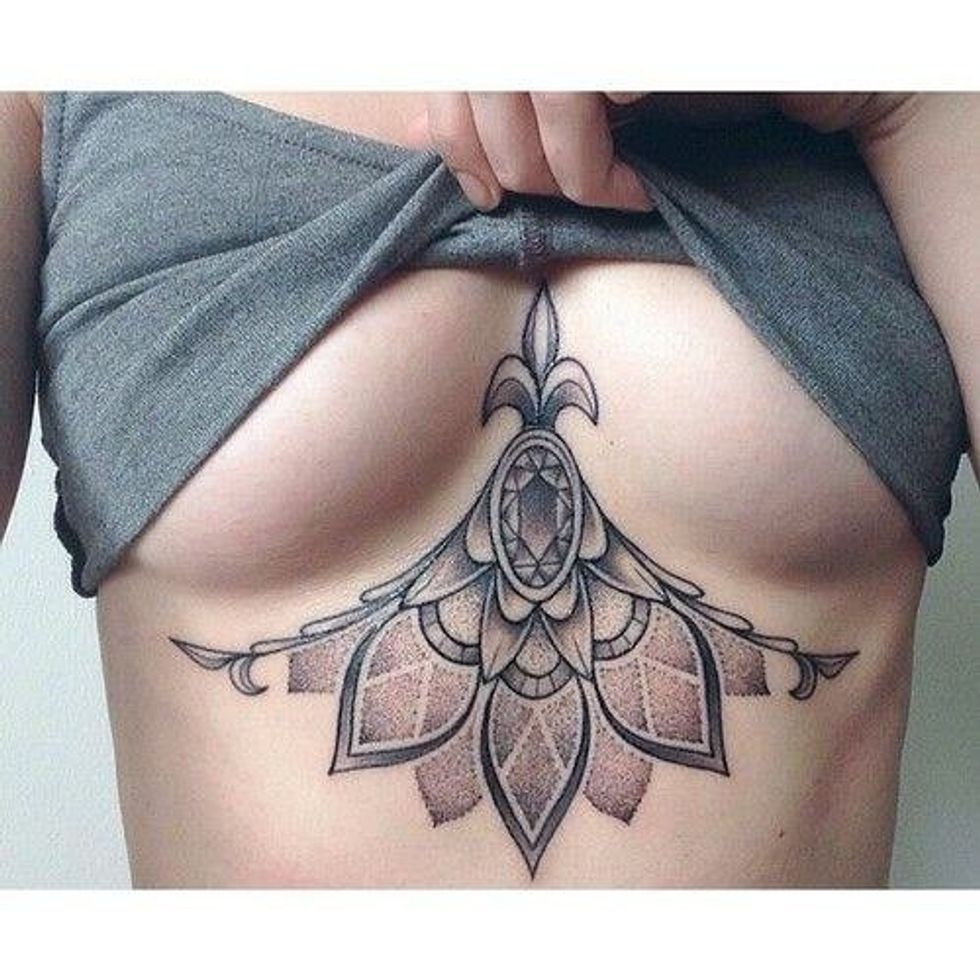
In the United States, as the popularity of tattoos has risen over the past few decades, so has the appropriation of Mandalas which are being used purely for vanity and consumerism. Mandalas have been made very popular as tattoo designs. Individuals get them as tattoos, without knowing their origins because they think Mandalas are exotic and different. They may get their inspiration from social media. These designs have been sexualized by being made into sexy tattoos which is far from their original purpose. Women have Mandala tattoos in intimate areas like their under breast. Another example may be a Mandala pattern on clothing or accessories. These are prime examples of the exploitation of a sacred Mandalas.
These designs are misleading American people about culture and to the people who practice it. This is a facade that Americans are putting on. This is a form of “sampling” another culture for their own purposes. Although the United States is a melting pot of many cultures, there is no excuse to using a sacred culture’s symbol for yourself. Doing research and evaluating a decision to use a symbol not from your culture is recommended before it is permanently on your body or worn in public. If you truly understand the culture and the symbol of which you are appropriating, and you are using it for the right purposes. Using these symbols is not an example of a blended culture because many tattoo artists and clothing designers are making a profit from these designs, without paying homage or benefiting to the original culture. This is the consumerism aspect. Making a product with a sacred symbol for personal profit, that does not benefit the culture or people is negative appropriation.
The United States has appropriated Mandalas for another purpose that can be argued to have a beneficial effect. In a positive manner, Mandalas are used for art therapy. Drawing is a calming activity that can be compared to meditation. In relation, meditation is the core purpose of creating sand Mandalas in Tibetan cultures. The combination of them both allows for the person practicing to meditate, or focus and create something that makes them happy. Drawing Mandalas is an existential approach to finding happiness within. If therapy and meditation have the same outcome, bettering one’s self, then is this really appropriation?
The real question is, does the culture the sacred symbol is from have to be offended for it to be appropriation? Indian cultures may approve of this use of their symbol, if it is for a similar purpose. This is just the American version of meditation. As mentioned before, the United States is a melting pot of many cultures, but they are not represented as exact replicas of the original cultures. The United States has its own versions of different cultures which are not necessarily wrong, but different because it is not from the country in which it originated. Maybe the solution to the appropriation of the Mandalas is the way in which it is marketed. Saying that something is a traditional Mandala and trying to claim it as your own in the United States is wrong. This may be avoided by marketing and identifying Mandalas in the United States as “American Mandalas.” This would not be disregarding the sacred symbol, rather, paying homage to it or using it as inspiration. Using something from another culture can be a form of flattery, if it is identified. Inspiration crosses over many cultures. Not every culture is completely original, they are inspired from one another. Using the term “American Mandala,” or something similar, would be an example of a blended culture. This blends the cultures of America and India in a way that compliments them both, canceling out the claim of appropriation.