While it is not given much attention in terms of environmental devastation, animal agriculture is actually a huge part of the problem. As the population continues to grow, and the world demand for meat increases, the endangerment rises.
In "Cowspiracy: The Sustainability Secret," a documentary directed by Kip Anderson and Keegan Kuhn, they discover shocking statistics revealing animal agriculture's contribution to key environmental issues including deforestation and greenhouse gas emissions.
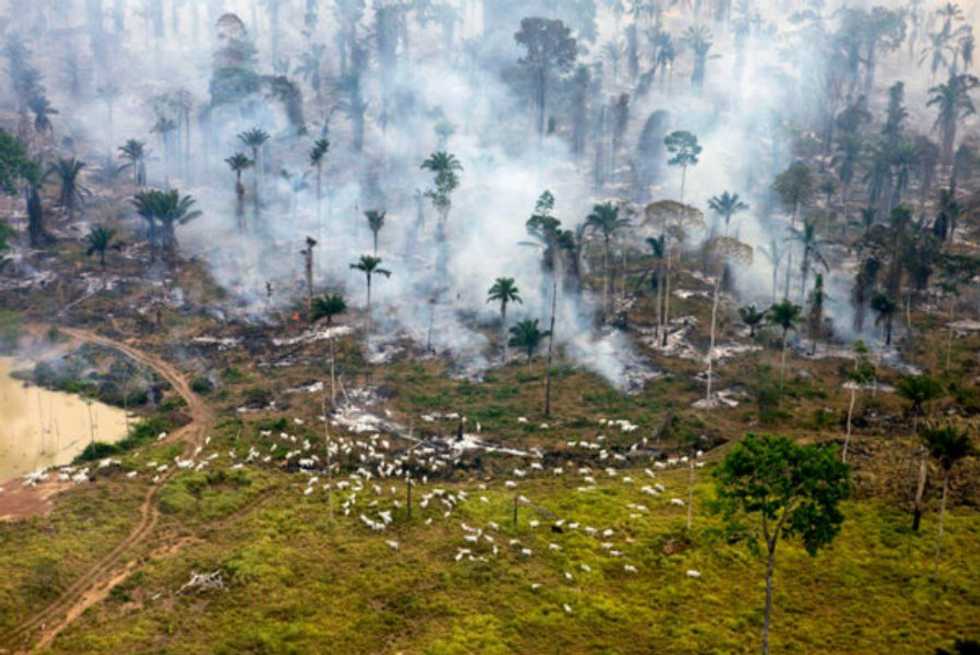
Although most people wouldn't suspect it, they found that animal agriculture's the number one contributor to deforestation. Initially, people automatically associate deforestation with creating more room for civilization and for paper products, but animal agriculture often goes unnoticed. At first glance, this does make sense because not many people actually ponder where their food came from, or what types of resources went into it. Though after taking into consideration how much land animals take up for grazing, it becomes logical to see how it directly relates to deforestation. It's also important to remember that the land is used not only for the cattle themselves, but also the crops they are fed. It's estimated that an entire football field is cleared every second in the Amazon. When considering that the majority of crops grown are fed to animals being raised for food and not to people, a whole new ethics question involving world hunger arises.
In terms of greenhouse gas emissions, the film reveals that raising cattle produces more CO2 than all exhaust from fossil fuels combined, even though the problem of fossil fuels is given significantly more attention than animal agriculture. To be more specific, emissions from livestock account for more than 51% of all greenhouse gasses in the atmosphere and are responsible for 50% of all human-caused global warming. When relating this problem back to deforestation, a common scientific connection can be made; since trees and rainforests are an essential part of clean air by absorbing CO2 and giving off oxygen when they are significantly destroyed it greatly affects the quality of the atmosphere.
Most of this deforestation devastation occurs in the Amazon rainforest since many countries import beef from there, but that does not at all mean that these issues are limited there. The atmosphere is everywhere, and the planet doesn't care where the physical destruction is happening because the aftermath is and will be felt everywhere. The aforementioned problems are just a few of the affects animal agriculture has had; others include ocean pollution, rising sea levels, species extinction, water usage, and heightened storms.
Although many people don't want to hear it because it pressures them to make lifestyle changes, diets and demands are greatly affecting the quality of the planet, even more so than fossil fuels and transportation. Since the problem of animal agriculture isn't addressed nearly as much as it should be when it comes to the discussion of global warming and environmental destruction, it's up to us to do our own research. In the film, the director spoke to numerous leading environmental organizations who did not want to address the problem, even though it's the number one contributor to what they are all advocating for.
It's important for society to question what's happening and why it's being ignored. For the sake of the very near future, and future generations it's crucial to bring awareness to the problem and investigate on your own. There is a simple solution to the widespread issue of global warming: limit your animal product intake as much as you can for the sake of...well, everything.
All statistics mentioned in this article are from the documentary "Cowspiracy: The Sustainability Secret."