


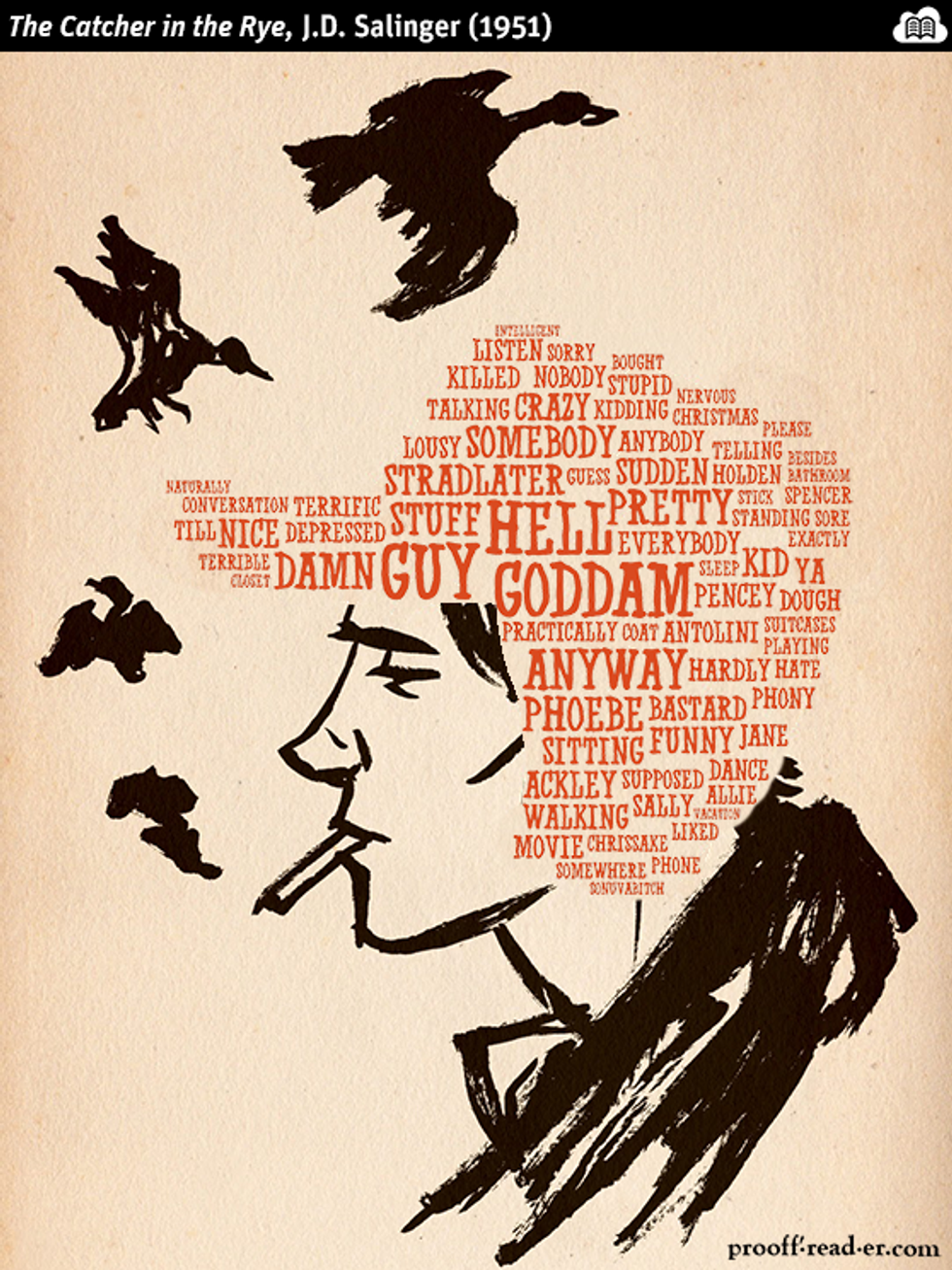
“What really knocks me out is a book that, when you're all done reading it, you wish the author that wrote it was a terrific friend of yours and you could call him up on the phone whenever you felt like it. That doesn't happen much, though.”
Ever since I read The Catcher in the Rye by J.D. Salinger during my freshman year of high school, I was awestruck at how much the book resonates within me. To tell you the truth, not much happens in this book. Holden Caulfield is a 16 year old boy who is simply trying to find his place in the world. Aren't we all? He gets kicked out of Pencey Prep (a boarding school for boys). and he decides that he is going to take a trip to New York City before his parents get the official expulsion letter. Sounds like your typical young adult novel, right? Wrong.
Holden is this protector of the innocent. He's already seen enough of the corruption that takes place in the "adult world." In a sense, maybe he's sort of scared to grow up. He doesn't want other children to go through the same pain and suffering that he experiences. In addition, Holden doesn't have too much compassion for anything other than his little sister, Phoebe. He ultimately wishes for Phoebe to stay innocent, and he desperately tries to protect her from seeing the profanity written on the walls of her school. In the end, Holden knows that he cannot save everyone. He realizes that life is just this continuous cycle that goes around, like the carousel he sees at the very end of the novel. Death is inevitable, corruption is inevitable, but still, life goes on.
What I find interesting about this book is that it was never made into a movie, unlike various literary classics. The best part is that Holden blatantly states that he hates the movies, so the fact that there was never one produced is quite fitting! Also, Salinger didn't want to sell the rights to producers either, and he was very much against it. In a way, I feel like he was sticking up for Holden and his ideals, which is a pretty neat thing to do for a fictional character. Salinger also started writing the book when he was serving in World War II, and according the the documentary Salinger, a few chapters were with him during D-Day. What's also intriguing is that so many war veterans were coming home and writing memoirs or historical fiction books based on their experiences, but Salinger came home and wrote a book about a rebellious teenager. I think it's safe to say that if there was anyone on this earth who was remotely similar to Holden, it was Salinger himself.
I believe that my favorite part of the whole book is when Holden goes into the museum and his revelation at the carousel.
"The best thing, though, in that museum was that everything always stayed right where it was. Nobody'd move. You could go there a hundred thousand times, and that Eskimo would still be just finished catching those two fish, the birds would still be on their way south, the deers would still be drinking out of that water hole, with their pretty antlers and they're pretty, skinny legs, and that squaw with the naked bosom would still be weaving that same blanket. Nobody's be different. The only thing that would be different would be you."
This quote completely changed my perspective on life. Yeah, it's true, inanimate objects will always stay the same. It just shows how dynamic humans are in contrast. We are constantly changing nonstop. Realizing that you're not the same person that you were before is a step towards maturing and reaching adulthood.
“Then the carousel started, and I watched her go round and round...All the kids tried to grap for the gold ring, and so was old Phoebe, and I was sort of afraid she's fall off the goddam horse, but I didn't say or do anything. The thing with kids is, if they want to grab for the gold ring, you have to let them do it, and not say anything. If they fall off, they fall off, but it is bad to say anything to them.”
This is Holden's big revelation. I just love how he is such an unreliable narrator, yet his voice is so authentic. That is what really struck me when I read this for the first time. Despite being published in 1951, it sounds like Holden is talking to us like an average, modern-day person. His voice lives on even though decades have passed. That is what's truly magical about The Catcher in the Rye. We can see parts of Holden in ourselves, and not all books allow the reader to do that. Ultimately, we all cannot be teenagers forever, but Holden Caulfield will always remain 16 years old in our hearts.
















