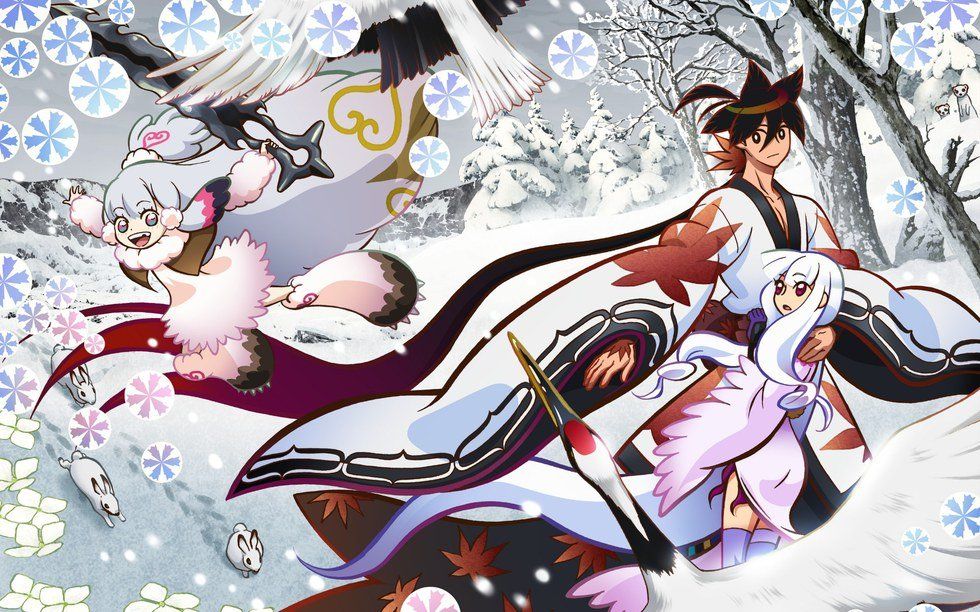
“Katanagatari,” directed by Keitarou Motonaga and produced by studio White Fox (who gave us the brilliant Steins Gate), aired in 2010 as a historical samurai drama with a unique art style. Ranked 93 on MyAnimeList, "Katanagatari" has developed a respected reputation that is bound to establish it, one day, as an anime classic. Beware, there will be spoilers ahead.
The Presentation
To understand why I have an unhealthy need to criticize “Katanagatari” it is necessary for me to break the show down, piece by piece. Starting with its presentation, the art style is impossible to ignore. First, it is gorgeous; second, it is unique. It is a visual experience that truly captivates the eye and engulfs the heart. We are immersed in the culture, land and people of the time period. Musically, the anime exceeds expectations with a great soundtrack and two equally stellar openings. The ending songs change per episode and add to the emotional impact the story has in and of itself.
The Animation
Beside the style of the work, which I have already brought attention to, the animation in the show is truly exemplary. The character design, especially in Shichka’s case, is unique and a joy to view without being too outlandish. The directing is above average and the show does a fair job of progressing the narrative without distracting with jumpy or ineffective cuts. The best part about the animation and, no doubt, where a majority of the key animation funds went to is apparent in the action scenes. These scenes have great directing and work effectively to illustrate “weight” in action, a term I take from the youtube reviewer Underthescope in his video “Weight in Action in ‘Grimgar.’” The animation is fluid and works in collaboration with some of the most excellently crafted choreography for a fantastic viewing experience.
The Plot
The plot of “Katanagatari” remains one of its strongest points because of the simplicity in its structure. In short, Togame, our female lead, goes to an island in search of Matsue Yasuri (who had killed her father) in order to collect twelve swords with immense powers to win over the emperor. Instead, she finds Shichka Yasuri, Matsue’s son and male lead, who falls for her and agrees to help her. They then collect the swords. Up until the last episode or two, this is all that the plot has to offer. The simplicity works in the shows favor to keep the focus on the budding relationship of Togame and Shichka and the character development of the sword holders, which is the meat of the show and creates the pathos that motivates the viewer to continue watching.
The Episodes
The episode count and length are both important to the overall presentation of the show. First, the episode count mirrors the number of the swords, 12. This enables the creators to make a clear cut system for the season to play out. Second, each episode is 50 minutes long, as compared to the usual anime, 24 minutes. This prevents each episode from feeling rushed or continuing for multiple episodes on end and enables the character development for the sword holders to foster. It also changes the feel of watching an episode; you don’t sit down to watch an episode, you sit down to watch a short film; a vital part of the show’s enjoyment comes from this semi-cinematic experience.
The Swords
The swords, in terms of creativity, are nothing out of the ordinary: one is sharp, another hard, another a suit of armor, etc. However, the swords serve a unique purpose, an interesting attempt at jobbing. Jobbing usually has to do with presenting an upcoming adversary with a previously exposed character, that was considered strong, and destroying them. Clearly these swords are not literal characters, except for maybe Gilt (sorry, but I know the swords by their English names), but by having a confrontation with each of these swords before the final episode it allow us to witness Shichka struggle against each and every one. This makes the final string of battles remarkable and Shichka’s ease in victory all the more potent.
The Maniwas
This assassin group serves primarily to job (explained in the previous paragraph). They become an established force that gives Shichka, at least, a workout in the first episode. Honestly, it got a little repetitive watching the Maniwas get demolished but it did something interesting. The viewer grows to feel for the corps and invests us in the relationships that they present about their inner workings. This will be important further on.
The Narrator
The narrator is vital to understanding the relationship the viewer has with Togame and Shichka because she paints these two characters to not only be our protagonists but to be completely righteous as well. This too will be important further on.
Hitei and Emonzaemon
One, I hate these characters and that is exactly what the creators want. Two, they serve as a complete reflection of Togame and Shichka. Both pairs contain a mastermind, yet useless in battle, the female who employs a servant, loyal to a fault. In fact, both servants seem to be more weapon than human. The only differences are that you spend more time with Shichka than Emonzaemon and Togame is adorable while Hitei is not. This adds an interesting dynamic to the viewing experience as you witness the protagonists fight head to head with themselves.
The Sword Wielders
Each sword holder has a past, skills, weaknesses and moral codes. As a viewer, you love each sword owner as much as the last and perhaps more than the protagonists. It is this unique relationship with the episodic characters that enables the viewer to care at all for the protagonists. The Shichka in episode twelve is the accumulation of his opponents and their experiences. This is why the viewer loves him. If anything besides the animation and romance was to be awarded as the driving force in this anime, I would argue the unique viewer/sword wielder relationship truly creates a memorable viewing experience.
The Villains
The villains of this show are Togame and Shichka. They march around the country killing people who, for the most part, are simply trying to live their daily lives. They do this for personal gain. Remember when I said the Maniwas would be important later on? The show has an inherent ability to establish pathos between the villains in the show and the viewer. This is not just relevant for the assassins but also for our protagonists. Togame’s high spirits and quirky persona paired with Shichka’s innocence endear these villains to us. The narrator (here she is again) tells us that they are good. That is how she paints them but in truth they are not. Following a villain is difficult and can quickly lead to an unsatisfactory experience but the narrative weaves the viewer relationship with the characters expertly so that it seems the villains are truly not villains at all.
The Romance
I tried writing about the development of Togame and Shichka’s romance but I couldn’t do it justice. The development was superb and for those who have watched this show (and let’s be real if you haven’t watched the show, why are you still reading?) you know exactly the experience I am talking about.
So Why Do I Hate “Katanagatari”?
Up until this point, I have nothing but glowing praise for this show.
The Ending
I am obsessed with hating “Katanagatari” because I, as the viewer, became whole heartedly invested in the design, the plot, the characters, the time period, the romance and my love was rewarded with the most disappointing ending I have ever sat through. No other ending has left a void so unfulfilled than what this anime has produced. Was it a bad ending? Yes, it was. Regardless, it was a meticulously crafted ending which rapped up each piece of the narrative. The ending correlated to the known character development. Simply because an ending is technically proficient does not make it appropriate for the series. The one thing the ending did to hurt me was that it harmed its own creations.
Togame is harmed in five ways: she is killed, she realizes she was never in love, Shichka ends the series with her nemesis, Shichka ignores one of her two final requests, the swords she so dearly sought after are destroyed. Shichka is harmed in four ways: his beloved is killed, his fate is toyed with, his newfound morality is disintegrated, and he breaks his vow as a weapon to follow only one of his master’s two final orders. The romance was my favorite pars of the series and it is utterly disgraced with the realization that Shichka ends the series, not by Togame’s side, but by Hitei’s. I wasn’t angry when I ended the show; I was sad. This isn’t the ending Togame wanted; this isn’t the ending Shichka wanted; this isn’t the ending I wanted; this is the ending the creators wanted. If this show was bad, mediocre or great, I could have shrugged off the ending without worrying about the details. This show wasn’t bad or mediocre or great; Katanagatari was a masterpiece and because of it’s mastery I felt disrespected as a viewer by the conclusion. Cheerio.