
The United States has the highest rate of sexual assault among all industrialized nations. According to a United States Judiciary Committee report in 1991, the rape rate in the US was eight times higher than France, 15 times higher than England, 23 times higher than Italy and 26 times higher than in Japan. In 2004, the US ranked #2, just behind South Africa.

Two prevalent issues in the Unites States today, highlighted by controversy surrounding the recent presidential election, are racism and sexual violence. Both are grounded in language meant to degrade and dehumanize targets in order to make the violence seem more acceptable. Both promote myth as fact through generalized stereotypes and victim blaming such as “black men are rapists” and “only women are raped” or even “if her skirt wasn’t so short, she wouldn’t have been raped”.

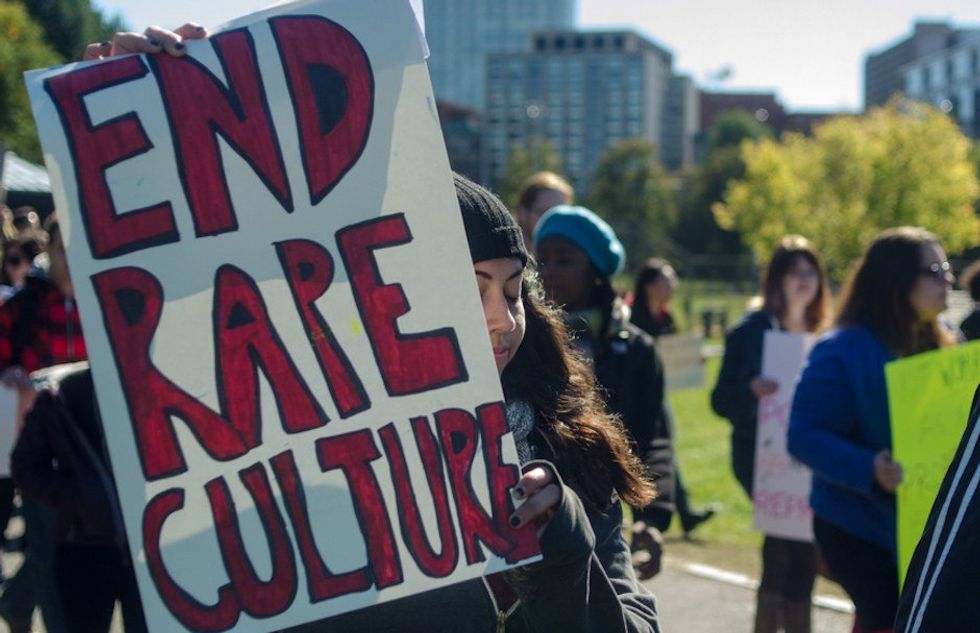
Other myths include: “you can’t be raped by your partner”, “well, you shouldn’t have gotten drunk”, or “it’s your fault for flirting”. These myths lead to victim blaming and promote a culture in which rape and sexual violence are tolerated. Rape culture is one in which legal, economic and social equality are skewed by gender and rape and other forms of sexual violence are common and tolerated, meaning that incidents occur often and yet arrest, prosecution and conviction rates are low. Victim-blaming, racist myths and other forms of sexual violence are also common and images of sex and violence appear together, often portraying women as the target.
Peggy Reeves Sanday, author of “Female Power and Male Dominance: On the Origins of Sexual Inequality”:
“Rape does not come from a biological drive, but is a learned response which comes from the way societies are organized”.
As stated by the Parent Television Council in 1999, “incidents of sexual violence and sadism doubled between 1989 and 1999, and the number of graphic depictions increased more than five-fold”. The National Institute of Mental Health identified three major effects on children regularly exposed to violence on television as 1) they may become less sensitive to the pain and suffering of others, 2) they may be more fearful of the world around them and 3) they may be more likely to behave in aggressive or harmful ways toward others. This is particularly true in programs where the violence of the perpetrator is presented as “justifiable”.
In key developmental stages during childhood and adolescence, observational learning (learning by observing others) and associative learning (learning that certain events occur together) allow us to take in the world and make sense of it. What we are exposed to during those critical periods of development can color our perception as we grow up. This is not to say that those that choose to exert their power over others are not responsible for their actions because, ultimately, it was their choice to act. However, it is important to acknowledge that as a society we’ve created an environment in which many are exposed to some form of sexual violence (whether in person or on TV, through advertising, video games, music videos, etc.) at a young age and are subsequently taught that sexual violence is a normal part of life and those that perpetrate it are unlikely to be held accountable for their actions. We cannot simply excuse offenses as “locker room talk” or show leniency for fear of “ruining a perpetrator’s future” because those excuses promote a culture in which we silence survivors and invalidate their experiences. The argument that sexual violence can often be traced back to exposure to violence growing up is not meant to excuse it, but bring awareness to cycle that, if left unaddressed, will continue to repeat itself.