


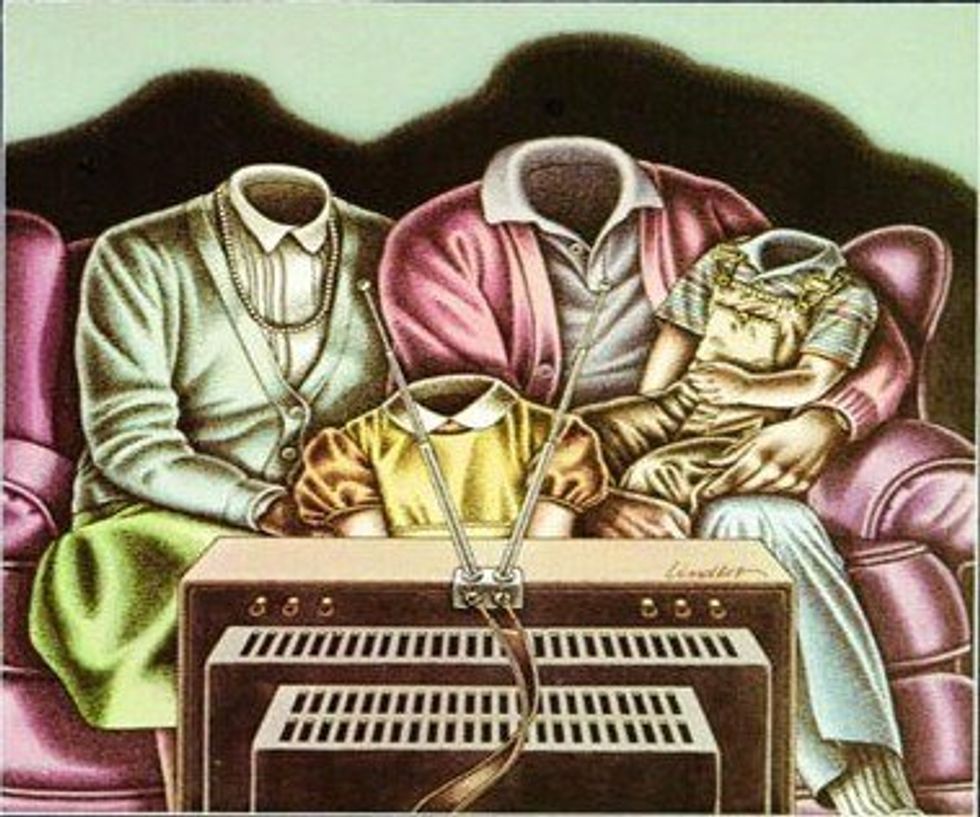
After reading Neil Postman’s “Amusing Ourselves to Death," I am automatically tossed into critical thinking. You would think that he was simply critical of television, but what he was more concerned with was television as a “medium." This “medium,” according to Postman, “employs a particular symbolic code, as it finds its place in a particular social setting, as it insinuates itself into economic and political contexts. A medium is the social and intellectual environment a machine creates." His major concern was the discourse that the “medium” was producing. Postman wrote about this concern in 1985, but in 2016, this still remains a valid concern. As I evaluate our current “medium” of television, I am drawn to the same conclusion as Postman: that we are intertwined in a culture of entertainment.
Postman asserts that “entertainment is the supra-ideology of all discourse on television." That “supra-ideology” has extended itself through the internet, as it has now become the predominant medium for reaching a mass audience, and that medium encompasses the same entertainment culture as that of television. It could be said that television was the gatekeeper that allowed our culture to be consumed with blogs, video postings, and social media. Postman was right in saying “Americans no longer talk to each other, they entertain each other. They do not exchange ideas; they exchange images. They do not argue with prepositions; they argue with good looks, celebrities and commercials," and this is even more prevalent in this era of the internet. We’re caught up in a culture where everything we do is for likes. This ideology, however, is not only restricted to Americans, but is a world-wide phenomenon.
For example, it is taboo to say “I don’t know” or “let me think” during a television show, according to Postman, because “this type of discourse not only slows down the tempo of the show, but creates the impression of uncertainty or lack of finish. It tends to reveal people in the act of thinking, which is as disconcerting and boring in television as it is on a Las Vegas stage.” As we have often seen in various TV shows, the host will often rush through a dialogue with someone who pauses to “think” in order to keep the show fast-paced and entertaining, so the “medium” itself is set up to discourage reflection.
In his rhetoric when scrutinizing television's treatment of news, politics, religion, and other serious matters, he makes an appointed assessment. Focusing on news shows, he states “everything about a news show tell us this—the good looks and amiability of the cast, their pleasant banter, the exciting music that opens and closes the show, the vivid film footage, the attractive commercials-all these and more suggest that what we have just seen is no cause for weeping.” This statement is very relevant because it paints a clear picture of what we see today on various news shows. Postman further proclaims that “a news show, to put it plainly, is a format for entertainment, not for education, reflection or catharsis,” which is also true for discussions of religion, politics and other serious matters. These discussions are heightened with a degree of entertainment when on television or over the internet, because it would be considered boring otherwise.
Entertainment has declared its dominance in the content of all of our discourse. The message itself becomes less important and the entertainment value in communicating the news or any important issue is more important. Postman examines the intrinsic biases that television has as a medium, demanding "fast editing," "on-going stimulation," and "the rhetoric for irrational entertainment." To think that a book that was originally published in 1985 can have such relevance in 2016 is mind-boggling, but if we were to closely evaluate what the television, the Internet, or any form of media is presenting to us and how it’s being presented, we would all have to agree that we are transfixed in a culture of entertainment.

















