
Every day, seven American children die from gun violence. 2015 saw more mass shootings than days of the year while 32,000 Americans annually die from gun violence. The United States now has more guns than people with millions of guns being sold each year, and as Ian Hockley frankly stated, "the human race has an obsession with violence."
On Dec. 14, 2012, Hockley's six-year-old son, Dylan, was murdered alongside 19 friends and 6 faculty members in Sandy Hook Elementary School, including Daniel Barden, Avielle Richman, and Ben Wheeler, all of whom were first graders. On Jan. 19, 2016, the fathers of these four children visited Bucknell University to share their stories and discuss the issues currently facing America in terms of gun violence and mental health awareness as a part of Martin Luther King, Jr. Week.
Although the fathers say that they have survived these past three years due to the strength from family, friends, community members, and the good people that they have met while advocating and telling their stories, David Wheeler shares that "loss is as individual as your own thumbprint." He believes that the distance from the event is an extremely sharp double-edged sword; while more time passed indicates that there has been more time to process and grieve, it also means that the life when his family was complete is slowly becoming more and more distant. Wheeler described the process of grieving as if you were given a set of heavy stones in which you have no choice but to accept them, and know that they will be with you for the rest of your life. As time passes, you start to get used to them and do not feel all of the pain. Eventually, however, those rocks can no longer be ignored, and the pain and raw emotion floods back, causing fresh wounds to rip the fathers' hearts and souls. Mark Barden agreed that the grieving cycle is a process, and at times the feeling is so raw and so fresh that he cannot control his emotions.
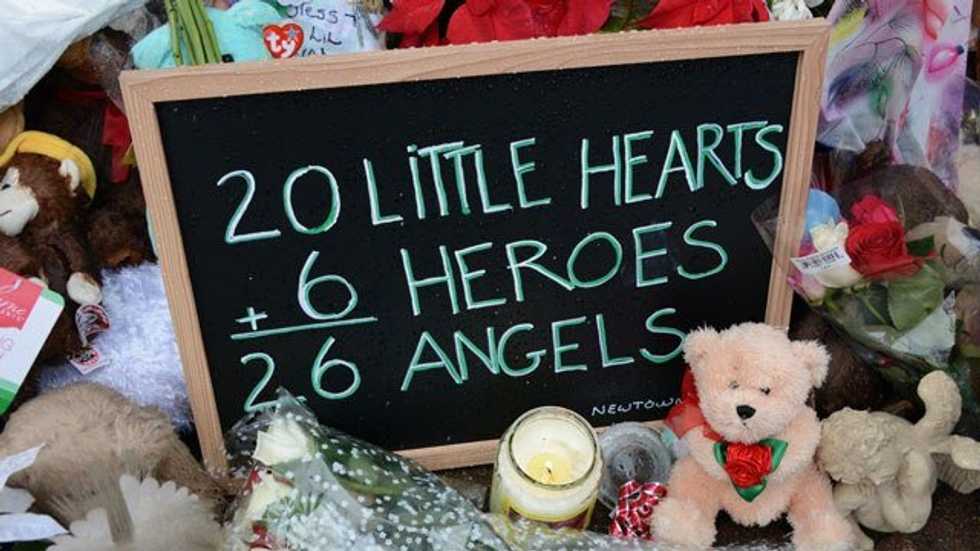
Following the shooting, the families were protected from the outside world (especially the media) by their family members and close friends. The victims' extended families flocked to Newtown, and neighbors would bring dinners with enough food to feed everyone. The community acted as an iron lung, allowing the families to stay afloat in such a difficult time. A few days after the shooting, Hockley brought his other son, Jake, to a warehouse in which donated toys and gifts for the children of Newtown were being held, hoping to cheer up his son. At the sight of the hundreds of stuffed animals, bikes, and play items, Hockley realized the true impact that the shooting had on not only Connecticut but the entire world. To this day, cars throughout Newtown have ribbon magnets commemorating the event, and ribbons are tied on objects around town.
Although these are daily reminders of the tragedy for the victim's families, none of the four moved out of Newtown. They can not imagine living without the community that has comforted them throughout these past three years, and although the ribbons and signs throughout the New England town can summon excruciating emotions, the families feel that something is missing when they leave their community and do not see the symbols of remembrance.
I cannot fathom the excruciating pain that these men and their families must endure each and every day. They sent their children to school to become tomorrow's leaders, expecting them to be safe and nurtured while learning. When their children were murdered in a quaint town thought of to be one of the safest and best to raise a family in, their lives completely changed. Relationships within the Wheeler family were shattered, and the other two Barden children began acting parental, comforting their parents at times when hope seemed lost.
All families, however, are now working towards bringing awareness to a particular cause. Jeremy Richman, a neuroscientist, believes that we are all the product of our brain chemistry and our environment, with "violence [being] a disease and the brain [being] just another organ." Richman explained that brain science is the least studied scientific field, with more being known about the bottom of the ocean and the surface of Mars than about the brain. Over the next 50 years, Richman believes that we need to research and educate people about mental health while Wheeler also believes that there must be tremendous progress in understanding the brain.
Following the event, Wheeler and I spoke of the stigma surrounding mental illness. His wish is that one day, through brain scans and other technology, doctors will be able to see exactly what is wrong with a patient and proceed to treat him or her accordingly, just like they would do in the case of a liver or a kidney disease. We agree that this would lessen the stigma, because "mental illnesses" would be treated like any other illness. Because of the title of mental illness, Wheeler believes that they are depicted as fabrications within one's mind, which contributes to the negative stigma surrounding them. If they are simply thought of as illnesses, people would be more willing to be treated and treatment would be much more accessible.
Daniel Barden, one of the 20 children murdered in Sandy Hook Elementary School, was described by his father as a loving, selfless little boy who would befriend the children who no one else seemed to talk to. One little girl in his kindergarten class was nonverbal, but Daniel would frequently talk to her, sensing that even though she was not speaking she could understand him. The mother of the girl with special needs requested for Daniel to be in her daughter's class in first grade because of the connection that the two children had made, and they remained friends; the day after the shooting was supposed to be this girl's birthday party.
Because of the loving and selfless aura that Daniel emanated onto all around him, his father has dedicated himself to bringing awareness to social isolation to teach others how to detect warning signs that were overlooked in the murderer of his child. "What Would Daniel Do?" has become a phrase to live by, encouraging people to be kind and help others, no matter how difficult it may be.
Gun availability, as well, is obviously a huge issue within the United States, regardless of your political view. Barden has worked diligently with President Obama and is fighting in support of his recent Executive Action which, in brief, requires sellers of guns to be licensed and do background checks, looks into using fingerprint technology for firearms, and gives $500 million to mental health research. Wheeler refers to guns as products, because they are made, sold, bought, and then used, just like any other product. The only difference is that guns are excluded from consumer protection laws, which creates a fatally benign relationship with these weapons. Guns are designed solely for one purpose, and combined with a fatal casual attitude from much of the American population, this has proven to be catastrophic.
How many more children need to die in order for us all to make a change? The four fathers agree that the worst enemy is anyone who does nothing; in the words of Abraham Joseph Heschel, "few are guilty, but all are responsible."
We, as the next generation of leaders, must become engaged in such important issues. We have to stand our ground and be willing to have the difficult conversations necessary to produce change. We must remember that we all have a voice, and we must use it to transform our nation into one that we are proud of. 32,000 Americans should not have to die from gun violence annually, but especially not young angels and heros like the 20 children and 6 educators from Newtown, Connecticut. No family should have to go through such a traumatic experience that could have been prevented long long ago.
Now think, what would Daniel do?
But more importantly, what will you do?