
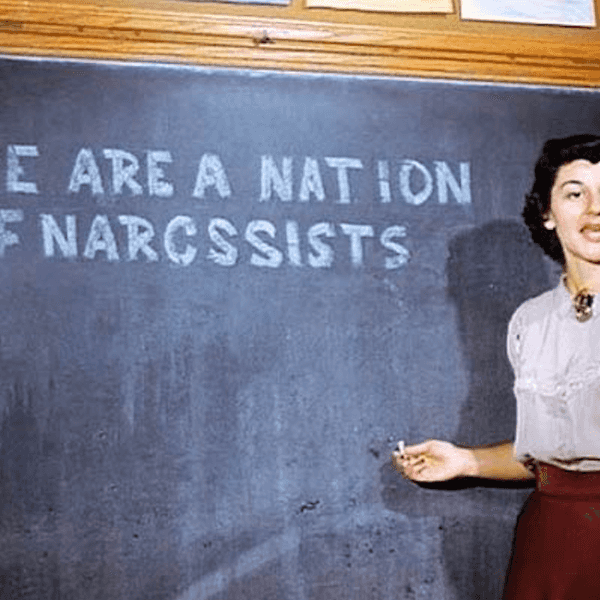

If you want to witness a learned reaction firsthand, wait for a large-scale crime.
Salivating at the sound of the bell, the standard comfort phrases will appear in drones at the very first glimpses of pain: “What goes around comes around” and “Everything happens for a reason”; reactionary offerings ironically embedded in a culture that thrives on individualism and free will. And maybe, for some, that’s just the way things are strategically designed in what people like author Martin Amis describe as “affable, melting-pot, primary-color, You’re-okay-I’m-okay-America.”
During periods of national distress, it often feels like we’d all rather be playing an elaborate game of pretend. We really like to talk about karma and how things are going to properly align on their own. We form elaborate explanations of “why” according to our personal preferences.
Autonomy, we say, is the most important attribute of an American citizen. Amen. People gain their statuses via qualities like focus and drive, the external showings being the primary method of proving how good we’ve gotten at this whole decision-making thing. So hobby by hobby we build ourselves, forcing our interests to the surface in order to gain this most lusted after sense of self. This is arguably our greatest human right.
Yet there are limitations to our independence. Decision-making ends at the point in which we are infringing on another’s autonomy. Murder is so awful not only because of the resulting pain, but because it demonstrates a profound disagreement with this most basic belief—that the individual deserves as much autonomy as his or her personal condition will allow. All of the worst crimes follow this pattern.
Recently, Orlando brought the harsh divisions over the proper labeling of a crime. Say ISIS. Say radical Islamic terrorism. Call it how you see it.
There is an ongoing battle over whether the details of a person who commits a crime should be released to the public, with one side arguing that it provides a sickening platform of glorification for evil; the other, that society simply has the right to know the most information possible. And while it’s difficult to determine if there is any concrete explanation of what should be the rightful protocol, what these conversations too often leave behind are the implications beyond legality: What happens to the autonomy of a person who does choose to interfere with another’s life, either lethally or as any other degree of a mental or physical violation?
To think visually, if you were to compare your life to building a structure, then maybe all the positives would be your “bricks” and all the mistakes would be the times you knocked those bricks over and were forced to rebuild. Sometimes you may even be brought so close to the beginning that you decide to make a completely different shape your next time around. Sometimes you’ve built your structure so precisely that losing any of your progress feels like the end of the world. And that’s all fine.
But committing the very worst crimes—the ones that steal a person’s autonomy—are much different. Those no longer count as mistakes, or as losing a specific portion of yourself; rather, they are the decision to lose your whole self.
That’s why the labeling of a crime that took 49 lives seems entirely irrelevant. What do all the particulars really matter for the victims and the loss? Why are we being forced to learn about a person who deserves to be obliterated from our minds?
Provide the details if they are indeed necessary, but don’t twist them into your own beneficial talking points. Mateen has already lost whatever it was he spent his past building, so stop giving “who” or “what” he was any of your time. In truth, the “bad guy” will always be tempting to obsess over, and if you are able to look past the atrocities, then you would likely find that crime, at its core, is inherently intriguing to us. We need to categorize the perpetrator into whatever block is currently performing poorly: Black, White, Muslim, man. As long as we are not personally impacted, we selfishly wish to get some obscure learning experience out of it all.
Sometimes, the category doesn’t really matter. The “bad guy” was simply failed by upbringing or society or his own evil tendencies. We don’t always get to make a sweeping generalization, and that often bothers us more than the crime itself. It isn’t ignoring causes that can be pinpointed, but rather choosing not to bask in irrelevant details, or worse, exploiting them for personal gains.
So believe that what goes around comes around, but remember that karma is typically man-made. A person doesn’t lose his relevance—his autonomy—until society mutually agrees to let all of the petty, meaningless factors go. Not everything can be explained away, and times when there should be feelings of pain for the victims are too often overridden by pride in opinion.
Stop offering up habitual clichés and ungrounded assumptions. Remember that losses are meant to be mourned. Forget the perpetrator; not the evil thing he did, but the identity he built for himself.
Allow the nation to, for once, experience a natural reaction to pain.