When the term “Conventional Wisdom” was originally coined by 20th century economist John Kenneth Galbraith, it was not meant to be a compliment. In fact, he says:
“We associate truth with convenience with what most closely accords with self-interest and personal well-being or promises best to avoid awkward effort or unwelcome dislocation of life. We also find highly acceptable what contributes most to self-esteem. Economic and social behaviors are complex, and to comprehend their character is mentally tiring. Therefore we adhere, as though to a raft, to those ideas which represent our understanding.”
So in Galbraith’s view, conventional wisdom, while often true, is widely accepted because it makes us feel comfortable. But finding areas where conventional wisdom may be false – noticing the signs of careless, self-interested thinking – is a good place to start asking questions. In this series, I am asking questions in an area that most find uncomfortable to think about – the irresponsible, self-interested spending by our institutions of higher education.
In the first three parts, I have established some basic facts on which I will build this next one:
- Student debt is skyrocketing despite increases in public investment.
- More than 99 percent of universities lose millions on college athletics every year – THESE TEAMS ARE NOT PROFITABLE.
- Students bear the majority of the financial burden of these programs.
- Despite the alarming level of student debt and the incredible losses on athletics, universities continue to increase athletics budgets based on the unfounded notion that investing more in sports will attract more quality students.
- Finally, the numbers and research just do not support the correlation between athletics and college growth.
Now that we know the schools and students do not benefit from higher education spending in athletics, the next step is figuring out who actually does. When you think about this, the answer is actually quite obvious – the NCAA.
The need for regulation of intercollegiate athletics arose in the late 1800s when Yale and Harvard began to hire non students to compete in their annual rivalry game. Concern arose that these amateur contests were becoming commercialized. In fact, the President of MIT at the time voiced his concerns, saying, "[i]f the movement shall continue at the same rate, it will soon be fairly a question whether the letters B.A. stand more for Bachelor of Arts or Bachelor of Athletics." Later, in 1905, 18 athletes died and 100 more had serious injuries. President Teddy Roosevelt called an emergency White House meeting and gave universities the option – accept regulation of their athletics or have their programs cut permanently. Thus, the IAA – soon to be NCAA, was born.
Over the years, The NCAA’s role has grown. Throughout this growth, there has only been one common trend – while colleges lose more and more money on athletics, the NCAA earns more and more.

Before getting deeper into these line items, remember that the NCAA is a certified nonprofit organization. This gives us two important things to keep in mind:
- If you were to cut a check to the NCAA, that money is a tax write-off.
- As a private nonprofit, the NCAA does not legally have to make their financial statements available to the public – so they don’t.
Now, $42 million in management expense is one the smallest general expense categories, but I believe it is the most important. Why? Because:
- The NCAA only has 450 employees (that’s roughly $93,333 per employee)
- Executive salaries have increased by an estimated 53 percent since 2009.
Let me explain how I got 53 percent without financial statements.
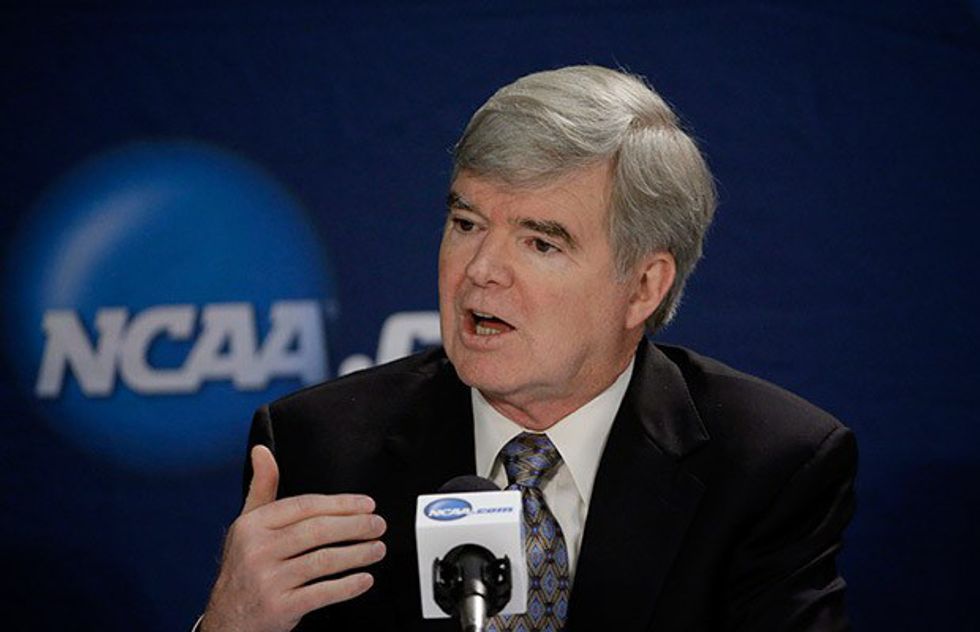
The NCAA does not release its financial statements, so I had to look deeper. The current president of the NCAA, Mark Emmert, made an estimated $1.7 million in 2011. President Myles, his predecessor earned $1.25 million in 2009. That is a 22 percent increase in just two years. If we continue that trend to 2015, President Emmert makes about $748,000 more (about $2.5 million total for 2015). But we can’t know for certain because they do not report how much executives are paid. In fact, in 2011, Emmert said, “Well, we don’t discuss my salary, but I’m well compensated, like many people.” So perhaps it’s not a big leap to assume the top administrators of the NCAA have incentives to mislead its member schools in order to encourage them to spend more on athletics.
Also troubling is their $80 million in Net profit. On the NCAA website, the latest financial data they report is from 2011. According to this report – which has not been fully released – they only recorded a four percent net profit. Compare that to the 2015 financial statement, in which they report that net profit margin is doubled. That is a four percent increase in net profit over a period of four years – which is impressive. If I lost you, all you need to know is that if the NCAA were able to sell stock, people on Wall Street would love to buy it.
To sum it all up, the NCAA is a regulatory agency that profits from the market it regulates. In the grand scheme of things, an $80 million net profit does not seem like much, but when you combine with the massive executive salaries and compare it to the massive amounts universities lose on athletics, it’s hard to be okay with it.
It’s time for everyone to take a hard look at the “Conventional Wisdom” that permeates college athletics.