

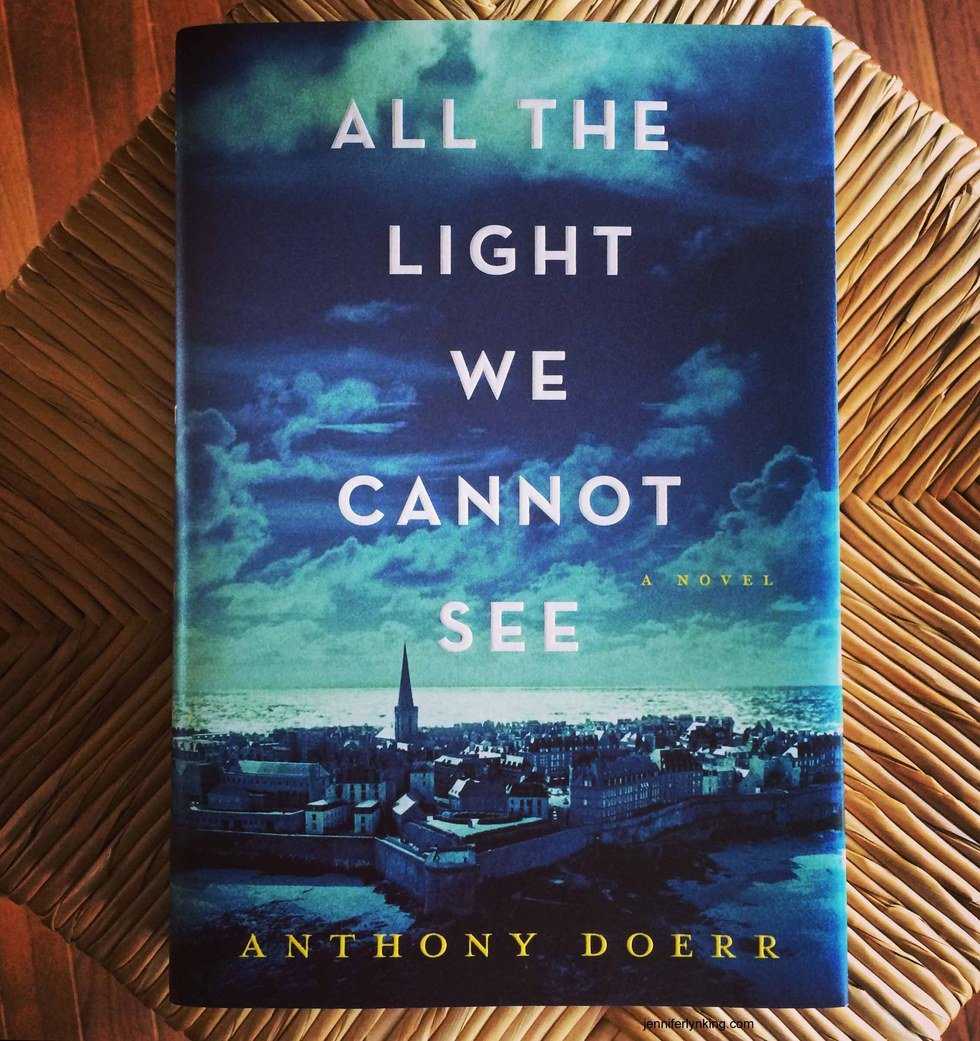
In "All the Light We Cannot See," Anthony Doerr takes a sharp turn away from the typical war novel. His Pulitzer Prize winning book is highlighted by the voice of Maurie Laure, a blind girl growing up in Paris at the height of World War II.
Maurie Laure’s vulnerability and her father’s disappearance make for a heart-wrenching storyline, especially when paired with Werner, her co-protagonist. Werner is a curious yet shortsighted Nazi recruit. As he ages his brilliance becomes compromised by the atrocities of the war. The book takes on an austere attitude as he ignorantly contributes to the crimes that haunt Maurie Laure. Doerr intertwines the narratives of the two until they finally come together in the climax.
Anthony Doerr has incredible diction. At times his writing borders on poetry. He has the ability to write beautifully without being superfluous, something that escapes a lot of talented writers (*cough, cough* J. R. R. Tolkien). In All the Light We Cannot See, Marie-Laure‘s blindness serves as a blank canvas for Doerr to flaunt his ability. For instance, when he writes:
To shut your eyes is to guess nothing of blindness. Beneath your world of skies and faces and buildings exists a rawer and older world, a place where surface planes disintegrate and sounds ribbon in shoals through the air.
Doerr’s ability to be both creative and succinct gives him an exceptional capacity to develop his characters. One of my favorite aspects of the book is the contrasting maturation of Maurie Laure and Werner.
Maurie Laure's growth is accentuated by her relationship with her great uncle. Blindness and inquisitiveness make Maurie Laure dependent on him, yet ironically she offers him life changing stability. With his help, her struggle with blindness develops from bouts of panic to composed introspection. The same can be said for Werner. Werner struggles to find himself for the entirety of the book. His sister, Judda, becomes frustrated with his inability to see through the Nazi artifice. But when he meets Maurie Laure — or rather just sees Maurie Laure — things change. His mind clears and he finally realizes the enormity of Nazism.
Obviously this is a Good book. But there are a few crucial things that keep it from being Great. The most apparent one being that its chapters are purposely presented out of chronological order. I can envision Doerr’s editor having the most brilliant idea, pulling up a number randomizer online, and sorting the chapters as so. The result is an incredibly jumbled and predictable storyline. I had to read back quite frequently and when I should have been focused on the page in front of me I was concerned about how it fit into the bigger picture. Eventually this got tiresome. The book developed into a literary puzzle. Each time I found myself wrapped up in the drama of the present, the story returned to the past.
Take a look at another reviewer's opinion. The book club at "A Beautiful Mess" had the following to say about "All The Light We Cannot See:"
I loved both the story and the writing. I love a book that’s a page turner yet savory at the same time. You can’t wait to read the next sentence, but you can’t help but dwell on the one you just read because there’s so much meaning packed into it and it’s just so beautifully and well-written.
My relationship with good books is brilliantly summarized in the second sentence. A good book makes me equally taken with the past, present and future. This is why I am so tempted to read them over again. Like a movie, you tend to notice more details the second time around, when the future is already well known.
But this is where I find myself disagreeing with "A Beautiful Mess." The problem with "All The Light You Cannot See" is that I already knew the future. I was cheated of the suspense you get from reading a book the first time. The only anticipation I had was in waiting for Werner to meet Maurie Laure. And when they finally did meet, it was incredibly too brief. By the end of the book I was so attached to the two that I was let down by their fleeting time together.
My take: 3/5