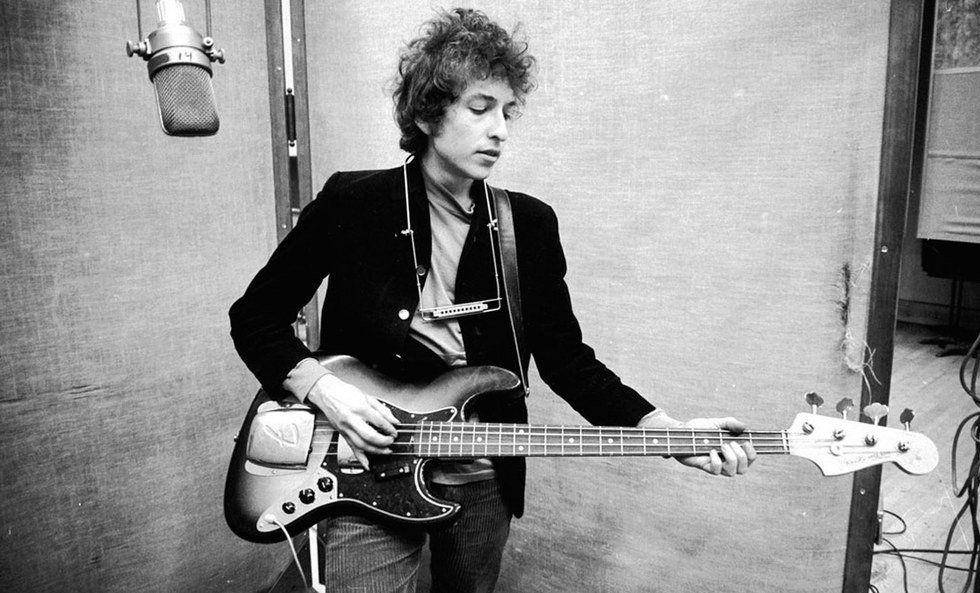
The scope, longevity and enduring power of Bob Dylan is palpable. The singer-songwriter reportedly helped The Beatles widen their musical perimeters; influenced and was influenced by the Beat Generation and their rambling genius; has been so ever-present in popular music, but yet so elusive and mysterious; whose words we sing with immediate recognition and without question, and all-out adoration. He has been on a Never Ending Tour, continuously performing and showcasing his work to raptured fans for many, many years, apparently defying the strictures of old age. He's worked with Johnny Cash, Jerry Garcia, The Rolling Stones, The Band, Roy Orbinson, Martin Scorsese. Listen first to the early scratchy protest songs that positioned Dylan at the forefront of a movement, and then to the smooth, loping renditions of Frank Sinatra released in the past year or so, and witness the range and development of an artist who didn't just create, but realized art's responsibility to take what had come before and make it into something new.
And the lyrics. The lyrics. Need I say more? A friend once referred to Dylan, the man himself, as a 'song book', and the description has stuck with me. There have been many covers and rehashes of Dylan's work, but nothing does the job more than the gravelly, croaky, oftentimes humorous tones of the man himself. The plethora of creative ambition and the mythologized nature of his image has created a giant of popular culture, a presence that refuses to diminish, and will continue to flourish long after the artist is dead.
Bob Dylan has been awarded the Nobel Prize for Literature. This decision has caused some consternation among people, even those who call themselves devoted fans. I understand the concern. The man is a musician, a singer, someone who writes songs, not literature. Sure, he has written a number of books, but those books are not the reason he's getting the Prize. He's getting the Prize because, goddammit, he's Bob Dylan. His marriage of words and music has haunted our movies, our politics, our conscience. When you think of Vietnam, you think of Bob Dylan. When you think of Civil Rights, you think of Bob Dylan. When you consider the evolution of rock music, you think of Bob Dylan. When you think of enduring figures of history, you think of Bob Dylan.
And why shouldn't the man be recognized in the area of literature? His songs are narratives, packed full with imagery, metaphors and daring points-of-view. The bare, repetitive simplicity of his music makes it seem his artistry is just stories with musical accompaniment. 'Hurricane' is a case in point. In it's eight-and-a-half minute length, you can learn everything you need to know about the whole convoluted case, as well as side with Dylan in believing Rubin Carter was an innocent man.
One of the proudest events of my life, and one that I bring up whenever I can, is seeing Bob Dylan live in Dublin. No longer playing the guitar in performances, he switched between standing at the microphone, rhythmically stomping his leg to the beat, or sat at the piano. A man of constant reinvention, unlike other musicians who have been around a long time, Dylan doesn't play his old tunes to please the crowd. He sticks to his newest releases, letting us hear this version of Bob Dylan in this time and place. His only communication with the audience was his singing. His stature in our minds and his persisting popularity give him no need for song introductions, or an attempt to gain our respect or adoration. He is Dylan, and we have come to hear him sing his songs.
So, whether or not you agree with Dylan winning the same prestigious prize as Winston Churchill, Samuel Beckett or John Steinbeck, and countless other writers, you can't deny his impact on words and their artistic capability.
As the concert in Dublin drew to an end, as if knowing what we secretly wanted - even though we were satisfied with what he had given us - he brought out one of the classics. I left that concert venue with the nasally, rickety vocals of Bob Dylan singing a version of 'All Along the Watchtower'. It's something I will most likely tell my grandchildren.