


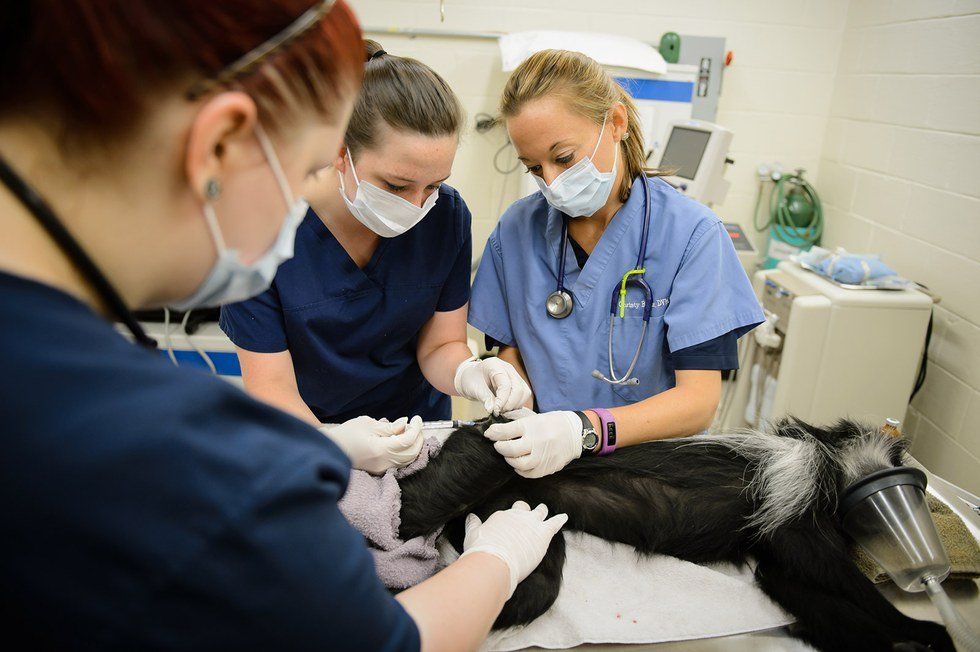
Pre-veterinary or "pre-vet" students are undergraduate students intending to go on to veterinary school to become Doctors of Veterinarian Medicine (DVMs). It's generally understood amongst pre-vet students that most people have never considered or do not have any concept about how veterinarians become veterinarians. Now, I don't blame you for not understanding the process. It's not widely known. After all, there are no soap operas or Shonda-Thursday mega-dramas about them on television. In fact, more often than not, doctor shows condescend veterinary medicine (I'm looking at you "Grey's Anatomy"). It's understandable why people have questions about the field and how to get into it. Undoubtably, if you're a pre-vet student, you've heard each of these questions more times than you can count, and kind of wish people would stop asking.
1. "So are you in vet school now?"

(Source: tumblr.com)
No. Pre-veterinary. "Pre" as in before-veterinary. Not. There. Yet. The response is usually a confused expression, until you reply: "Like pre medical students," which is met with sudden, though not quite complete, understanding. Which leads to number 2.
2. "Wait, so you have to do undergrad?"

(Source: giphy.com)
Well, I'm not here for my health (and I'm pretty sure Organic Chemistry has taken at least 10 years off my life). Yes, undergraduate studies are required no matter which veterinary school you apply to. There are some universities that don't require a bachelor's degree, but you still must complete all of the undergraduate pre-requisites. Which, considering those courses include hard sciences that have their own prerequisites, is only a few liberal arts classes away from a full-fledged degree.
3. "At least you don't have to go through what medical students go through!"

(Source: tumblr.com)
I cannot count the number of times I have heard this on all of my fingers and toes. Pre-veterinary students go through all the same classes (and more) as pre-medical students. No, the MCAT is not required by all veterinary schools for application, but the GRE is. Instead of Human Anatomy, pre-veterinary students are taking classes like "Comparative Vertebrate Physiology" or "Comparative Vertebrate Morphogenesis." Similar classes, more species. There are also classes like "Animal Nutrition" or "Animal Sciences" that could be on the prerequisite list, depending on the institution you apply for. In addition, top-marks in all classes is a requirement. With only 30 veterinary schools in the United States as compared to over 100 human medicine and osteopathic medical schools in the country, acceptance and entrance is very competitive.
4. "You're going to be making the big bucks, huh?"

(Source: tumblr.com)
This is probably the most common misconception. Sure, general practice veterinarians have the potential to make six-figured salaries if they own the practice and have a good clientele. There are specialty positions in veterinary medicine that lead to six-figured salaries. However, a general practice veterinarian straight out of veterinary school is likely to only earn between $49,000 and $60,000 per year depending on the region where they practice. According to US News, in 2014 the average salary for a practicing veterinarian was $98,230 (the median salary being $87,590 and the lowest $52,530), which is only a little more than half of what practicing human physicians made ($189,760). Believe me, we're not in it for the money.
5. "Oh, I wanted to be a veterinarian, too! But I just couldn't stand the thought of putting anything to sleep!"

(Source: giphy.com)
Really? Tell me more. At least some people use the excuse that they're squeamish around blood or they're not "good" at science. But the euthanasia comment is particularly grating.
6. "My dog/cat/fish/horse/lizard/bird/etc... has _______ wrong with it. What should I do?"

Take it to your vet. Or if you're not feeling up to that, even a phone call to the vet's office could be beneficial (but they'll probably tell you to make an appointment). Pre-veterinary does not equal Doctor of Veterinary Medicine. Dr. Google does not have its DVM, either. Take it to your vet.
6. "So when you get out of vet school you're going to take care of my pets, right?"

(Source: tumblr.com)
Of course, I would be honored to one day work with you and your pets to help ensure they get the best care possible. Just, you know, not for free. Like your tone and playful nudge suggested. Why not for free? See No. 4.
7. "You're so lucky you're going into a field where you can play with animals all day!"

(Source: giphy.com)
If you're in any part of the veterinary field (assistant, technician, doctor, etc,), a little part of your soul dies every time you hear these, or any variation of these, words. I've given up trying to explain why that is not the case. Now, I just pull up pictures on my phone of pyometra, intestinal parasites and scrubs with all sorts of bodily matter on them.
8. "Why don't you just become a real doctor?"

(Source: tumblr.com)
The question you wanted to ask was "why not just treat humans"? Medical doctors treat humans. Humans are animals. Veterinarians are doctors. They are doctors of veterinary medicine, treating non-human animals. Especially in this day and age where pets are seen less as property and more as members of the family, the field is broadening each and every day, with new specialties becoming available. Think of a particular field in human medicine, and I promise you will find, if not it's exact equal, at the very least its analogous veterinary field. Veterinarians are real doctors. And honestly, if you look at the figures of acceptance to medical school and the salaries post-graduation, becoming a human doctor might just be the easier route.

















