As I didn’t get to go to the beach this week, I got thinking of course about something I would never ever see at my local beach: octopods. Octopod refers to the order Octopoda which includes, you guessed it, octopuses! Order Octopoda contains some of the most intelligent and diverse organisms in the invertebrate animal kingdom. The only octopods I’ve ever seen in real life are the little ones at the Boston Aquarium, and while they’re amazing, there are some much more wild eight-legged friends out there…
1. Casper octopus

This little buddy here is the reason this list is being made! A brand new octopus found just this February, 2016, by NOAA’s remotely operated vehicle Deep Discoverer deep below the Hawaiian archipelago, may open up an entirely new genus for the octopod family. Casper is unlike any other octopus in that he is an incirrate octopus, one without fins, found about 1000 kilometers deeper than any other incirrate octopus ever cataloged. And don’t be fooled by the photo, he’s actually super small, measuring about 10-12 centimeters long and five centimeters tall!
2. Mimic octopus (Thaumoctopus mimicus)
Native to the Indo-Pacific, this amazing friend defends himself from predators by mimicking more toxic creatures than its 60-centimeter-long self. By transforming not only the shape of its body, but its color, texture and behavior, it can act like lionfish, sea snakes, flatfish, jellyfish and most anything else that would benefit it to mimic. Mimics are not only amazing for this ability, but for the intelligence, it must take to utilize this ability, requiring a knowledge of the predators in its area and what preys on it, and thus what will scare its predators away.
3. Greater argonaut (argonauta argo)

The greater argonaut, called the “white seahorse’s nest” in Chinese, is a species of paper nautilus, which gets its name from the film-like shell that surrounds it, much like the true nautilus’ (family Nautilidae) hard shell. The true nautilus uses its shell to affect its buoyancy; the shell contains pockets of gases which allow it to stabilize itself in the open ocean at low depths, but they can only change their buoyancy through osmosis, whereas the paper nautilus can change its buoyancy actively by simply cresting the end of its “shell” above the water, and taking in air bubbles. Another kind of scary behavior of the greater argonaut is that it parasitizes jellyfish. The argonaut will latch onto the bell of the jellyfish and eat not only the jellyfish itself, but whatever the jellyfish was eating--it bores holes into the jellyfish’s gastric chamber and sucks bits of its meal. Delicious.
4. Coconut octopus (Amphioctus marginatus)
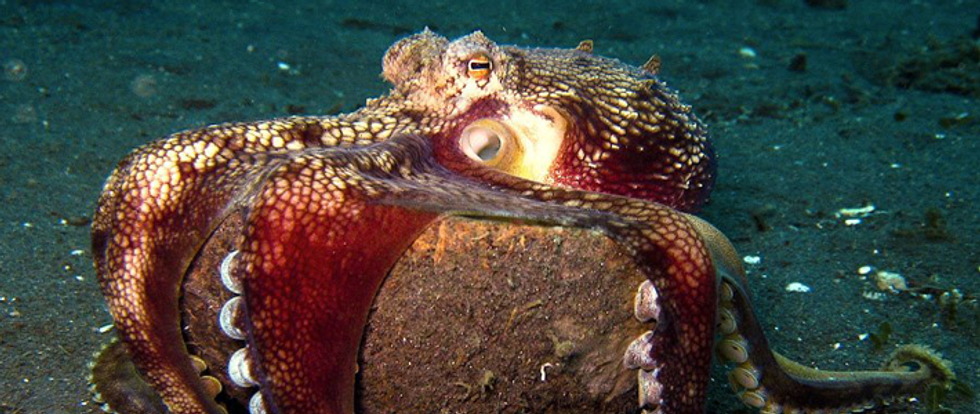
The veined octopus, or coconut octopus, is a small and soft baby, typically only 15 centimeters long, but this baby is smart. He learned to use tools to build fortresses for himself, such as discarded coconut and clam shells. He’ll select the particular items he wants, then carry them tens of meters across the seafloor to build large circular fortresses. This makes him the only invertebrate known to use tools, especially to create a structure designed for future use, as well as one of only two to exhibit another strange behavior which we find pretty common--bipedal walking, rising on two tentacles and walking along the seafloor.
5. Dumbo octopus (Grimpoteuthis spp)

I hope everyone has seen this video of scientists being very excited about a little dumbo curling his little tentacles up around his eyes, so if you have, watch it again! Another cute friend to hang with Casper, they’re named after the Disney character with equally big and cute ears (although dumbo octopus’ ears are actually fins). They are also the deepest living octopus known, living at depths of 3000-4000 meters, which makes them both cute and wicked metal, surviving in almost total darkness and in the company of some of the scariest organisms in the ocean. They belong to the “umbrella octopus” group, which means they can float around on their parachute-like tentacles. Also, they belong to a unique genus of octopods which swallow their food whole instead of chewing it so that’s… cute…
6. Glowing sucker octopus (Stauroteuthis syrtensis)
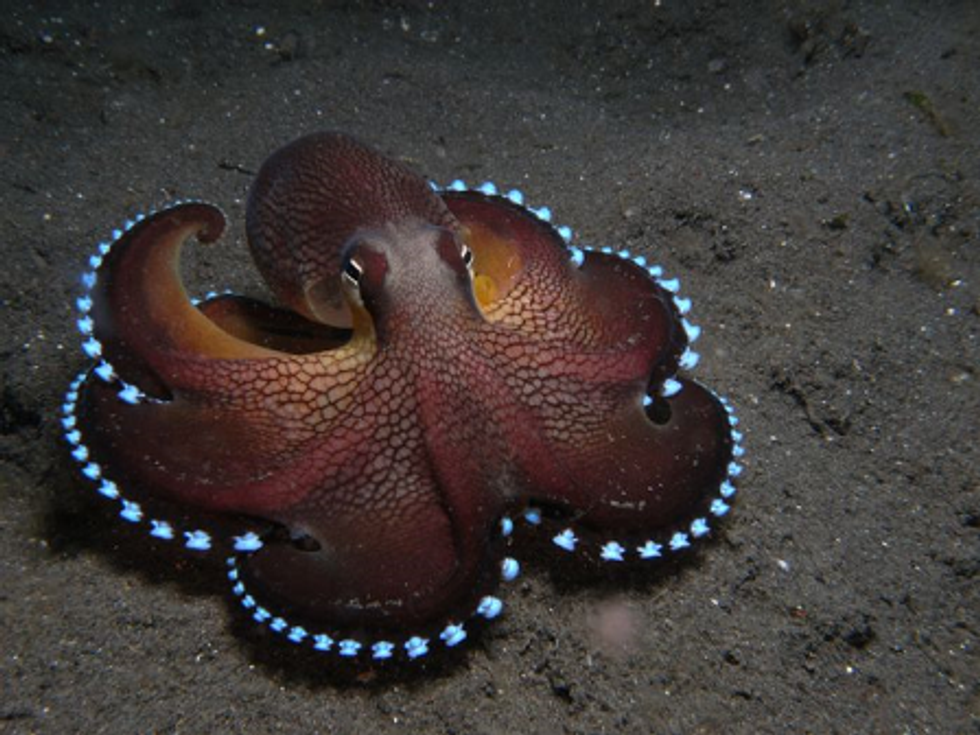
The glowing octopus is the main species of one of the only genera of octopods to bio-luminesce or glow! They are most frequently found 1500-2500 meters below the surface. They appear to have glowing photophores instead of suckers, like little Christmas lights strung along their tentacles, which emit a blue-green light when stimulated. They don’t glow all the time, rather they light up for about five minutes at a time, and appear to twinkle because of brighter flashing photophores mixed in with the dimmer solid-color photophores. Petition to re-nickname this one the Christmas octopus?
7. Blue-ringed octopus (genus Hapalochlaena)
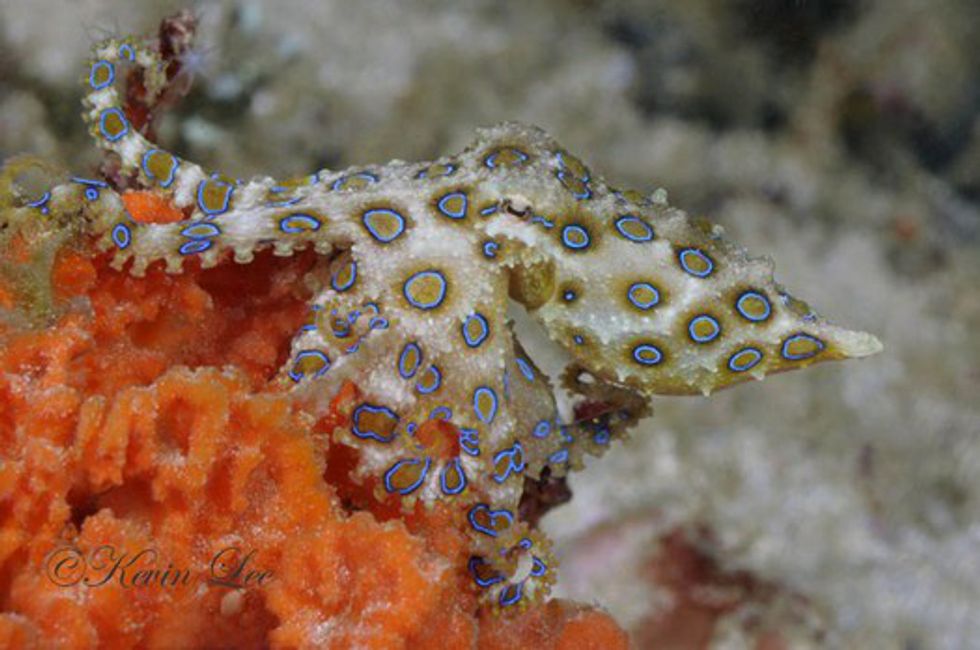
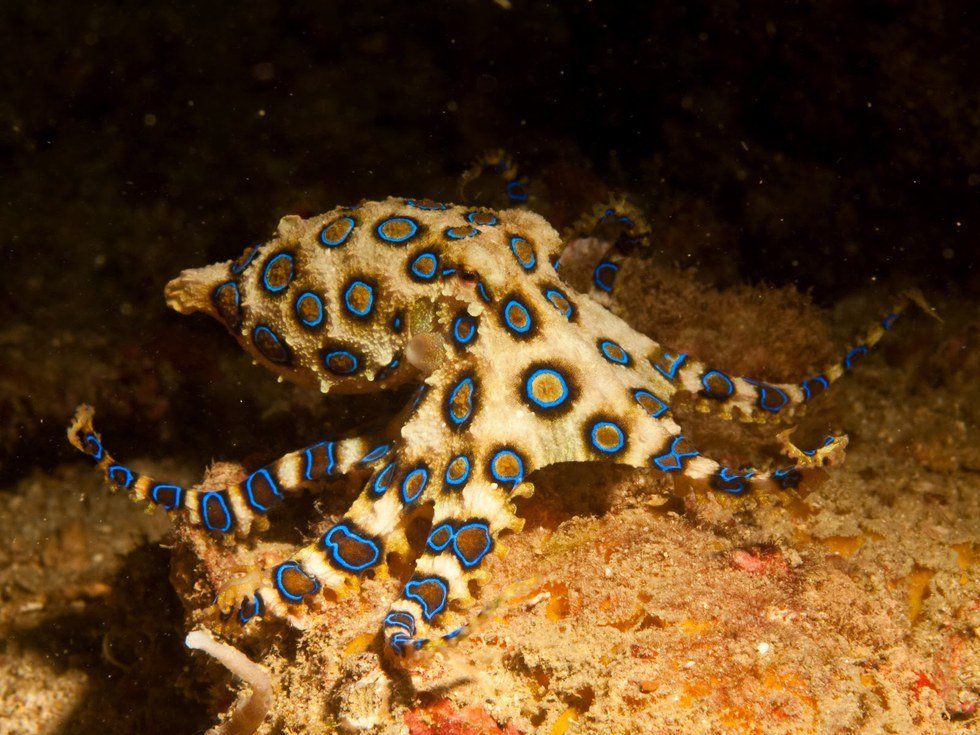
These tiniest of octopods are actually some of the deadliest, most poisonous creatures in the sea. Hapalochlaena consists of three (or four?) species of similarly bright blue marked octopuses. Similarly to a poisonous dart frog, the blue-ring uses its coloring to say “don’t mess with me! I’m dangerous!” A single blue-ring contains enough toxin to kill 26 adult humans in minutes, and their bite is so painless that many don’t know they’ve been stung until, y’know, they can’t breathe or move and probably drown if they don’t experience respiratory failure first. And there is absolutely no antivenom! So, needless to say, underwater photographers and naturalists consider capturing this little guy on film without dying a huge achievement (this is also why so many good pictures of this guy exist).
8. Pareledone charcoti

Charcoti is an Antarctic octopus known for literally having blue blood, and having evolved an important survival mechanism surrounding this blue blood. These octopods survive in their shallow-Antarctic waters, ranging from only 1.8 to 2 degrees Celsius (28.8-35.5 Fahrenheit), which would literally freeze the blood in the body of a common octopus (Octopus vulgaris), by including a copper-based protein called haemocyanin, which is much more efficient at oxygenating blood at low temperatures. Despite this, they actually appear to thrive the best at temperatures closer to 10 degrees (50 degrees Fahrenheit). Which means, essentially, they are the most prepared organism on Earth for global warming right now.