Flashback to as early as the 13th century -- to a time so long ago that the city of lights was hardly a city at all. You are in a time where quarry mines, not fashion, food, or fantasy, are what run and build the city of Paris. These quarries, digging far and deep for limestone, are a network below the city that cover 200 miles. Fast forward, you are now in the late 1700’s and you live near Les Innocents, Paris’s oldest and biggest cemetery of the time. Your city’s streets are becoming overrun with decomposing flesh, the cemeteries are overcrowded, the pungent smell of death rises in the air, ceasing to waver, and the groundwater is no longer as clean as it once was. Your city has outgrown itself from the inside; it is ruled by the dead. Churches don’t want to disturb the buried, yet, there is no more room for the newly dead to be placed. What can be done? Perhaps, we must dig just a little bit deeper.
In 1763, Louis XV issued a decree banning all burials from occurring inside the capital, but because of the differing Church opinion, nothing became of it. Louis XVI, Louis XV's successor, continued this demand, also proclaiming that all cemeteries should be moved outside of Paris. However, it wasn't until 1780, after a prolonged period of spring rain, that anything was done. This intense spring rain caused a wall around Les Innocents to collapse, which resulted in the spilling of rotting corpses into a neighboring property and it was then that the city finally realized just how immense this situation was. So, they went to the tunnels. Moving the bones from the cemeteries into the former quarries began in 1786 and started out with Les Innocents. It took the city 12 years to move all the bones, with bodies numbering between 6 and 7 million, into the catacombs. Today, about one mile of this movement can now be seen by anyone who dares to go below the city and back in time.
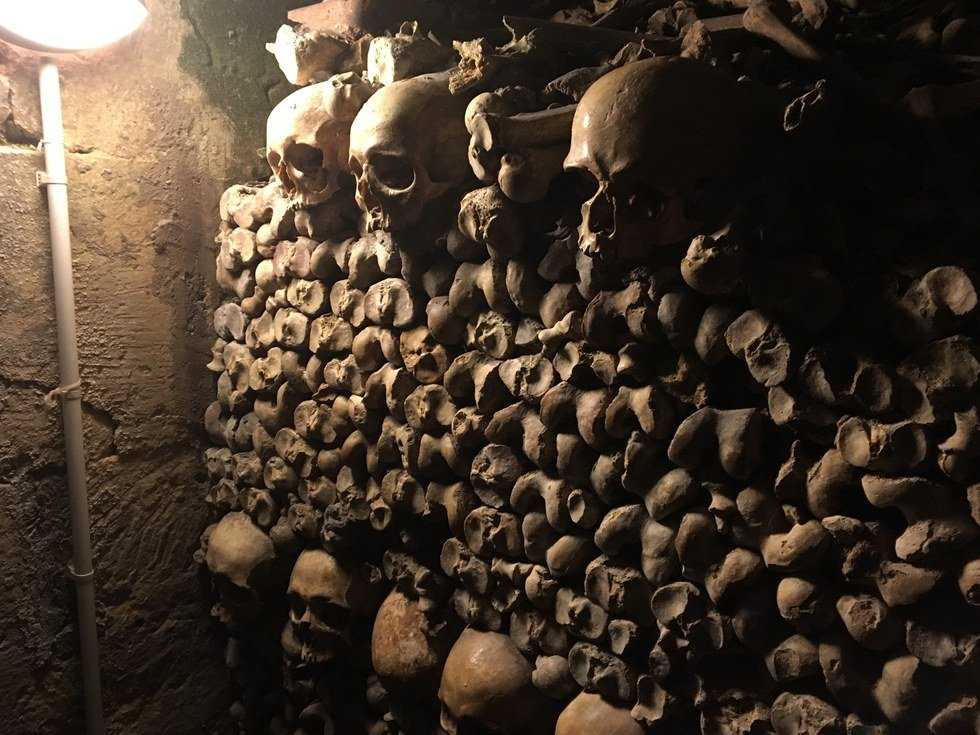
After crossing the barrier under a sign that reads, “Arrête, c'est ici l'empire de la mort! (Stop! This is the empire of death!)”, and into the ossuary, I was nearly stopped in my tracks. When you step through that doorway, you go from bare walls to bone walls. And, while they are all stacked so neatly, so blended, that an unsuspecting person may walk right past them without noticing they are there, they do in fact exist, lying in their final resting place. Nearly six million bodies piled in these tunnels; six million people, names, jobs, lives, and stories. Strong feelings of guilt set in as we wound our way through the tunnel including guilt for the number of people who pass through every day in perhaps not the most respectful way. Though through circumstance they have been reduced to bones, unmarked, unknown, there was a time when they were known and I hope, loved, too.