Back when books were worth more than how many copies they sold, and people actually read them to expand something called a brain, Naomi Wolfe's "The Beauty Myth" hit more than just the shelves because it opened the public eye to the commercialization of feminine beauty. The book not only shook the minds of its readers, but it also saved women from believing that there was only one type of beauty; blonde, blue-eyed and thin.
But, while women are still fighting to define beauty for themselves, there is another group subject to the media's lies and manipulations of the concept of 'beauty': gay men. Not only has the media defined what constitutes a "beautiful" gay man, but the damage escalated further when the media became a major part of gay culture. Once the media's influence stretched out into every outlet of gay social life including bars, dating apps and common conversation, its standard of beauty severely diminished our self-image, told us what we should desire, and taught us how to categorize ourselves. So, if you happen to be gay and, like many others, can relate to the struggle of self-image, you can thank the media for these five facts.
1. We want our perfect Prince Charming.
Though we may have realized it at many different points in life, we gay guys have come to terms with our sexual preference through a series of visualization and fantasy. While some of us have always pictured Chad Michael Murray finding our flip phone and sweeping us off our flamboyant feet since we were 11, others may have blushed in wonder at the thought of co-starring with Brad Pitt in "Mr. and Mr. Smith" (yes, two misters).
But no matter what fantasy got us through years of closet-bound solitude and endless middle school “girlfriends”—who we got as far with as sitting next to them at the lunch table—they all had one significant thing in common. These fantasy men were actors. They were models. It was society’s most basic form of a “beautiful” man that made us fall in love in the first place. This becomes a very big problem when it comes to finding someone realistic.
2. We compare… a lot.
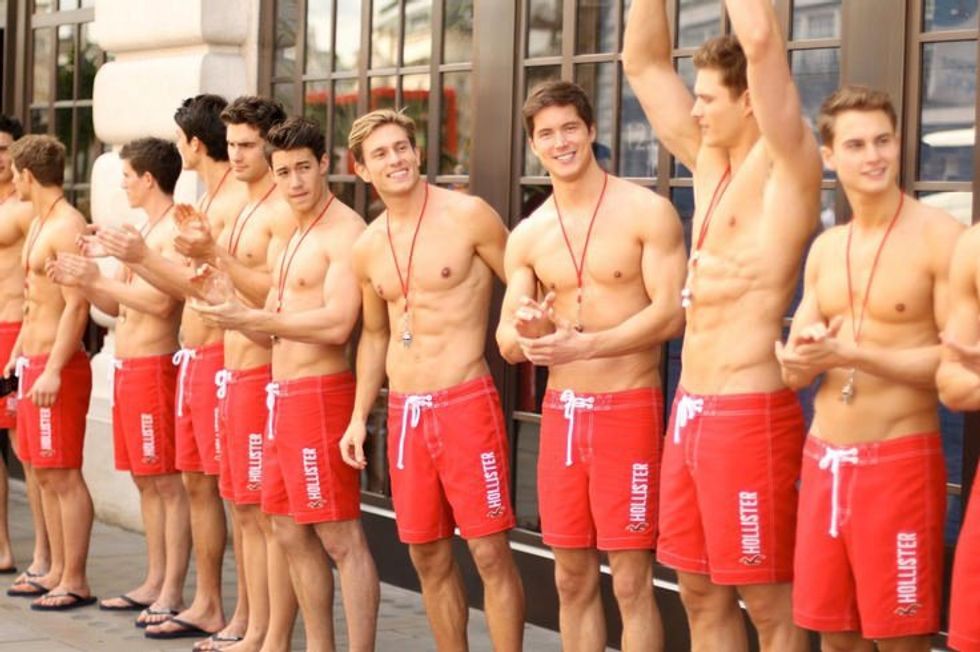
How many times have you walked past Hollister and thought to yourself, "Why can't I look like that guy on the 50 percent off jeans with any purchase of nine or more' ad?" It usually comes right after "Why does it smell like someone dropped a cologne bomb?" We tend to do it much more than straight men—compare. We do it... all the time... probably way too much. Yes, while there is certainly a degree of comparison between straight men and women as seen in movies like "She's Out Of My League," it is way beyond worse for gay guys.
The balance of attraction for straight couples is usually exaggerated in movies. A not-so-hot guy being with a pretty cute girl in real life isn’t really out of the ordinary. It's not a totally improbable case of hotness imbalance. However, I’d suggest you start picking numbers for the lotto if you ever see a not-so-cute gay guy with a really hot one. It just doesn’t happen. While women sometimes compare themselves to other women in regards to a man, we gay guys compare ourselves to the man in whom we find our fancy. I mean, when was the last time Jennifer Lopez thought a guy wasn’t a good match because his butt was smaller than hers? Probably not in the last few years.
But this is never the case for gay men. If they aren’t somewhat close in attractiveness or even in certain features, they don’t “look cute together." In some sense, gay couples have been commercialized as twins. But such comparisons become dangerous when you find that you have to alter yourself to be just like the person you want to end up with. Harsh world. Oh, well. “Sorry about it.”
3. We are the most shallow.
Maybe it’s the same gay gene that allows us all to fully memorize every Gaga song, or simply because that’s where the gay society is. Gay guys are extremely shallow. Now, if you are gay and reading this like “OMG, girl, I’m not even shallow,” just give me a minute. No, not all gay men are shallow, but there is no doubt that there is a lot more expected of a gay man than a straight one when looking for a match. You can’t look too feminine, you can’t be overweight, you have to be at least the same height or taller, you have to be a certain race, you have to dress well but not too well, etc. The list is endless. And while women certainly do not have it easy, they don’t live every day comparing abs and biceps to their husband’s.
In most cases, a gay man won’t even consider the other if he is of a specific skin color, or “chubby” or short or otherwise. This then makes it very hard for most of us to develop any type of self-esteem to hit on a guy face to face. The montage of general preferences has been reduced to the cultural pattern of “No Fats, No Fems,” deriving from the Grindr app preference meaning “Not into fat or feminine guys.” In general, we will know whether or not we like someone within the first 30 seconds simply based on their appearance or even faster with a swift swipe left on a dating app. Our generation, the apps it’s given us, and the ideals Hollywood has instilled has numbed us to the idea that we are more than our appearances.
4. We categorize ourselves.
Over the years, gay men have become completely sexualized. So sexualized, in fact, that we categorize ourselves based on appearances that allow us to make assumptions about what we like in bed, who we are into, and what type of person we are. Society suggests that if you are a gay man you fall into one of the following categories: Twink, Jock, Bear, Daddy, Trans, Otter, Leather, Clean-Cut, Rugged, etc.
Most sexualized of these types is the “Twink”, the prototype of an attractive gay male according to society. “Twink” refers to young, hairless, skinny, and submissive in nature. Moreover, the sexualized idea of a Twink has led to more controversy than any of the others because it is usually deemed the most desirable or attractive category. If you are tiny and cute you are considered the “ideal gay,” which of course goes both ways where some consider twinks “too skinny” or “not powerful enough.”
The terms themselves, being derived specifically from a pornographic culture, have led to decreased self-esteem, boosted eating disorders and even mental illness for a great number of men in the gay community. But because the terms are used in everyday language and the body shape determines one’s placement among the groups, we remain subject to a pattern of lust and loneliness.
5. We’re afraid.
You aren’t a gay man if you have never had nightmares about the idea of being 67, alone, cat hair all over the furniture, and paying a college “Twink” just to have dinner with you. But even if you have not, everyone generally fears being alone. While cat ladies have surely inspired an epidemic of fear among women at some point in their lives, the number of older men, moneyed and alone, on gay apps and social groups leads most gay men to fear that they, too, could end up that way. Not that there is anything wrong with their choices, our generation simply pictures a day when we could be married, with children, in a home and best of all, with a husband. After all, gay marriage was only just fully legalized. And even now, times are still changing.